
ENGINEERING • COMPUTATION • APPLIED RESEARCH
Cognitave EE Store
Technical Publications & Engineering Systems
Research monographs, engineering textbooks, computational frameworks, case studies, and design tools developed by Cognitave Inc. and Maxdi Research.
Explore: EDFS & EDA · Finance EDDA · Quantum Engineering · RF/MW Services · Applied Mathematics · Institutional Research
FINANCE EDDA — EVENT-STATE INFERENCE
Mathematical and computational research on financial markets as evolving event-state systems, spanning inference evolution, external information transport, trader-centered dynamics, and reproducible market case studies.
Volumes I–III · Case Studies · Research Papers · Webinars
EXPLORE FINANCE EDDA →
COGNITAVE RF ENGINEERING — CRE-RF
RF and microwave engineering from foundational field, network, and device principles through deformation dynamics, robustness, adaptive control, inference, and computational design workflows.
CRE-RF I · CRE-RF II · Workshops · Webinars
EXPLORE CRE-RF →
QUANTUM ENGINEERING — MAQM
Applied quantum mechanics for electronics and quantum engineering, progressing from operator algebra and Schrödinger dynamics to tunneling, confinement, semiconductor structures, and quantum technologies.
MAQM Course · Full Text · Essential Lectures · Engineering Resources
EXPLORE MAQM →
EDFS — ENGINEERING DESIGN FLOW STUDIO
A graph-native computational engineering environment connecting mathematical models, numerical computation, circuit and EM data, mixed-domain inference, and system-level observables within executable design flows.
EDA Software · Demonstrations · Documentation · Workshops
EXPLORE EDFS →
FEATURED PROFESSIONAL SERVICES · RF / MICROWAVE / mmWAVE
RF/MW Engineering & Technical Consulting
Engineering services led by Dr. Mahdi Haghzadeh
Specialized RF, microwave, mmWave, antenna and radar engineering spanning design, EM simulation, measurement, validation, and computational design-flow development.
Areas of Activity
RF & Microwave Design · front ends · filters · matching · amplifiers · passive networks
Antennas & Arrays · elements · phased/reflectarrays · beamforming · unit cells · coupling
Radar & Sensing · automotive radar · FMCW · 76–81 GHz ADAS · radar signal processing
mmWave Materials & Radomes · dielectric characterization · Dk/Df · fascia/radome validation
Measurement & Validation · S-parameters · VNA · time-domain gating · simulation correlation
EM & EDA Workflows · full-wave modeling · circuit/EM co-design · ECM · computational workflows
Advanced RF Systems · 5G/mmWave · MIMO · satellite/LEO · emerging RF architectures
Featured Service: Automotive Radar Radome Measurement & Validation — 76–81 GHz
VIEW SERVICE · RF/MW ENGINEERING · REQUEST TECHNICAL CONSULTATION
Filters
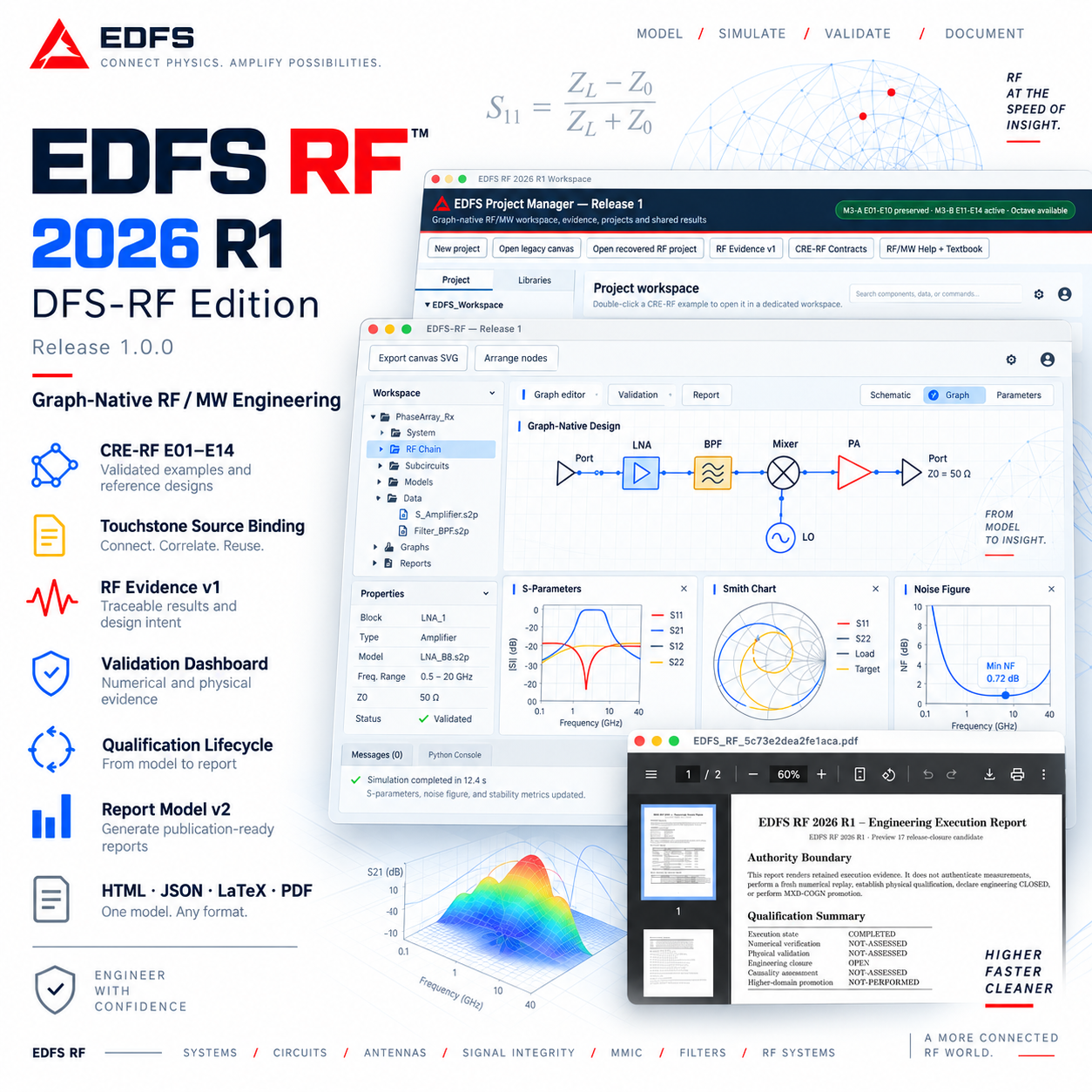
EDFS RF 2026 R1 is a graph-native RF/MW engineering environment for modeling, executing, validating, and documenting RF workflows.
DFS-RF combines typed RF objects, ports, fibers, numerical kernels, provenance, validation state, and engineering evidence in one executable project structure.
Purchase & Download — $1,495
macOS Intel x86_64
DFS-RF Capabilities
EDFS RF includes:
Graph Schema v2 RF workflows
CRE-RF examples E01–E14
Touchstone S1P/S2P source binding
S, Z, Y, and ABCD conversions
network cascade
renormalization
de-embedding
reference-plane translation
frequency alignment
RF network comparison
RF Evidence contracts
numerical assessment and validation
project persistence and replay
HTML, JSON, LaTeX, and PDF reporting
Python and GNU Octave backend support
CRE-RF E01–E14
The included verification series progresses from fundamental RF representations to deformation, robustness, and recoverability.
E01–E05
RF objects, Z→Γ, Möbius mapping, transmission lines, and reference-plane transport.
E06–E10
Power and matching, de-embedding, S/Z/Y/ABCD conversion, network closure, Jacobians, and static RF deformation.
E11–E14
RF dynamics, event trajectories, robustness, and bounded recovery/control.
RF Network Engineering
DFS-RF provides reusable graph-native network operators for:
S↔Z,S↔Y,S↔ABCD
Source identity, reference impedance, reference planes, topology, and provenance remain associated with the engineering data throughout the workflow.
Numerical Backends
EDFS RF supports:
GNU Octave — numerical authority where declared by CRE-RF kernels.
Python 3.12 — graph execution, orchestration, QA, and approved numerical implementations.
EDFS does not silently replace an unavailable authoritative backend.
Validation & Evidence
DFS-RF distinguishes:
execution
numerical verification
physical validation
engineering closure
causality assessment
Successful execution alone is not presented as physical validation.
Reporting
RF Report Model v2 produces:
HTML · JSON · LaTeX · PDF
Reports preserve project, graph, source, backend, numerical-result, and provenance information without recomputing engineering results.
Project Integrity
Validated projects preserve historical qualification evidence.
After reopening:
REQUIRES_RERUN
After relevant project modification:
STALE_PROJECT_CHANGED
This prevents old results from being silently treated as current validation.
Release Validation
EDFS RF 2026 R1 Release 1.0.0 completed the Intel release-validation program:
261 / 261 engineering regression tests passed
2 / 2 packaging-policy tests passed
RC1 persistence lifecycle — PASS
RC1 source pre-freeze acceptance — PASS
Native runtime verification — PASS
macOS x86_64 binary — VERIFIED
DMG integrity — VERIFIED
System Requirements
Current release: macOS Intel x86_64
Apple Silicon arm64 distribution will be provided separately after its corresponding release acceptance.
GNU Octave is required for workflows that declare Octave numerical authority.
License
EDFS RF 2026 R1
Professional Single-User License
Includes EDFS RF software, DFS-RF workspace, CRE-RF E01–E14 examples, RF network operators, RF Evidence, reporting, documentation, and downloadable macOS installer.
Purchase & Download
For the actual webpage, I would keep the title around H1, make every section above H3-sized, and reserve larger typography only for the product name and $1,495 price. This will read much more like a professional EDA product page and less like a technical white paper.
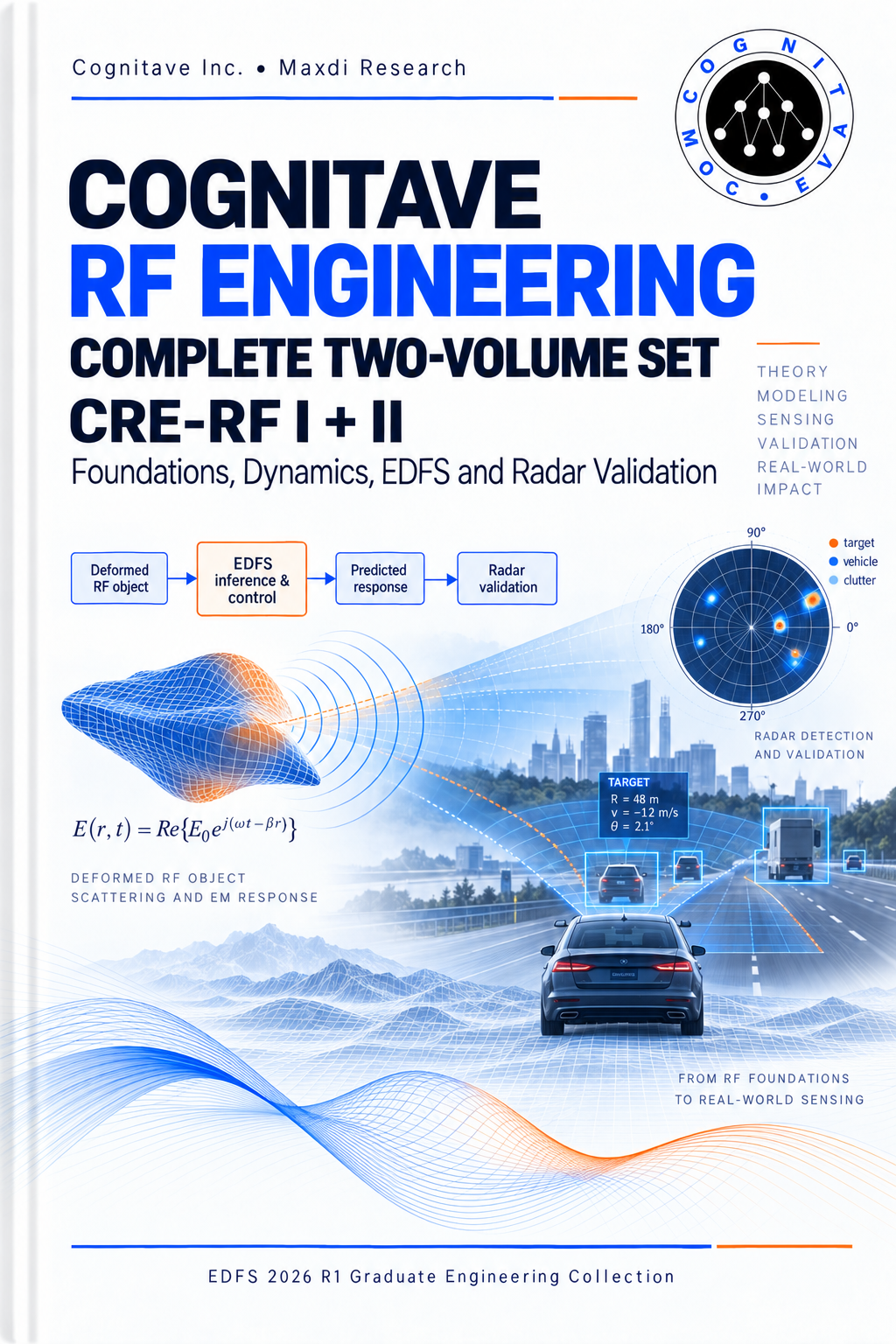

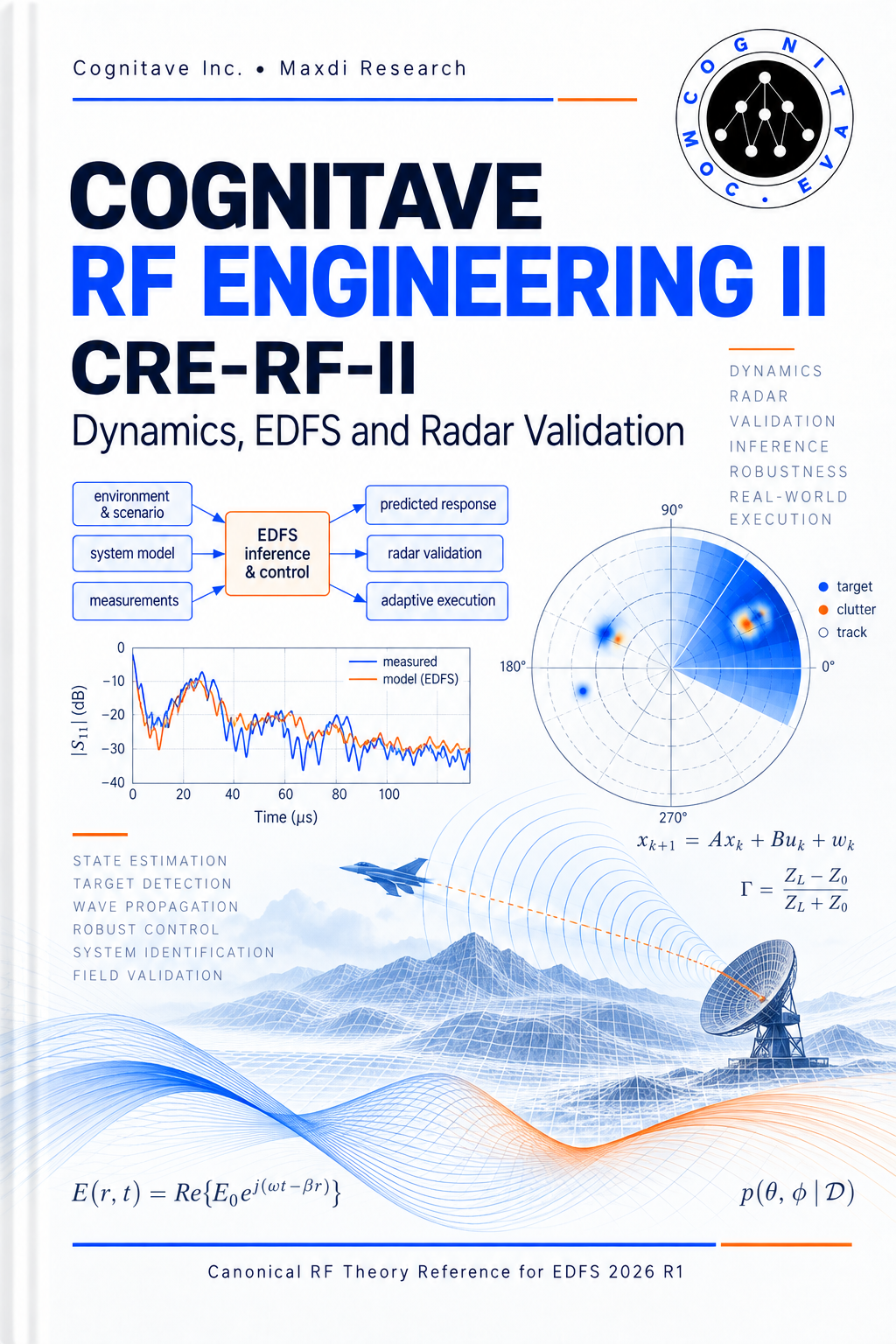
The complete CRE-RF I + II engineering series: twenty chapters spanning classical RF representation, electromagnetic fields, microwave networks and scattering through deformation dynamics, robustness, recoverability, stochastic RF, model fidelity, arrays, radar, EDFS execution, MXD-COGN inference and adaptive intelligent radar.
CRE-RF Complete Two-Volume Graduate Engineering Set
2 volumes · 902 publication pages · 20 chapters · Complete CRE-RF theory sequence
Volume I — Representational Foundations and the Deformed RF Object
Volume II — Deformation Dynamics, Robustness, Control and Inference
Canonical RF Theory & Training Reference for EDFS 2026 R1
COGNITAVE RF ENGINEERING
CRE-RF I + II
Complete Graduate Engineering Series
Volume I: 423 pages
Volume II: 479 pages
Volume II begins on PDF page 424
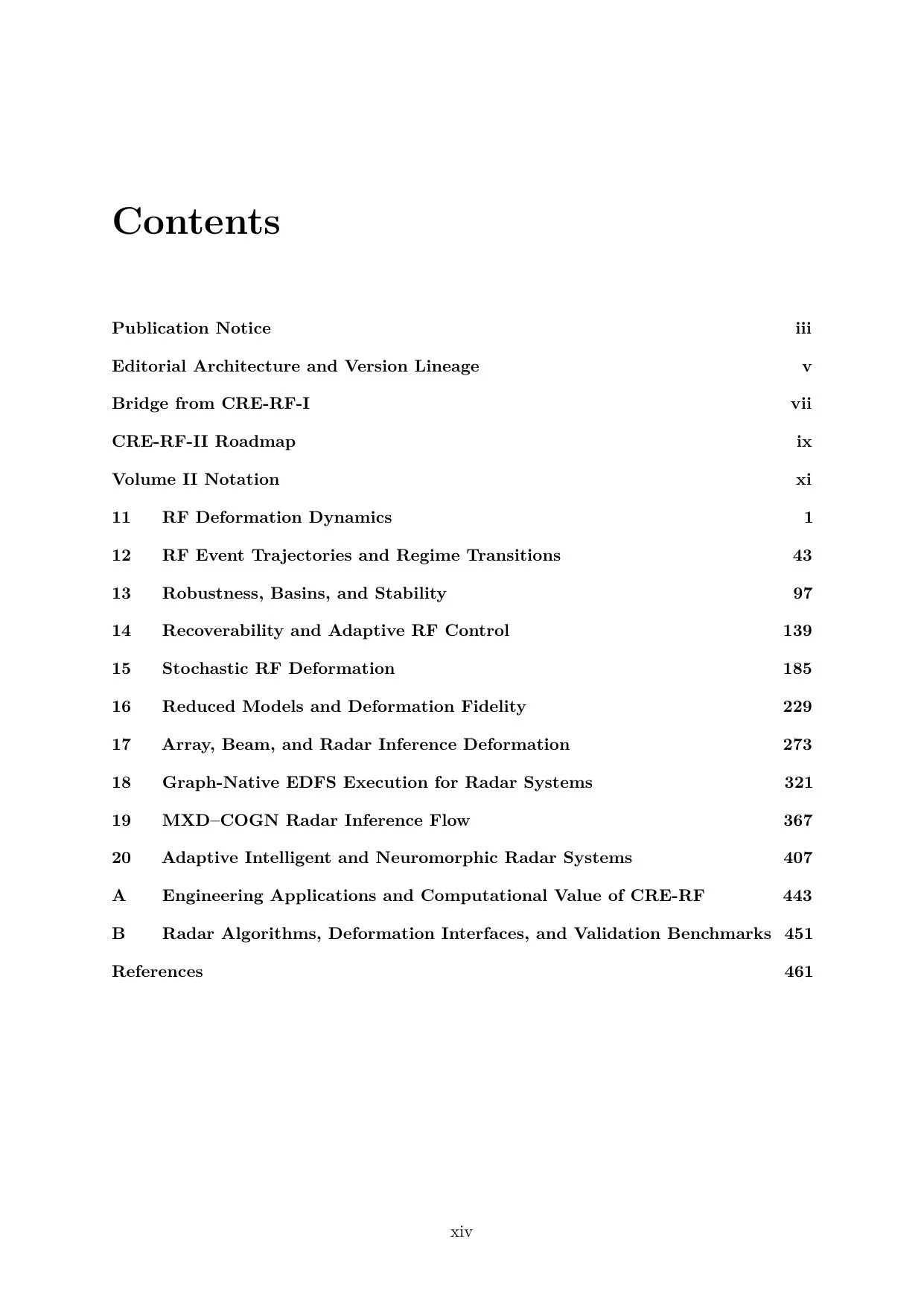
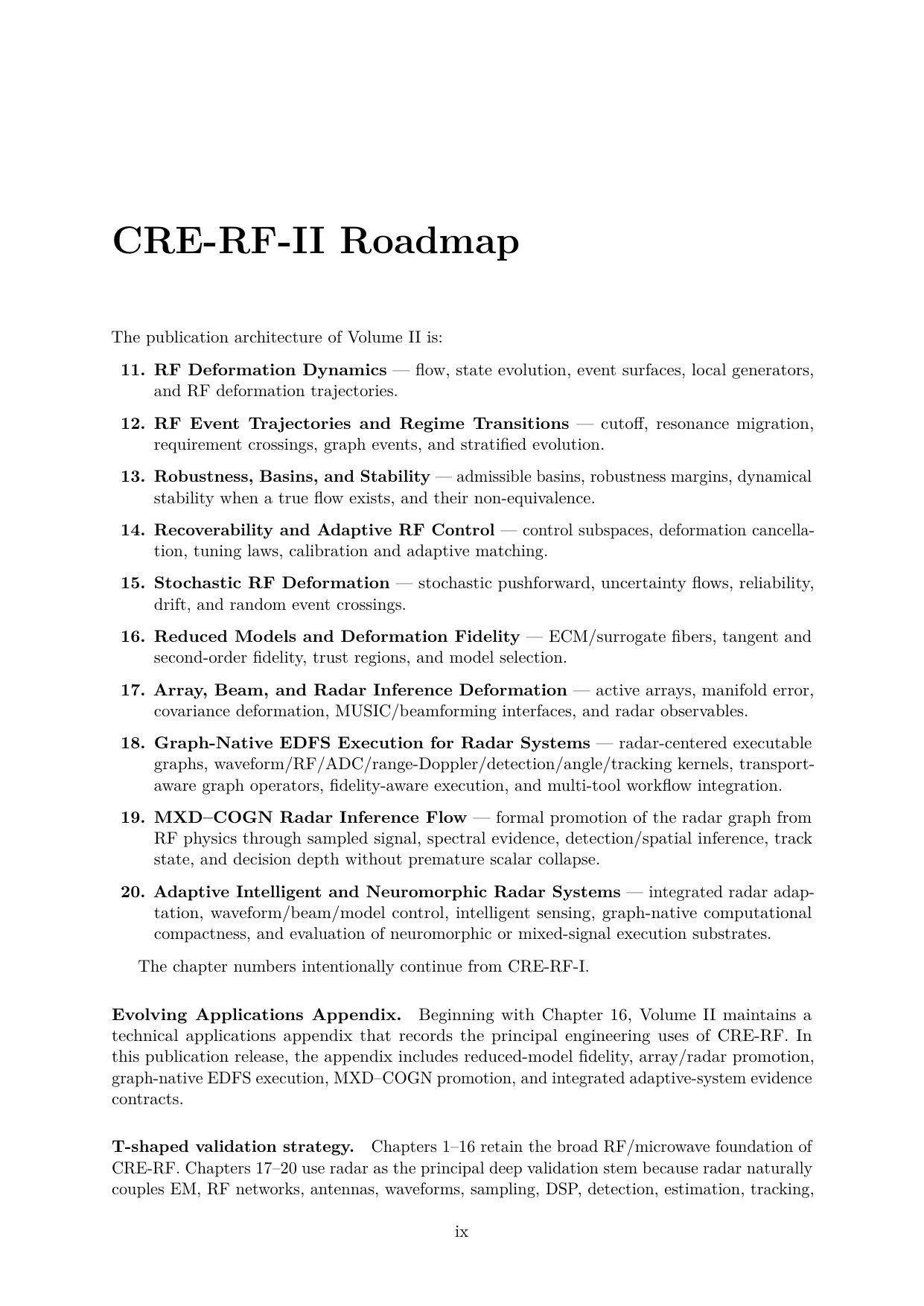
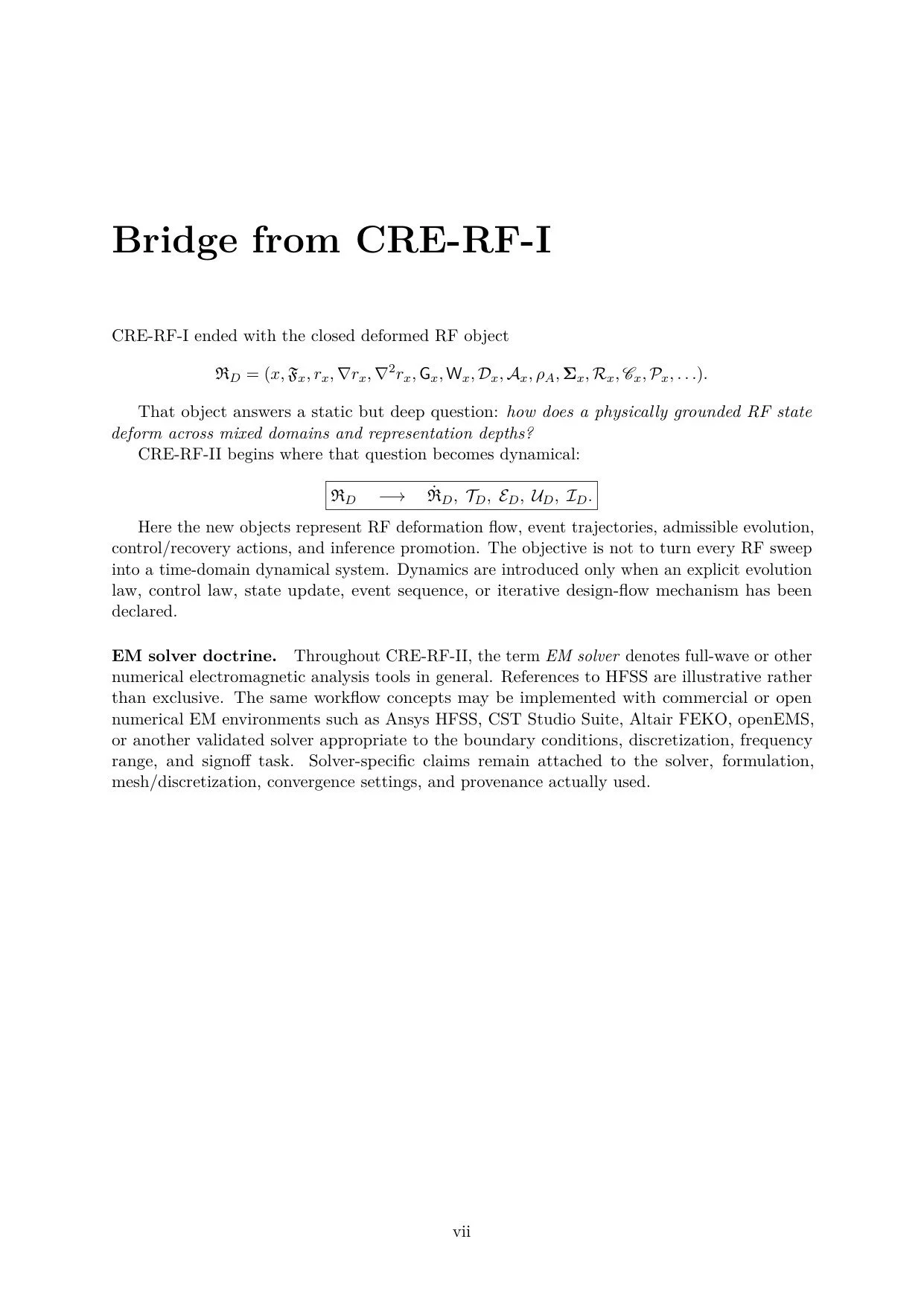
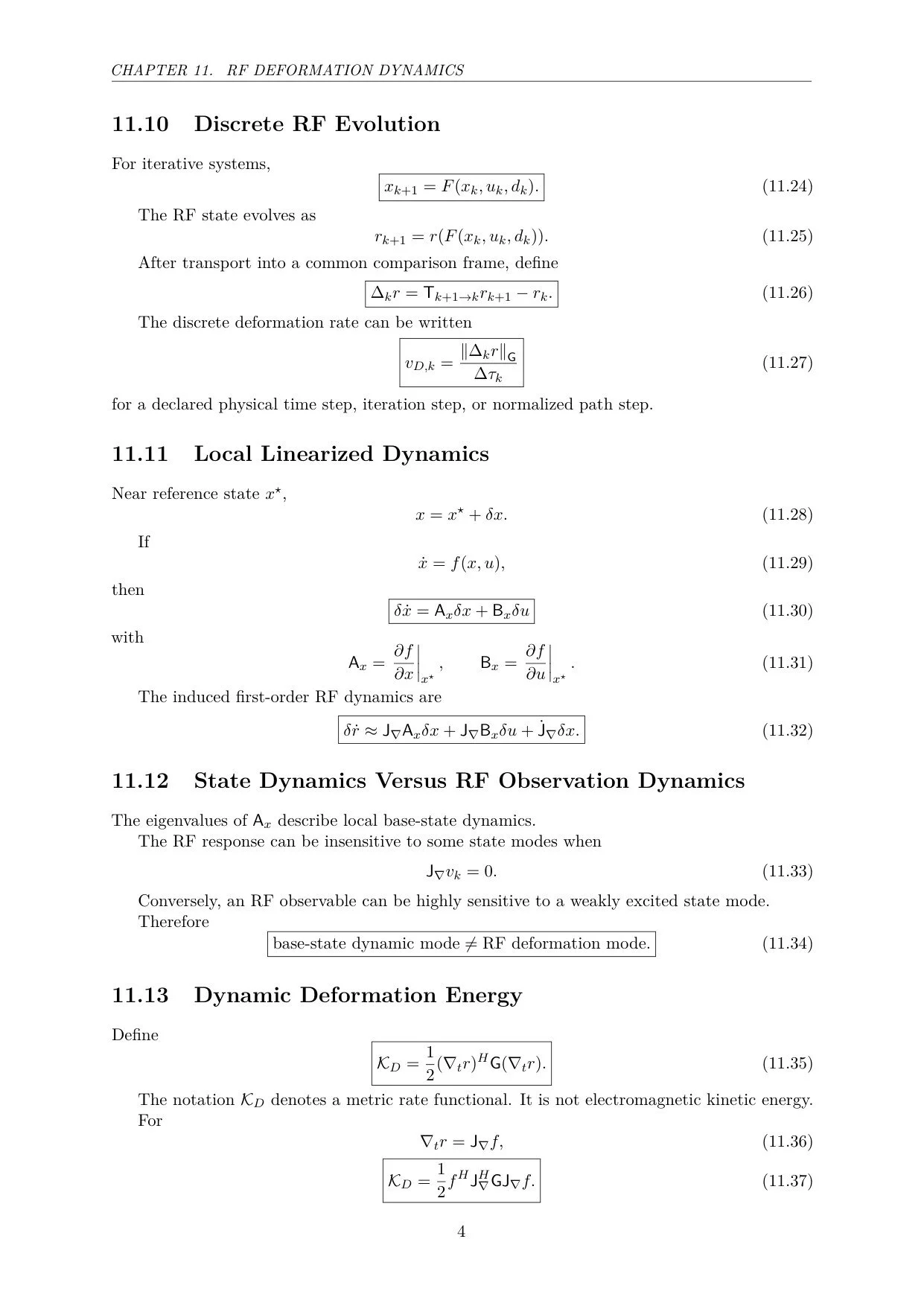
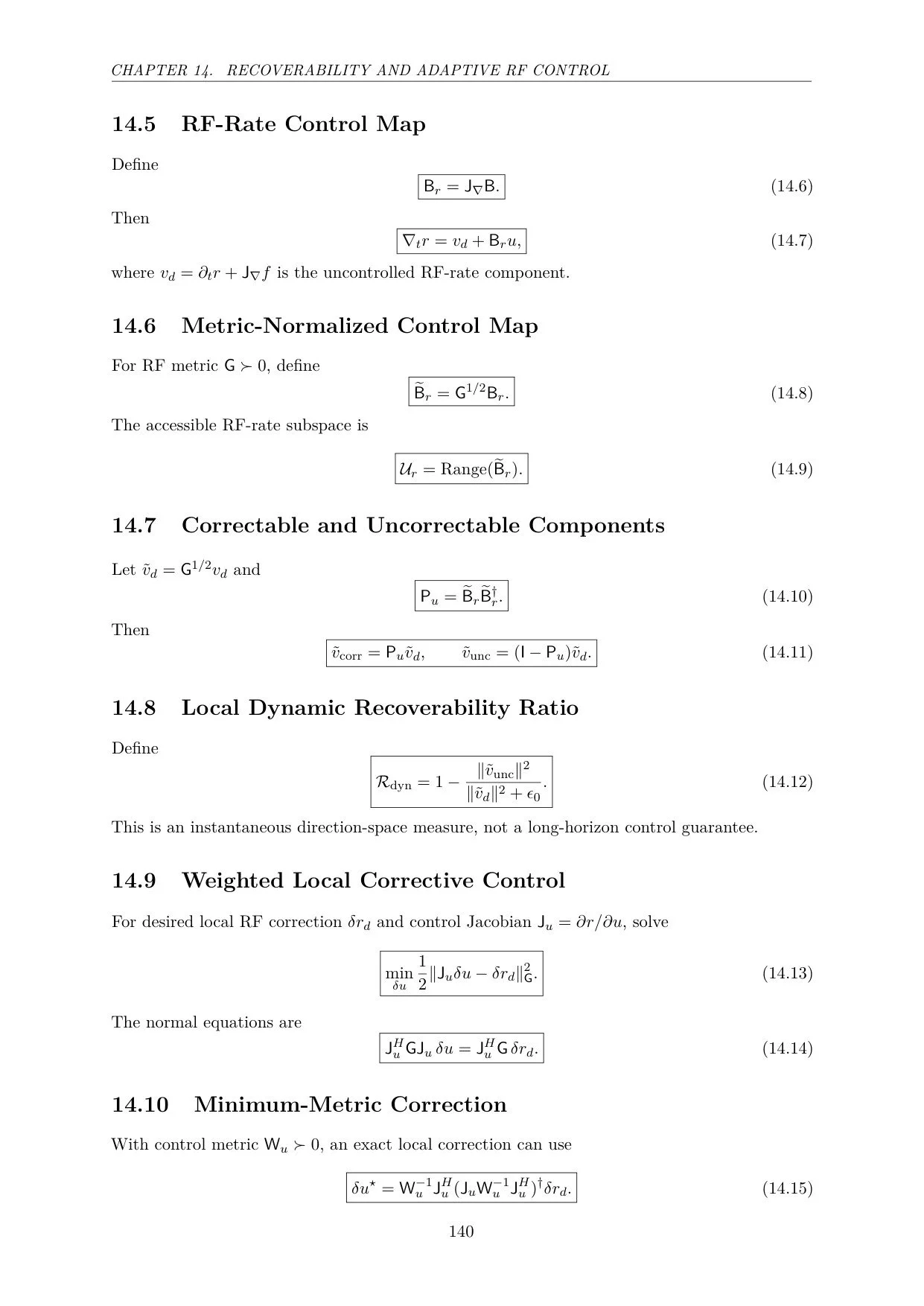
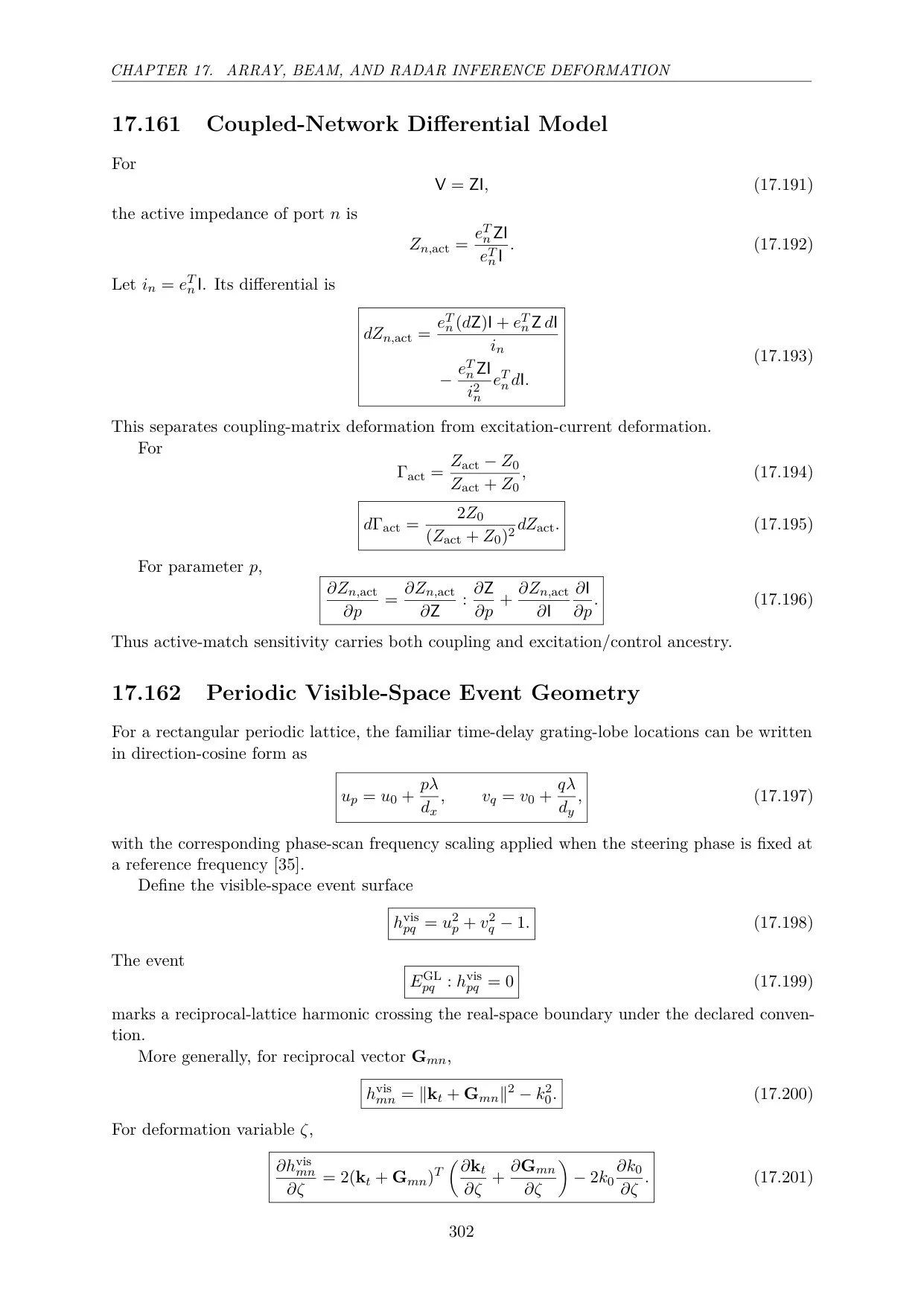
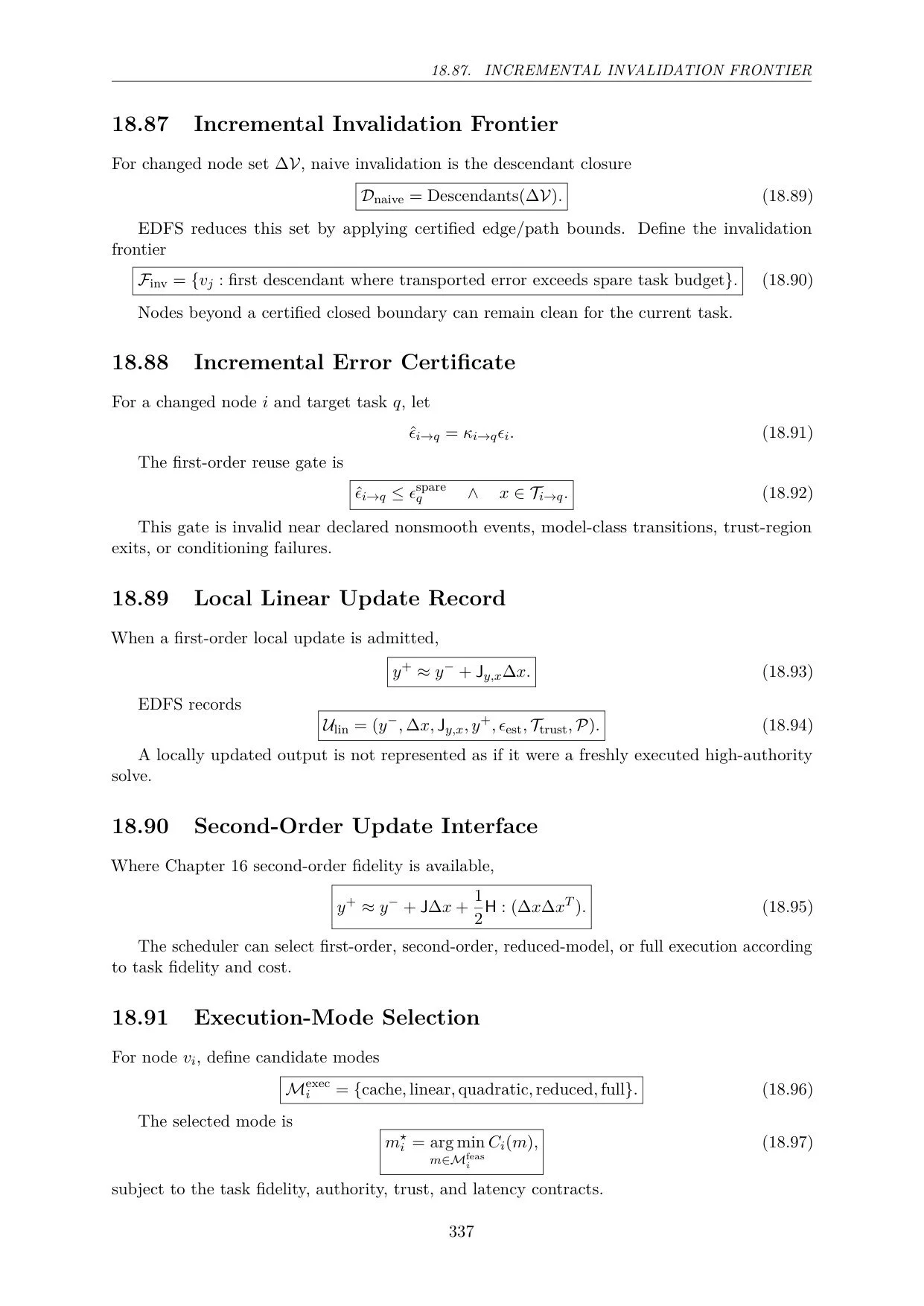
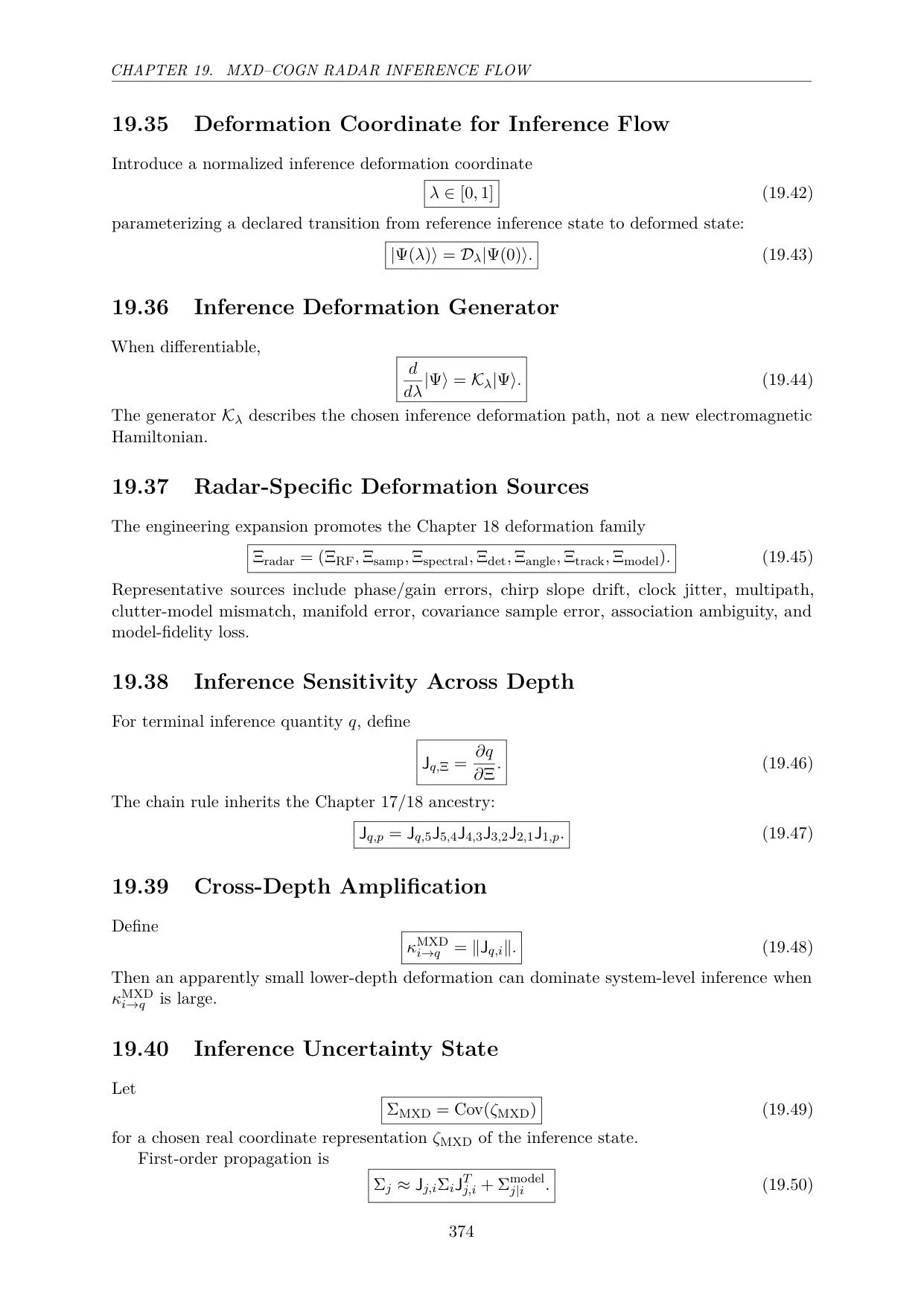
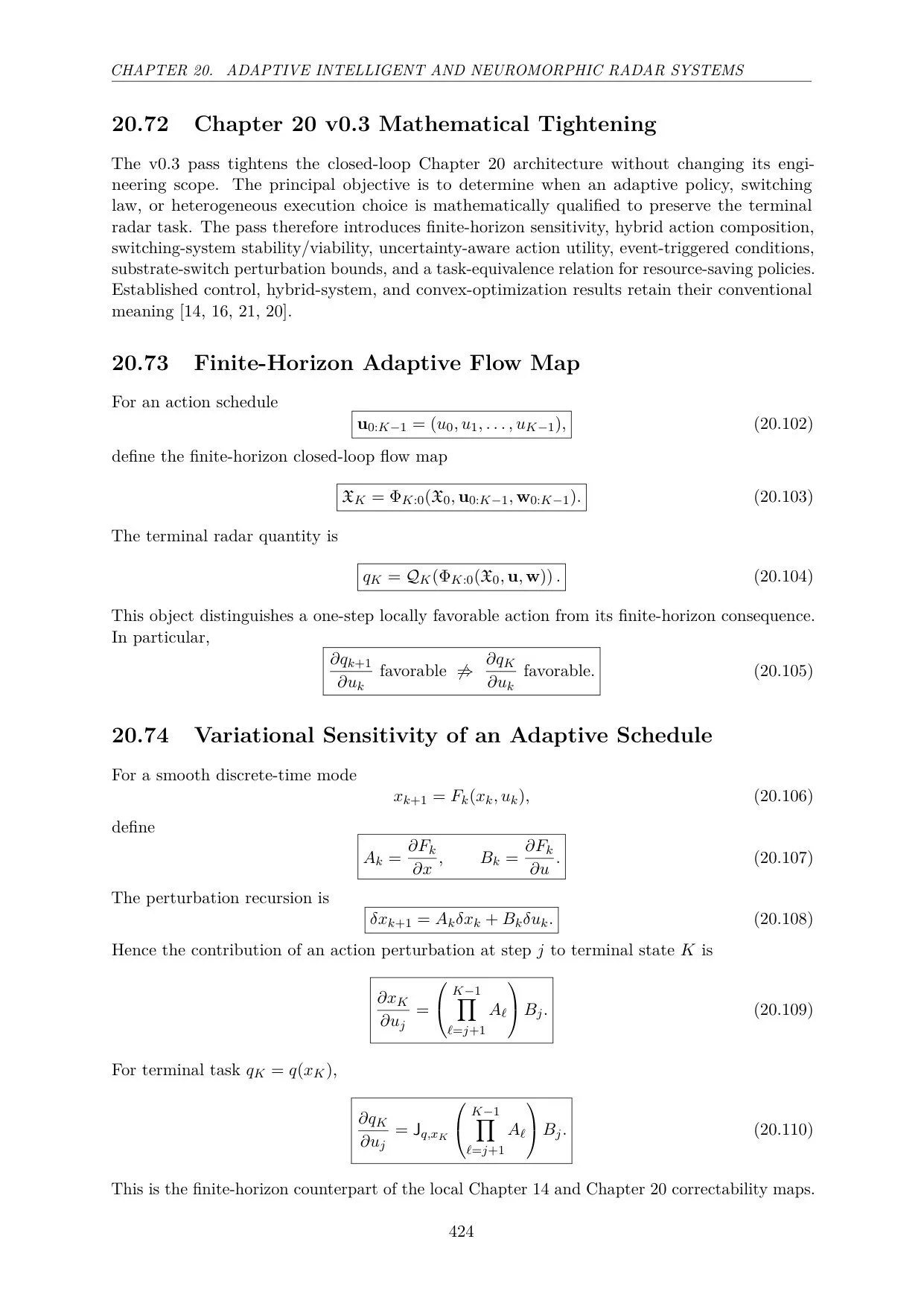
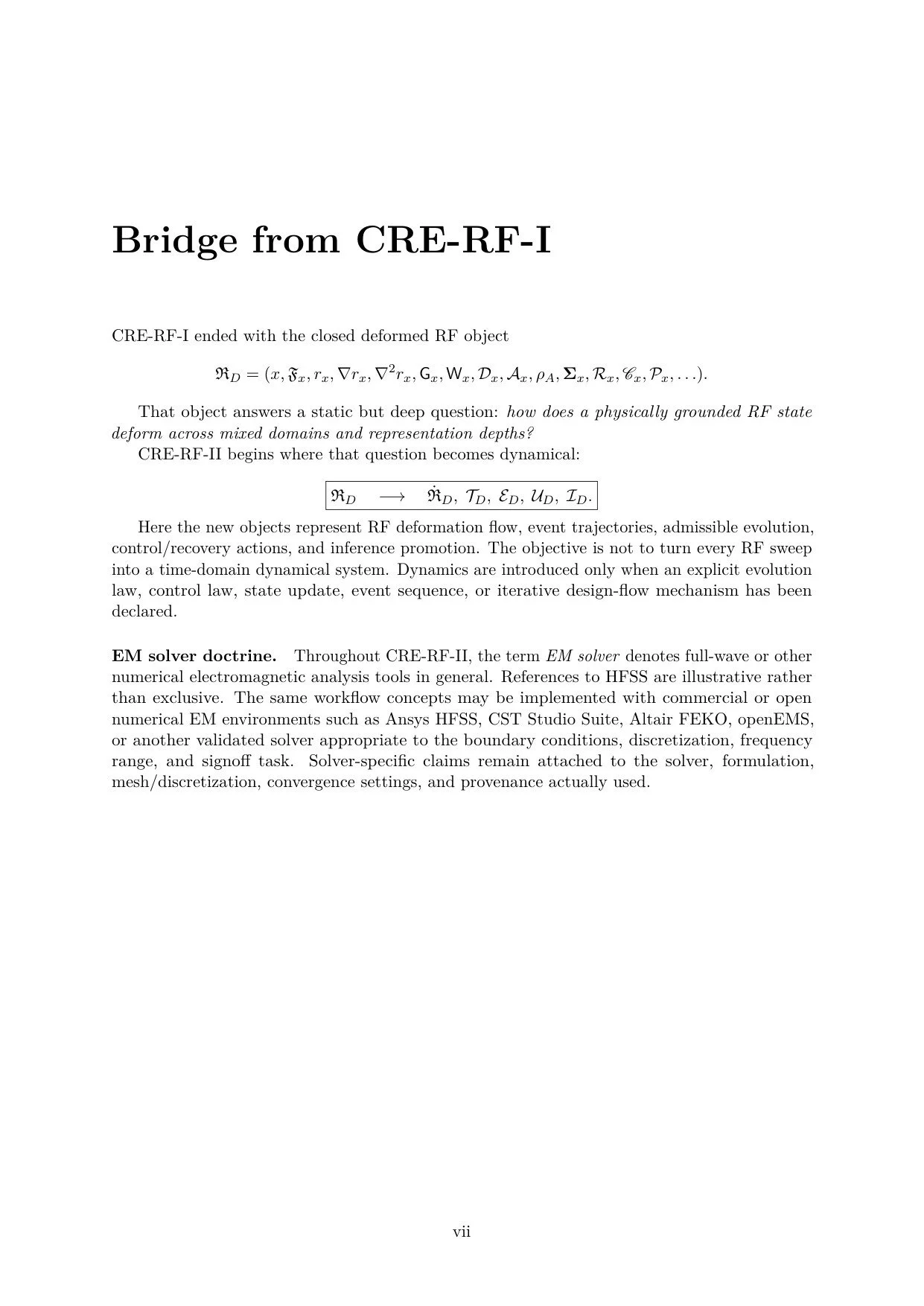
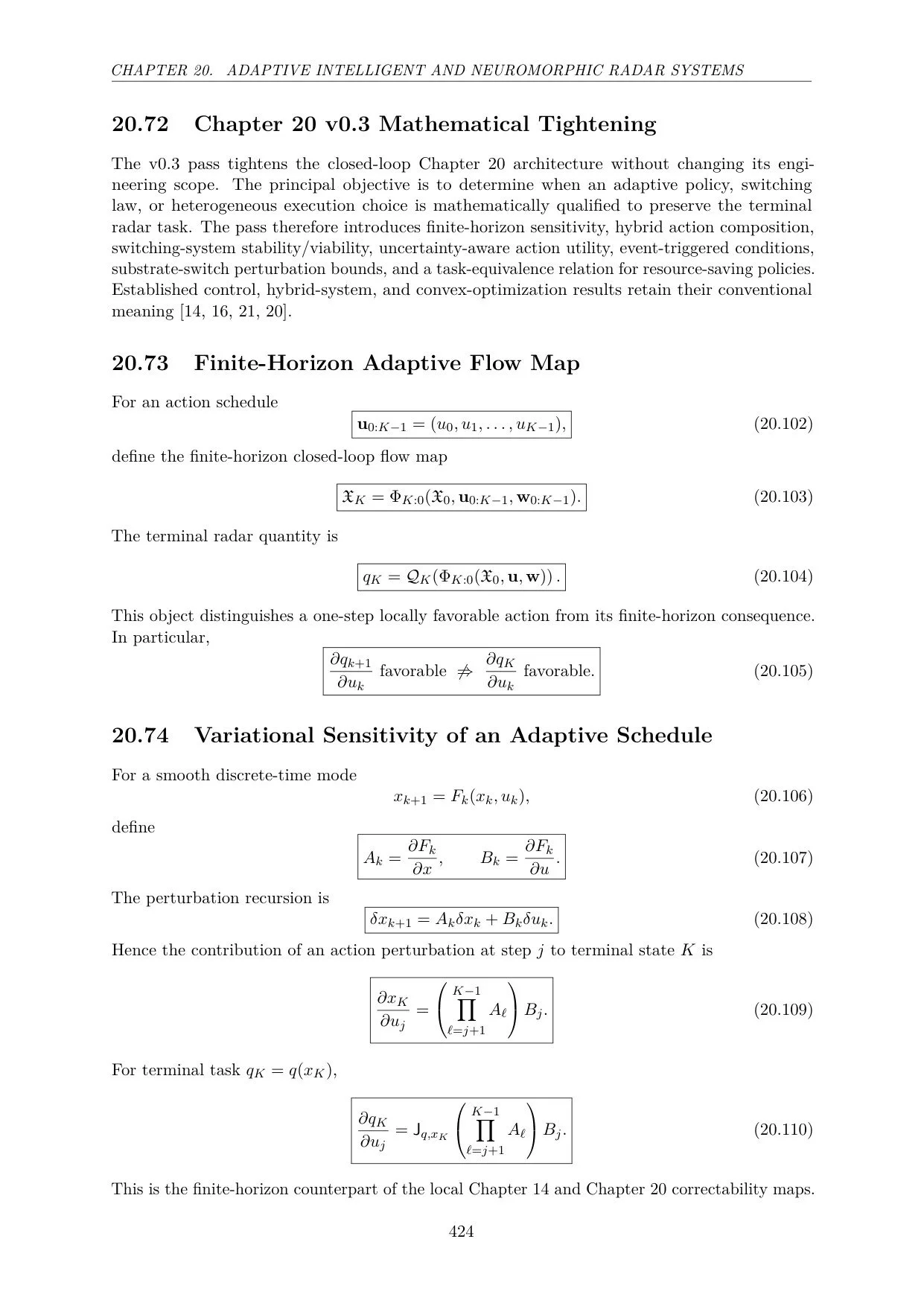
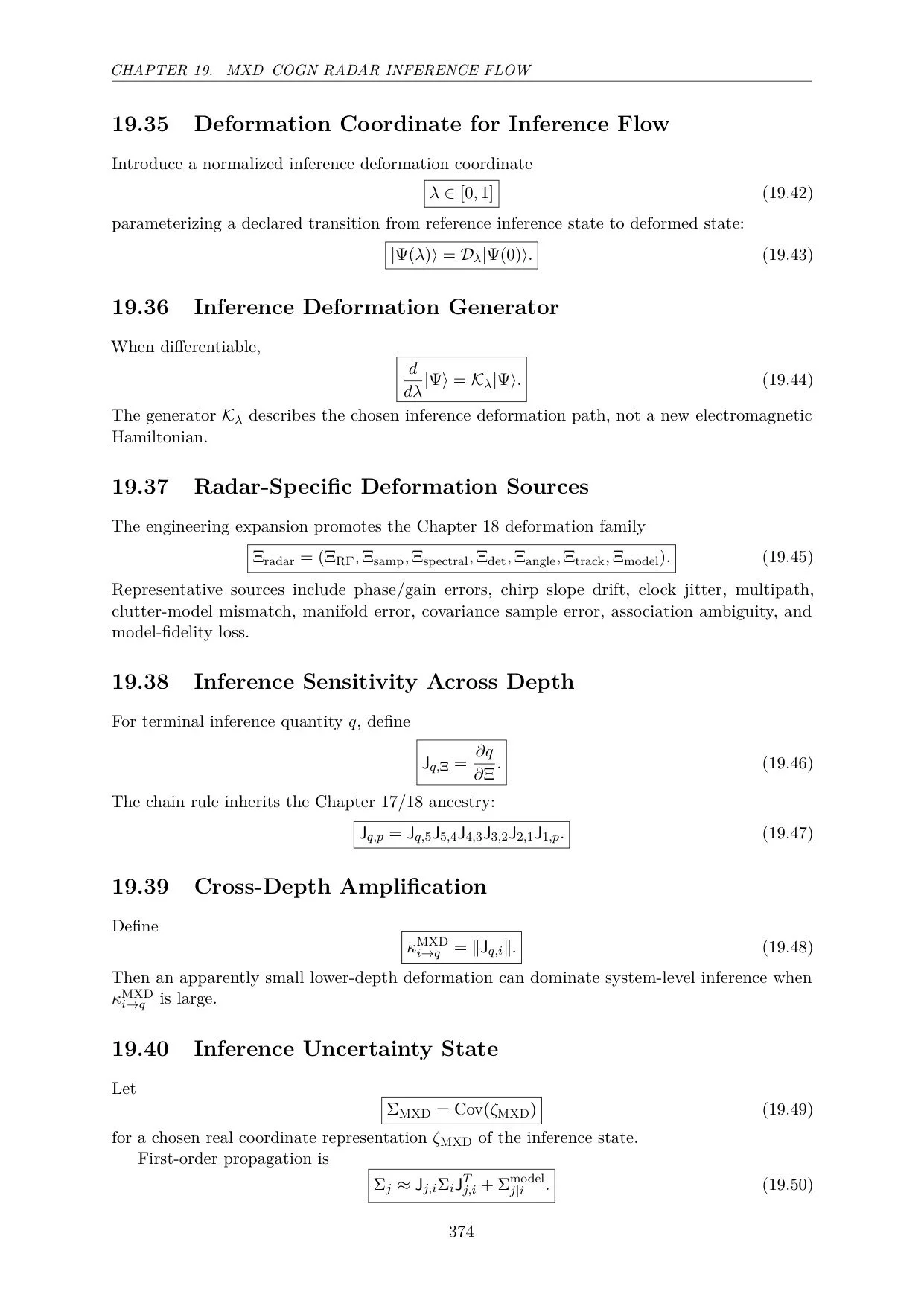
CRE-RF-II extends the deformed RF object into dynamics, event trajectories, robustness, recoverability, stochastic deformation, model fidelity, arrays, radar, graph-native EDFS execution, MXD-COGN inference and adaptive intelligent radar systems.
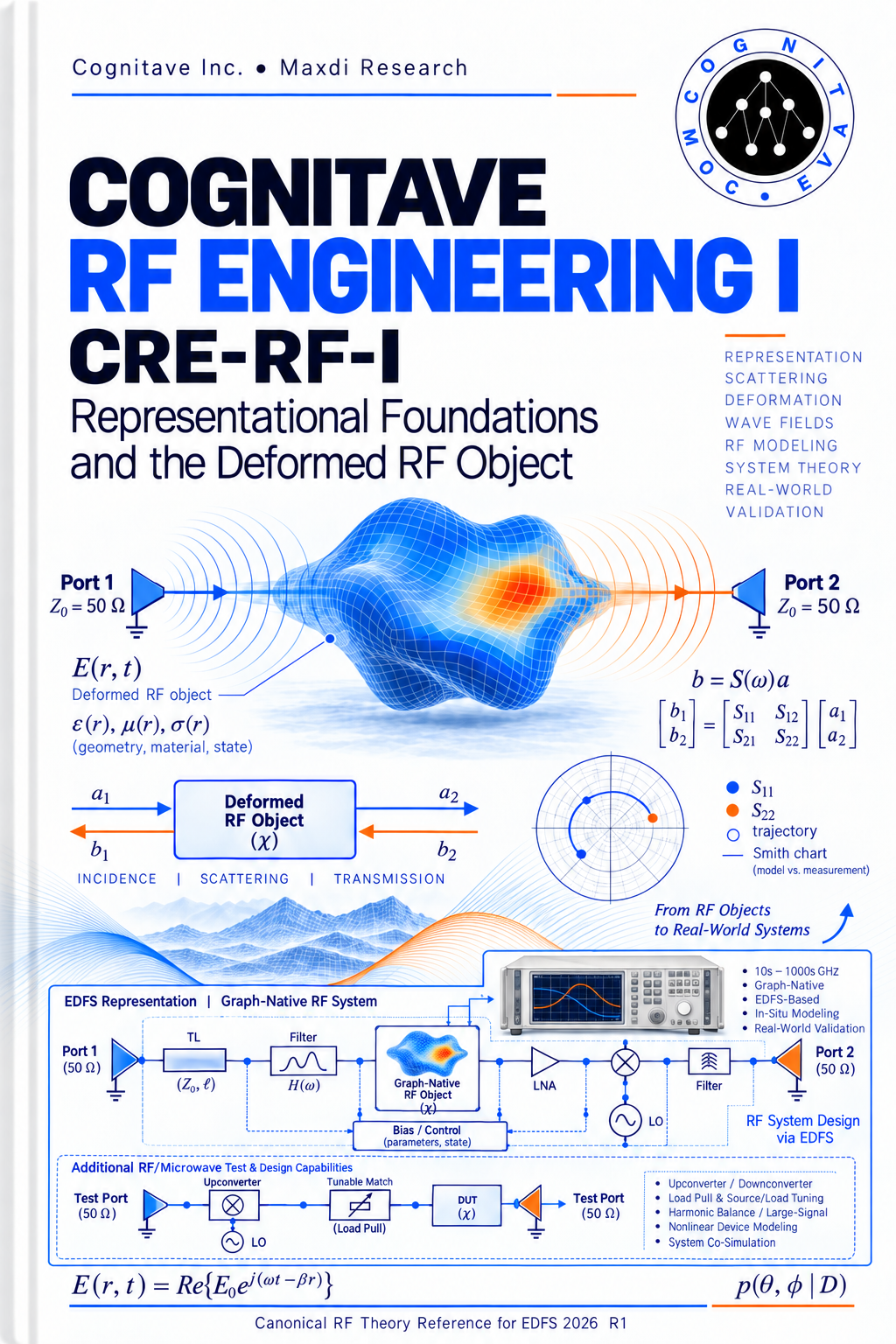


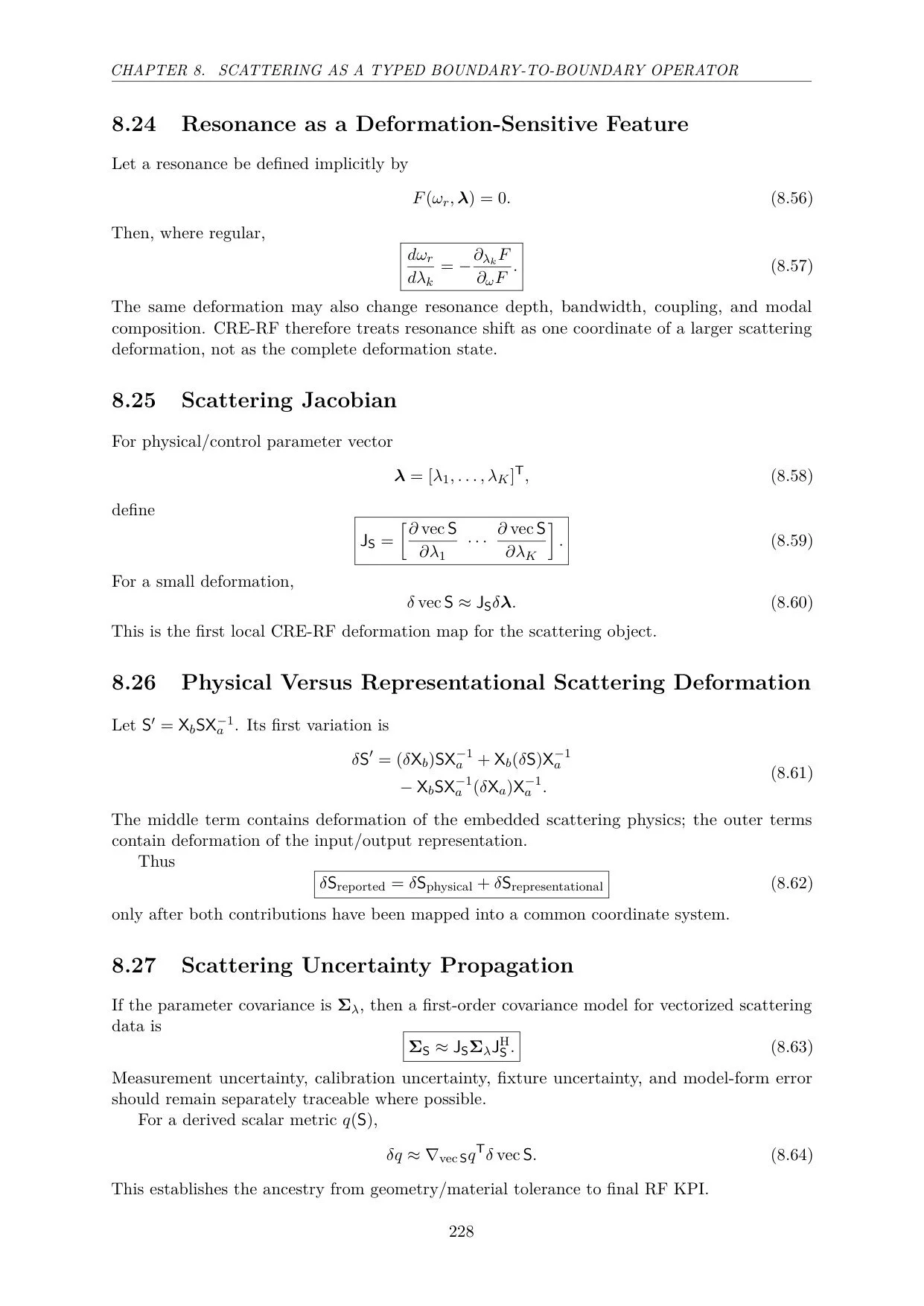
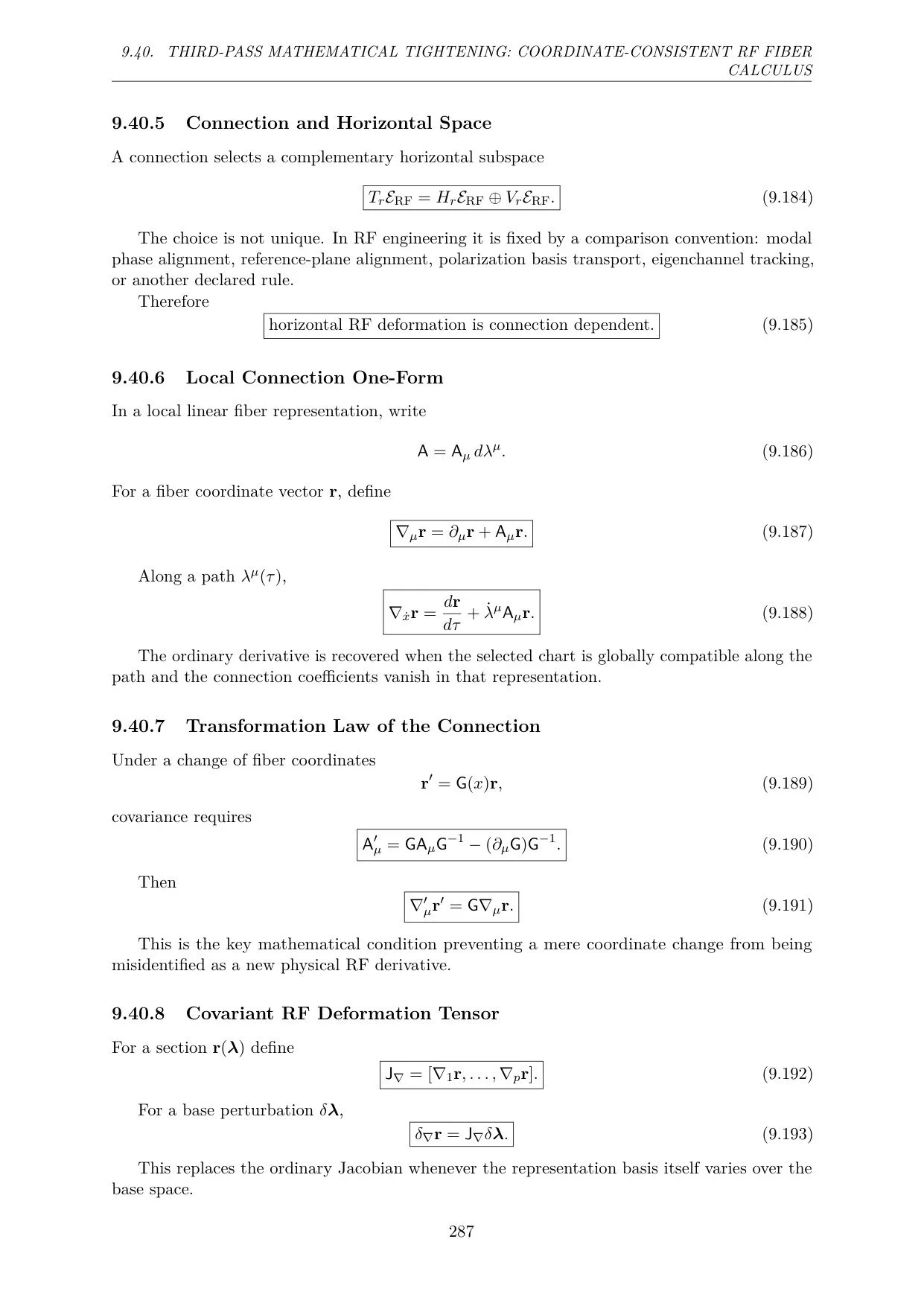
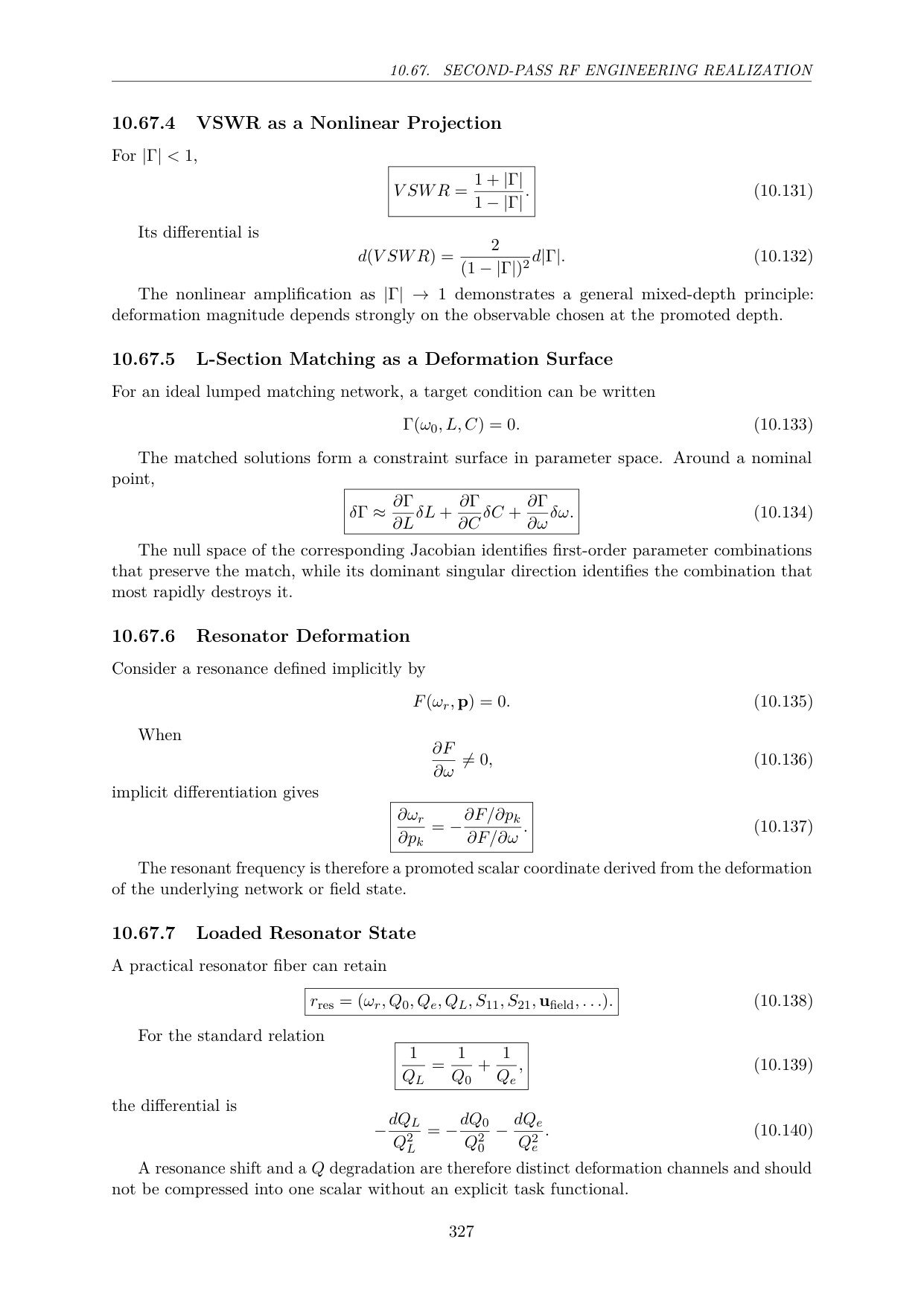
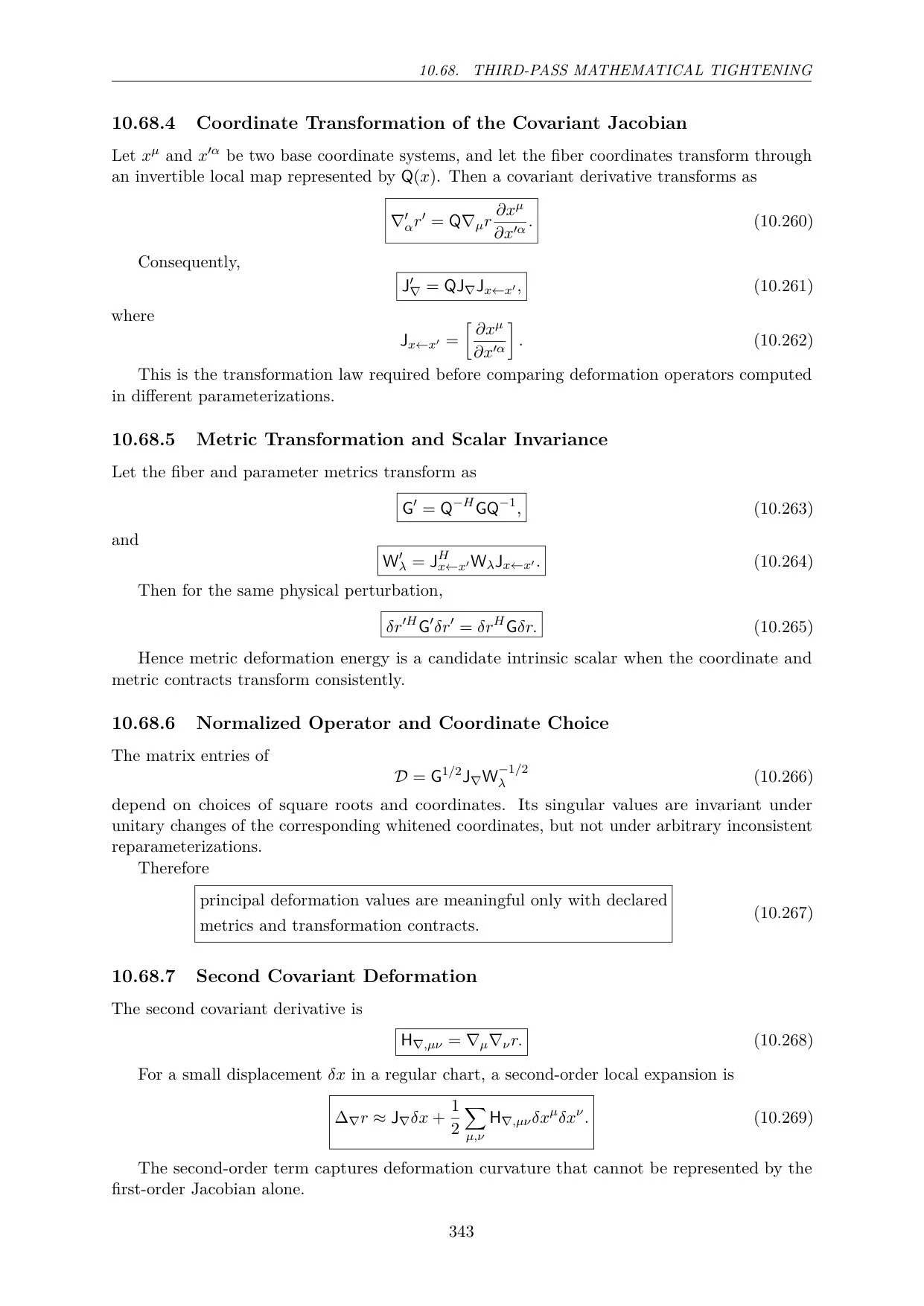
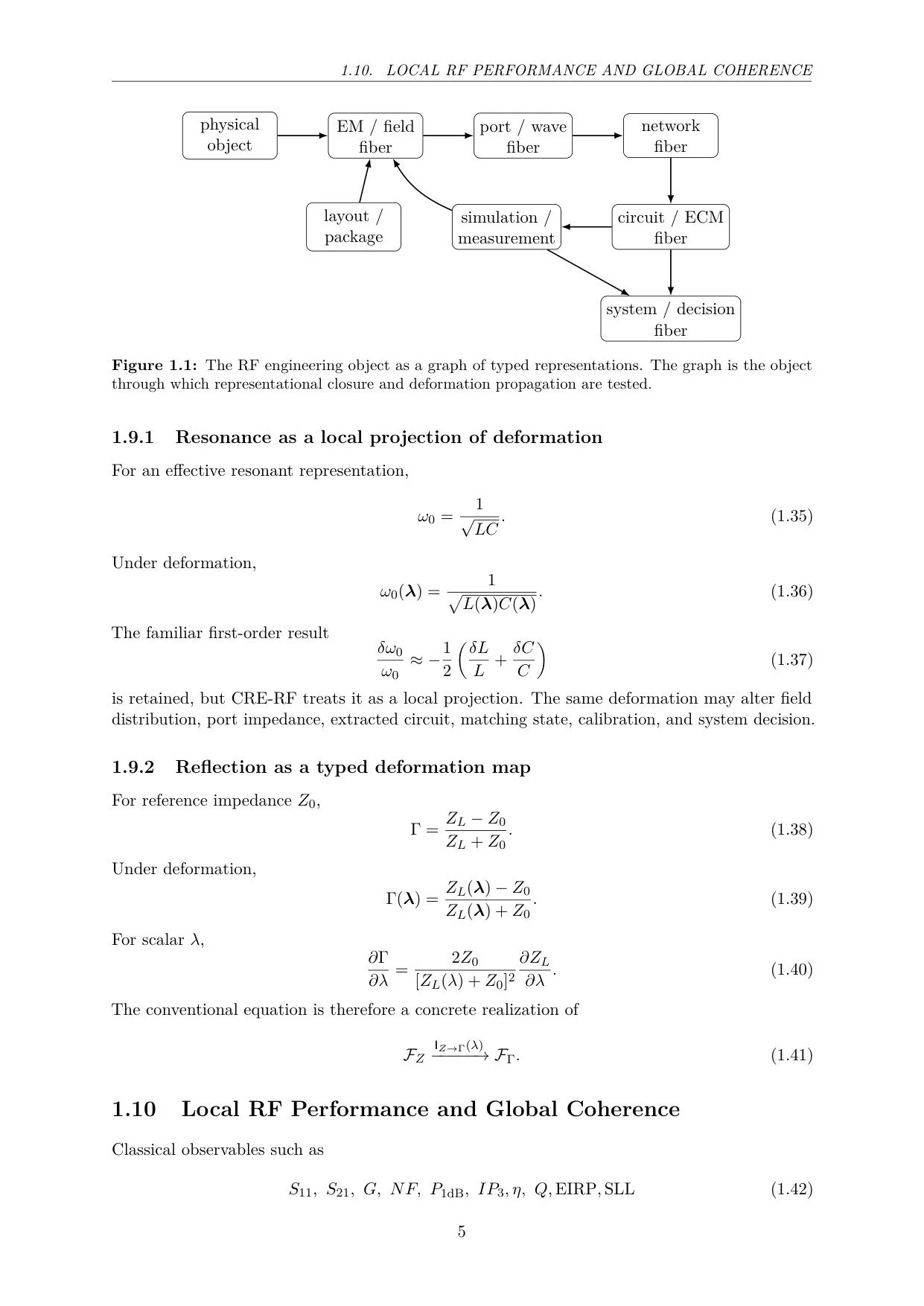
CRE-RF-I develops a rigorous graduate-level foundation for RF and microwave engineering from electromagnetic fields, waves, power, impedance and distributed systems through typed ports, scattering operators, RF fiber geometry and the deformed RF object. It provides the mathematical RF foundation underlying the RF engineering layer of EDFS 2026 R1.
COGNITAVE RF ENGINEERING I — CRE-RF-I
Representational Foundations and the Deformed RF Object
Publication Release v1.1 · Cognitave Inc. / Maxdi Research
Cognitave RF Engineering I develops RF and microwave engineering as a structured progression from the physical RF artifact to the mathematical and computational representations used to analyze, simulate, measure and ultimately deform that artifact.
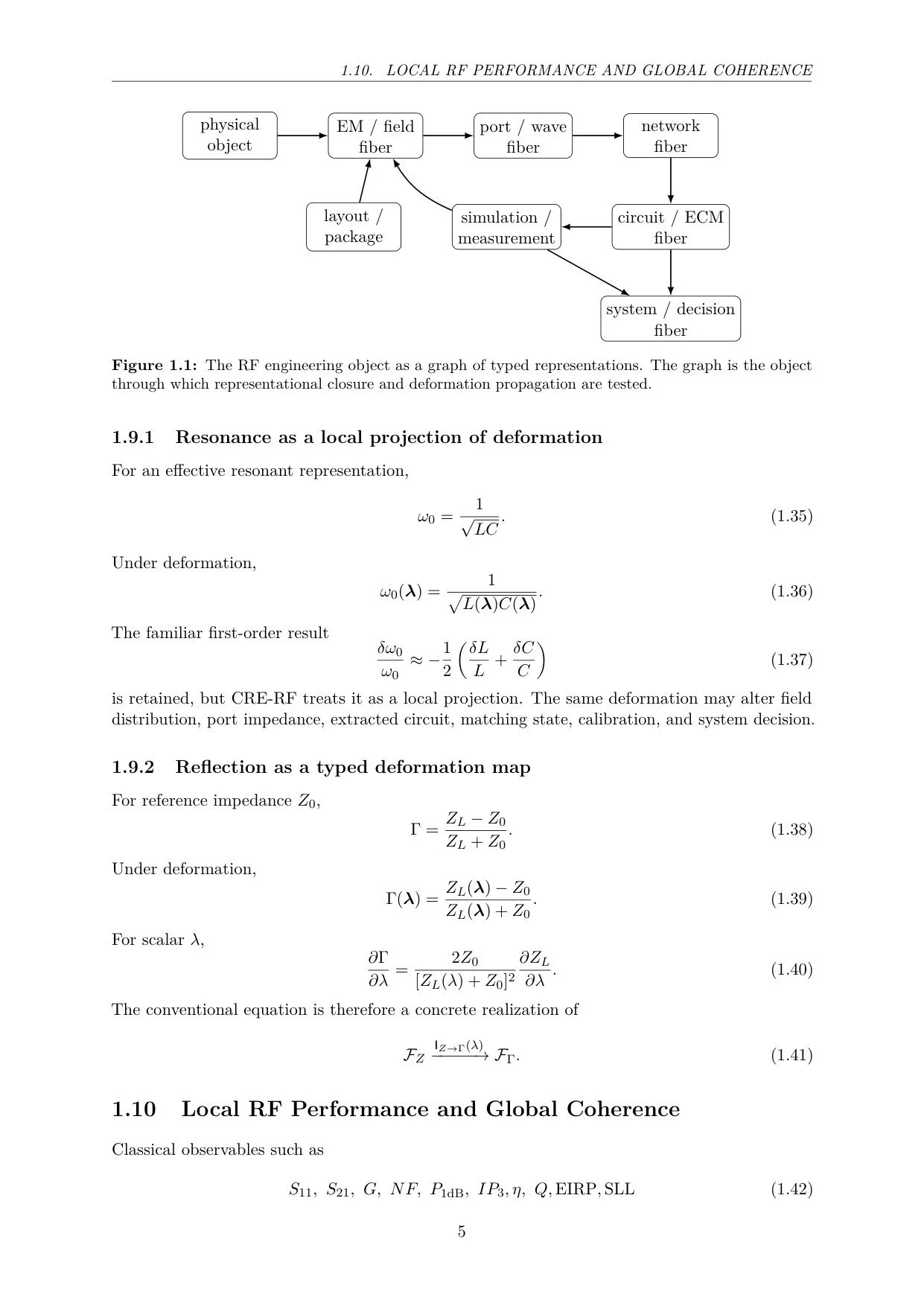
The volume begins from a familiar engineering observation: the same RF system may appear as electromagnetic geometry, electric and magnetic fields, complex phasors, transmission-line quantities, ports, scattering parameters, equivalent circuits, numerical solver states and measurement data. These objects may all describe aspects of the same engineering system, but they are not interchangeable.
CRE-RF-I therefore develops a typed representational architecture in which RF quantities retain their physical meaning, reference conditions and transformation contracts as the engineer moves between domains.
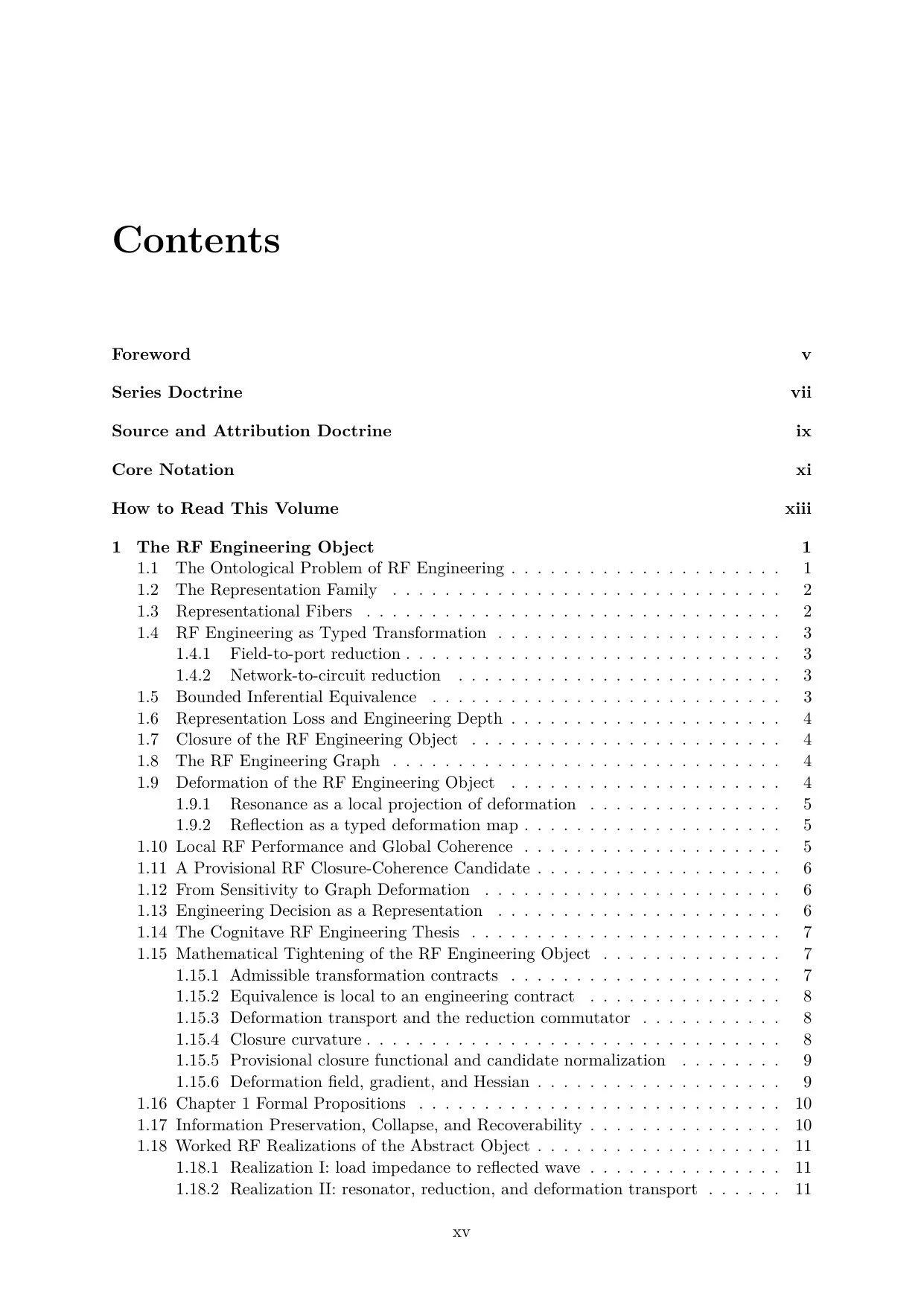
The ten chapters establish the sequence:
RF engineering object → complex representation → electromagnetic field fibers → wave transformations → power and impedance → distributed RF systems → typed ports → scattering operators → RF fiber geometry → deformed RF object
Chapters
Chapter 1 — The RF Engineering Object
Introduces the RF artifact as a mixed-representation engineering object and establishes the distinction between the physical system and its mathematical, numerical and measured representations.
Chapter 2 — Complex Representation as the First RF Fiber Geometry
Develops complex numbers, phasors, rotations, impedance/admittance and Möbius transformations as the first explicit RF representation geometry.
Chapter 3 — Electromagnetic Field Fibers
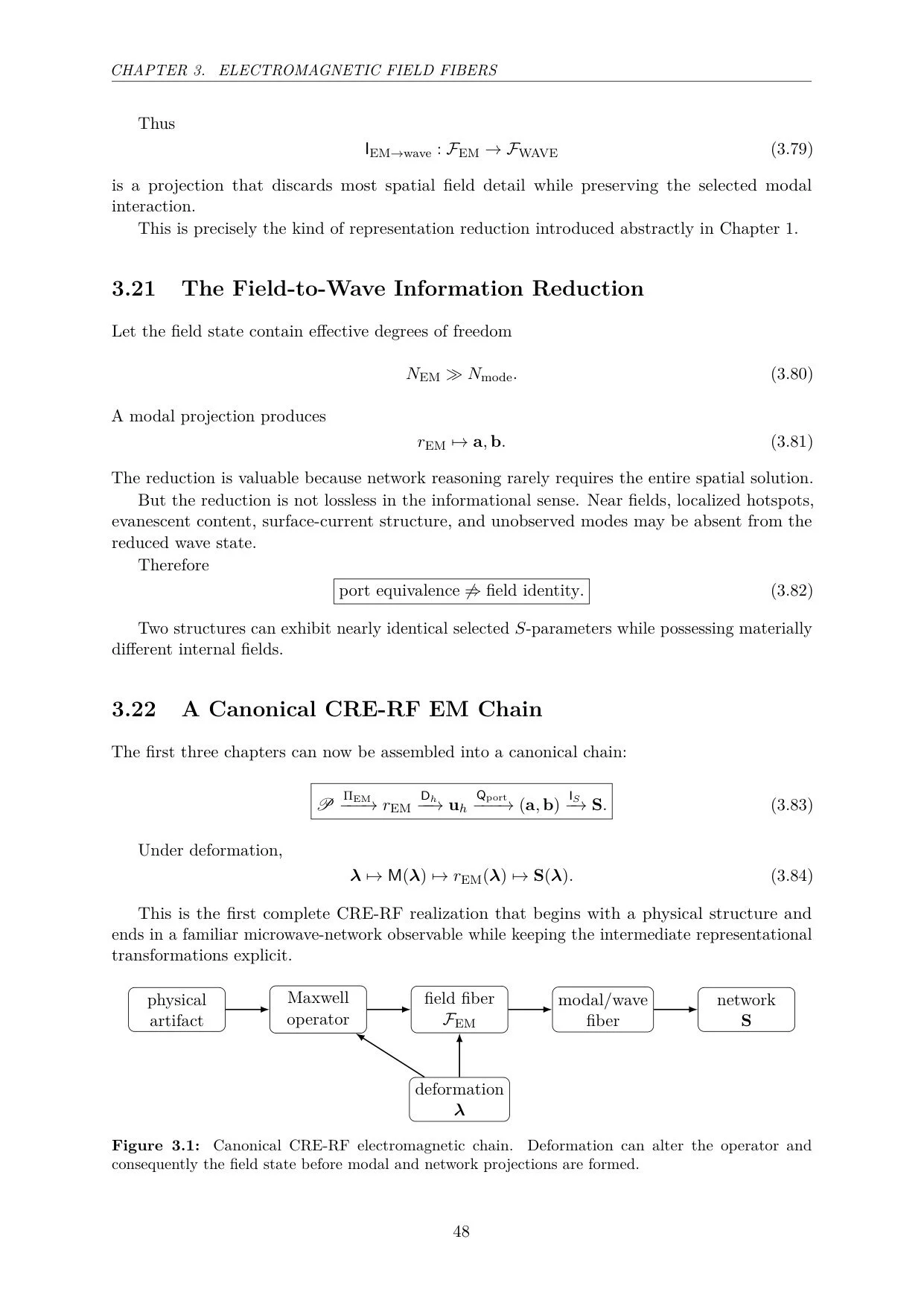
Places Maxwell-field solutions, materials, boundaries, sources and numerical discretization inside a typed electromagnetic representation.
Chapter 4 — Wave Transformations
Develops propagation, forward/backward waves, reference-plane transformations, modes, polarization, cutoff and dispersion.
Chapter 5 — Power and Impedance
Separates complex power, delivered power, impedance, admittance, mismatch, passivity and associated RF engineering metrics.
Chapter 6 — Distributed RF Systems
Develops transmission-line and distributed-system representations through RLGC parameters, propagation constants, characteristic impedance and spatial transport.
Chapter 7 — Ports as Typed Boundary Operators
Treats ports as engineering boundary contractions carrying orientation, mode basis, normalization, reference impedance and reference-plane information.
Chapter 8 — Scattering Operator
Develops S-parameters as typed multiport boundary operators with explicit passivity, losslessness, reciprocity, normalization and interconnection contracts.
Chapter 9 — RF Fiber Geometry
Introduces transport-aware comparison, sections, covariant differences, metrics and path-dependent representation changes.
Chapter 10 — The Deformed RF Object
Integrates the preceding framework into a deformation-aware RF engineering object incorporating sensitivities, uncertainty, admissibility, robustness, closure and recoverability interfaces.
Why CRE-RF-I is different
CRE-RF-I does not replace Maxwell equations, transmission-line theory, microwave network theory or conventional S-parameter engineering. Instead, it connects these established theories through an explicit representational framework designed to prevent common ambiguities between:
representation and physical state
coordinate transformation and physical deformation
nominal equivalence and deformation equivalence
engineering admissibility and representational closure
This structure provides the mathematical RF foundation for later deformation dynamics, robustness, stochastic evolution, array/radar inference and graph-native engineering execution.
Relationship to EDFS 2026 R1
CRE-RF-I provides the canonical RF mathematical foundation underlying portions of the RF engineering layer of Electronics Design Flow Studio — EDFS 2026 R1.
EDFS operationalizes selected CRE-RF representations, network objects, deformation operators and engineering evidence contracts inside a graph-native execution environment.
The textbook remains the theory and training reference; EDFS is the corresponding execution environment.
Graduate course and webinars
CRE-RF-I is accompanied by the Cognitave graduate RF engineering course covering Chapters 1–10 with chapter-by-chapter technical lecture decks.
Course:
cognitave.com/cognee-cre-rf(recommended new landing page)
Purchase and Download
Digital publication — PDF download For individual academic, engineering and professional study.
Technical inquiries:
tex@cognitave.com
Enterprise, institutional and engineering-program engagements may include:
extended usage rights
instructor/training packages
integration with EDFS engineering workflows
workshops and webinars
technical onboarding
certification pathways
Pricing for institutional engagements is determined by scope and intended application.


MAQM — Modern Applied Quantum Mechanics is best understood but as an engineering distillation of quantum mechanics from operator algebra toward semiconductor-scale device analysis. Its distinguishing feature is the sequence it establishes: abstract Hilbert-space mathematics is introduced first, translated into matrix, wave-function, and Dirac representations, and then progressively converted into calculational machinery for confinement, tunneling, periodic structures, resonant transport, quantum wells, and ultimately three-dimensional semiconductor quantum structures. The uploaded volume contains seven substantive chapters, despite the cover identifying the edition as “Part I, Chapters 1 to 6.”
The editorial logic of the book can therefore be summarized as:
quantum algebra → operators and states → Schrödinger dynamics → quantum waves → canonical potentials → transfer matrices and tunneling → multidimensional confinement → semiconductor quantum structures.
That progression is particularly relevant to electrical and microelectronics engineering because it does not leave quantum mechanics at the level of philosophical postulates. It develops the mathematical objects that eventually become the working variables of nanoscale device models.
Chapter 1 — Hilbert Space and Algebra of Operators
The opening lecture establishes the mathematical language on which everything else depends. Eigenvalue problems are developed in matrix space, function space, and Bra–Ket space, making explicit the equivalence between Heisenberg matrix mechanics, Schrödinger wave mechanics, and Dirac’s abstract formulation. Hermitian matrices and operators, real eigenvalues, eigenvectors, eigenfunctions, orthogonality, normalization, degeneracy, inner products, Kets, Bras, operator action, identity and null operators, and eigenstates are developed systematically.
This is the first important engineering distillation in MAQM. A semiconductor device ultimately presents an eigenproblem: given material properties, geometry, interfaces, boundary conditions and a Hamiltonian, what electronic states and allowed energies can exist? Chapter 1 builds precisely the algebra required to formulate that question. The book explicitly constructs one-to-one correspondences between matrix, function and Ket-space descriptions rather than treating them as unrelated mathematical conventions.
MAQM-m4-KNj3.pdf
Chapter 2 — The Principles of Quantum Mechanics
Having established the algebra, Chapter 2 turns it into dynamics. The lectures cover evolution equations, Poisson commutators, dual relations in bracket space, and identities/unity relations.
MAQM-m4-KNj3.pdf
The importance of this chapter is that operators cease to be static mathematical definitions. Commutation structure determines how observables relate, while evolution equations establish how quantum states change. This creates the bridge from linear algebra to physical dynamics—the prerequisite for understanding how electronic states respond to Hamiltonians, potentials and other governing parameters.
For an engineering reader, Chapters 1 and 2 together form a compact quantum algebra toolkit. They supply the state space, operators, basis transformations, commutators and evolution machinery that later reappear in concrete device calculations.
Chapter 3 — Schrödinger Equation
Chapter 3 brings the preceding algebra into the central governing equation of nonrelativistic quantum mechanics. The chapter develops the Schrödinger equation in Bra–Ket space and then treats quantum measurement, uncertainty relations, time-independent solutions, time-dependent solutions, and energy eigenstates.
An especially useful feature is the comparison among abstract bracket-space, spatial-function and momentum representations of the Hamiltonian. The manuscript emphasizes that these mathematical representations look different while describing the same physical quantum system.
This is the point at which MAQM becomes directly recognizable as a device-physics foundation. In microelectronics, the Schrödinger equation becomes the computational engine from which one obtains confined states, subband energies and wavefunctions. Geometry and materials enter through the potential and effective Hamiltonian; device behavior emerges through their eigenstates.
Chapter 4 — Quantum Wave
The fourth lecture gives physical and mathematical content to the wavefunction. It treats the free particle, wave envelope/wave packet, and probability density, followed by a substantial problem set.
This chapter is more consequential for engineering than the simple title “Quantum Wave” suggests. Wave packets introduce dispersion and localization; probability density converts an abstract state into a spatially interpretable electronic distribution; and the exercises extend the discussion toward probability flux, refraction and reflection of matter waves, energy expectation and energy-state density.
Those concepts later become recognizable semiconductor quantities: carrier confinement, probability current, reflection/transmission at interfaces, dispersion relations and density of states.
Chapter 5 — Special Problems
Chapter 5 moves decisively from foundations into solvable physical models. It studies even-symmetry potentials, the Pöschl–Teller potential, Dirac potential, hydrogen molecular ion, harmonic oscillator and periodic problems. The harmonic oscillator is deliberately examined in Bra–Ket, momentum and function-space representations and extended to three dimensions.
Editorially, this chapter serves as the book’s laboratory. Instead of introducing new formalism for its own sake, it demonstrates how the formalism behaves under representative potential landscapes. Symmetry reduces complexity; exact potentials teach boundary behavior; the oscillator establishes quantized spectra and ladder-like energy structure; and periodicity anticipates crystalline solids.
For semiconductor engineering, this chapter develops the intuition needed to recognize that different physical structures are fundamentally different potential-energy landscapes posed to the same quantum machinery.
Chapter 6 — General One-Dimensional Problems
Chapter 6 is arguably the strongest bridge between MAQM’s quantum algebra and practical nano/microelectronic analysis. It develops analytical approximations, Wilson–Bohr–Sommerfeld quantization, optimized solutions, transfer matrices, transitions through boundaries, wave reflection and transmission, consecutive interfaces, tunneling, symmetric square wells, resonant tunneling, Dirac transfer matrices, periodic potentials, finite periodicity, the Dirac crystal and the differential transfer matrix.
This is recognizably an engineering toolkit. A heterostructure can be represented as a sequence of regions possessing different potentials and material parameters. Instead of solving the entire structure from scratch, interfaces and propagation regions can be represented by matrices and cascaded. Transmission and reflection then become calculable properties of the assembled structure.
That machinery leads naturally to quantum wells, barriers, superlattices and resonant-tunneling structures. Tunneling is therefore not presented merely as the familiar paradox of a particle crossing a classically forbidden barrier; it becomes a quantitatively exploitable transport mechanism. Periodic potentials then extend the same reasoning toward crystal and artificial-lattice structures.
Chapter 7 — Multidimensional Problems
The final chapter expands the one-dimensional machinery into realistic confinement geometries. It introduces the variational method, separable potentials, potential boxes, axial symmetry, angular momentum, cylindrical quantum points/dots, radial symmetry, rotational momentum, spherical oscillators, boundary conditions, the three-dimensional harmonic oscillator, the hydrogen atom and radial momentum.
Here the semiconductor-device destination of the preceding mathematics becomes explicit. In the section on the cylindrical quantum structure, the text considers electrons and holes confined in three dimensions. It describes a narrow semiconductor cylinder such as GaAs, laterally confined by the surrounding potential and vertically bounded by a larger-bandgap semiconductor such as AlGaAs, producing a zero-dimensional quantum dot.
This is an important culmination of the book. Hilbert spaces and eigenvectors introduced in Chapter 1 have now become confined carrier states inside an engineered semiconductor geometry. Eigenvalues have become allowable device energies. Boundary conditions have become semiconductor interfaces. Probability functions describe where carriers reside. Transfer matrices describe propagation through layered structures. Tunneling becomes a transport mechanism. Symmetry determines solvability and degeneracy. Three-dimensional confinement produces quantum dots.
The central accomplishment of Modern Applied Quantum Mechanics is therefore its compression of the conceptual distance between quantum algebra and electronic-device physics.
Rather than organizing quantum mechanics as a sequence of historical discoveries, MAQM organizes much of the subject as a chain of mathematical abstractions that become progressively more operational:
Hilbert space supplies the state space.
Operator algebra supplies measurable quantities.
Eigenproblems supply allowable states and values.
The Hamiltonian encodes the physical system.
The Schrödinger equation supplies its dynamics.
Wavefunctions supply spatial representation.
Probability density and flux supply physical interpretation.
Boundary conditions encode fabricated structures and interfaces.
Transfer matrices make multilayer structures computationally tractable.
Tunneling and resonance introduce nanoscale transport.
Periodic potentials lead toward crystalline and engineered periodic media.
Multidimensional confinement leads finally to quantum wells and quantum-dot-type semiconductor structures.
That is what is distilled in these lectures: the algebra of quantum mechanics is progressively converted into an engineering language for designing and analyzing matter at electronic and semiconductor dimensions.
Modernapplied quantum-mechanics bridge between mathematical operator theory and micro/nanoelectronic device physics. Its value lies in showing why the abstract mathematics matters: the Ket eventually represents an electronic state; the operator becomes a physical observable; the eigenvalue becomes an allowed energy; the potential becomes a device structure; and the boundary-value problem becomes the mathematical representation of an engineered semiconductor.
That gives MAQM a much clearer identity within the Cognitave engineering curriculum: quantum algebra distilled into calculational methods for electronic states, waves, barriers, tunneling, periodic structures and semiconductor confinement.
Modern Applied QM (MAQM) mathematics and numerical tools presented in this technical Cognitave ee-store publication are applied in consumer electronics, telecommunications and aerospace industries to solve design and engineering problems in telecommunications or for environmental threats mitigation and counter measures.
Access related on-demand EE course at:

MODERN APPLIED QUANTUM MECHANICS (MAQM) — ESSENTIAL LECTURES
Expanded Quantum Reality & Engineering Edition
Mahdi Haghzadeh, PhD | Cognitave Inc.
MAQM Essential Lectures is not simply an abridged version of the original Modern Applied Quantum Mechanics textbook. It is an editorial reinterpretation of MAQM’s mathematical core, viewed simultaneously through engineering, quantum foundations, and the philosophy of physical reality.
The original MAQM develops an applied-physics progression from Hilbert spaces, eigenvalue problems, Hermitian operators, and Dirac notation through Schrödinger dynamics, measurement, quantum waves, special potentials, transfer matrices, tunneling, resonant structures, and multidimensional semiconductor confinement. Essential Lectures retains that technical spine but turns the reader’s angle of view: the same mathematics is used to ask what a quantum state means, why measurement context matters, what Bell experiments exclude, how interference and alternative histories differ from classical possibilities, how decoherence changes accessible observations, and how these ideas become physical devices and quantum communications infrastructure.
A distinctive three-tier reading system separates Physical Intuition, MAQM Mathematics, and Foundations & Interpretation. This allows the book to move from an equation to its experimental meaning and then to its philosophical implications without confusing those levels of description.
The expanded edition introduces EPR and Bell/CHSH correlations, contextuality, delayed-choice and quantum-eraser reasoning, Schrödinger’s cat, Wigner’s friend, decoherence, Copenhagen-family interpretations, Everettian relative states, Bohmian mechanics, entanglement, teleportation, QKD, and quantum networking. These editorial expansions are clearly distinguished from the source-derived MAQM material.
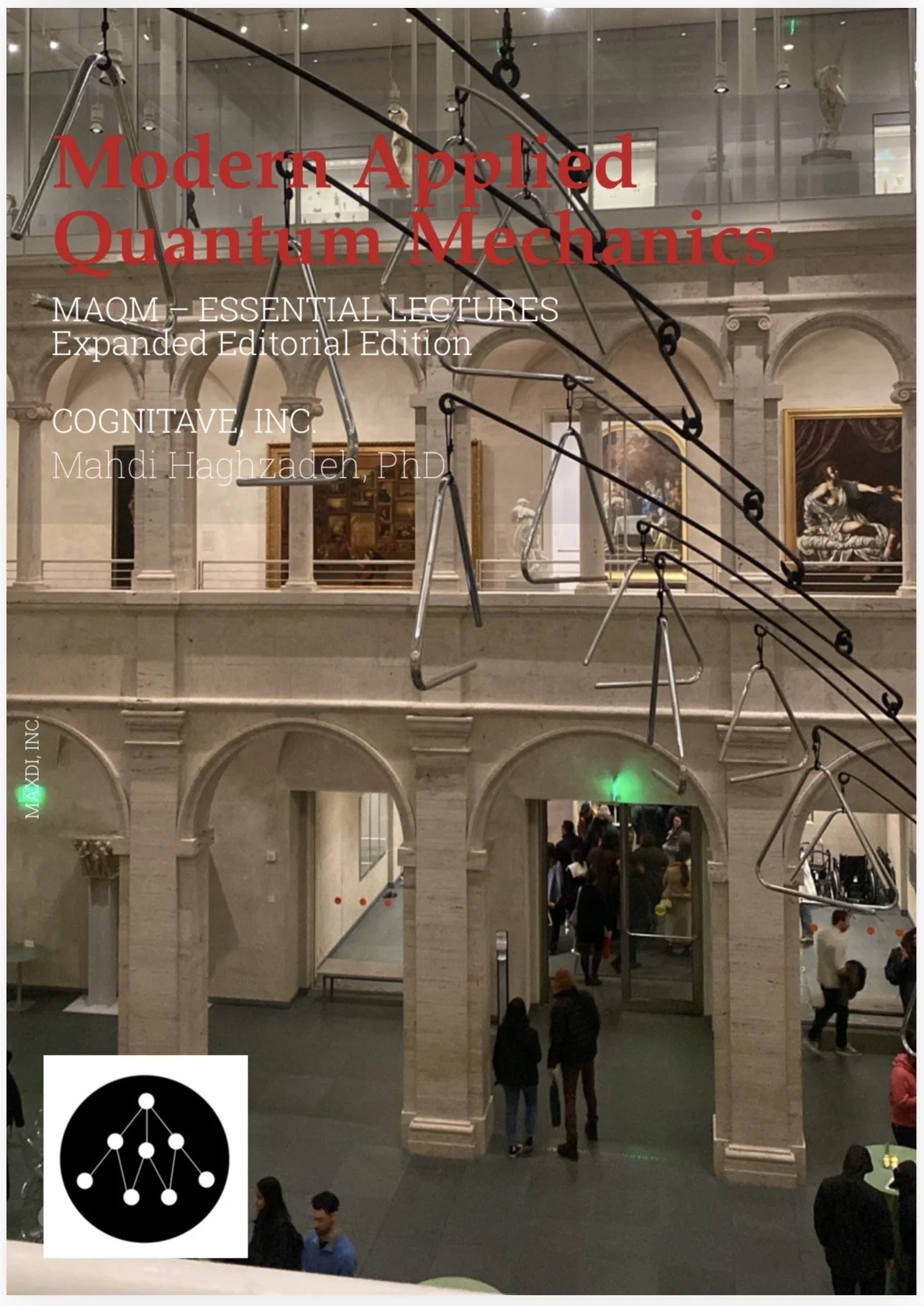
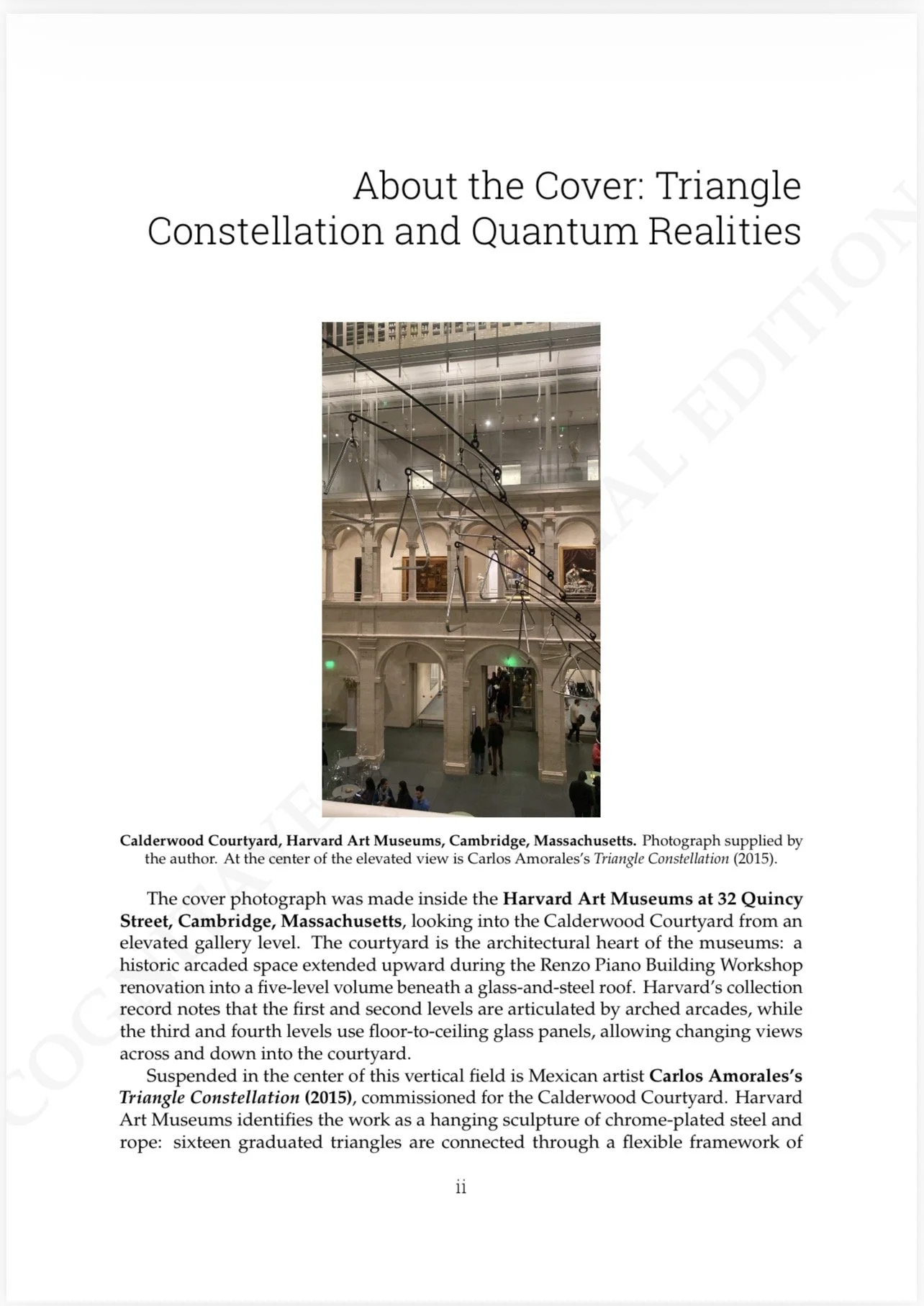
The cover establishes another unusual dimension of the edition: art as an interpretive companion to quantum theory, never as scientific evidence. The photograph was taken inside the Calderwood Courtyard of the Harvard Art Museums in Cambridge, Massachusetts. Suspended through the multi-level courtyard is Carlos Amorales’s Triangle Constellation (2015), a commissioned mobile of graduated chrome-plated steel triangles, painted steel, and rope. The Harvard Art Museums describe the work as occupying the five-level courtyard beneath the Renzo Piano Building Workshop glass roof and as creating a visual idea of sound while tying together the museum’s interior spaces.
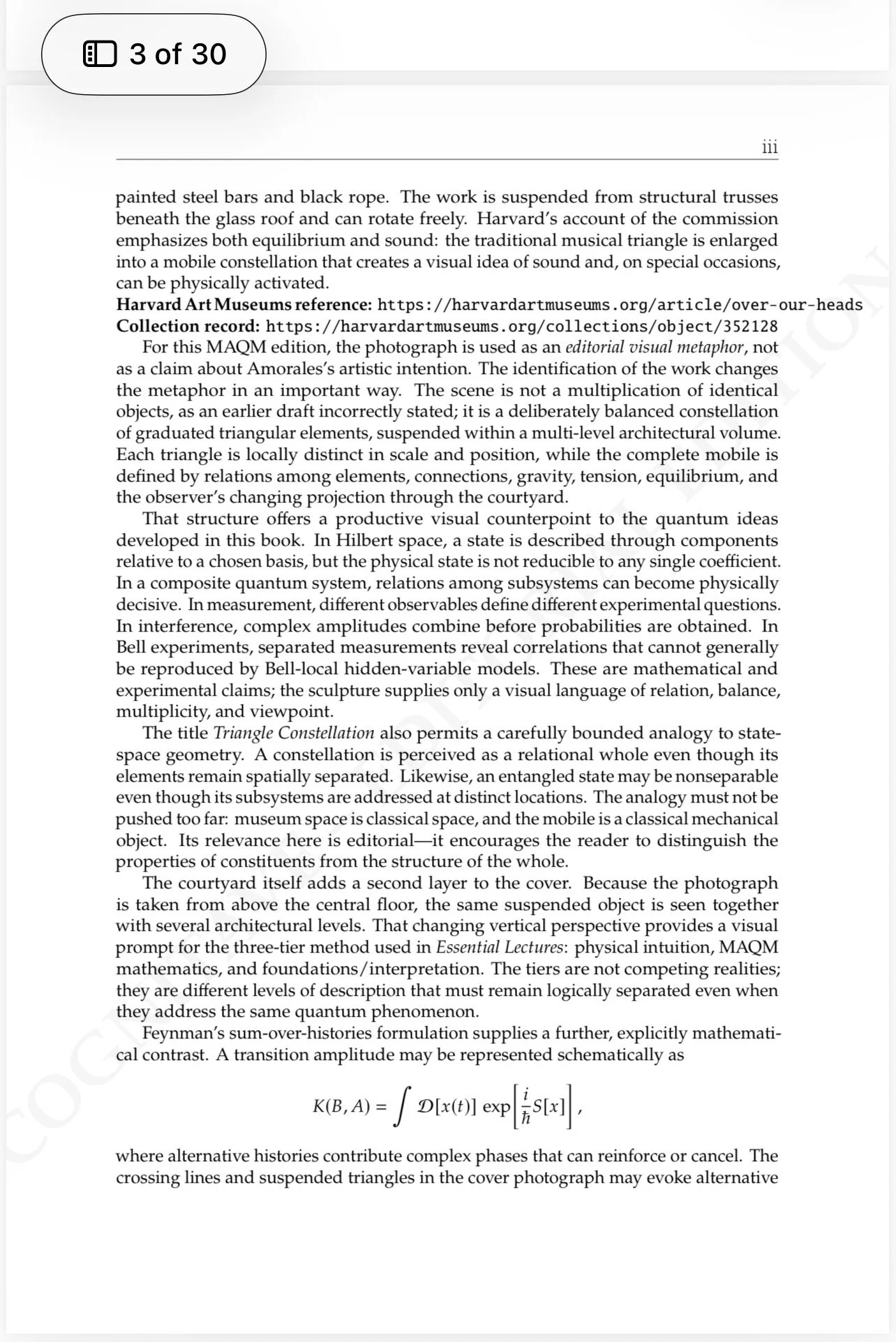
For MAQM, Triangle Constellation becomes a carefully bounded visual metaphor for relation, balance, multiplicity, projection, nonseparability, and changing viewpoint. The artwork is not presented as a representation of quantum mechanics and no quantum intention is attributed to the artist. Instead, its relational structure provides a visual counterpoint to a book concerned with states, basis projections, interference, entanglement, measurement, and the distinction between constituent properties and global structure.
This produces two parallel trajectories:
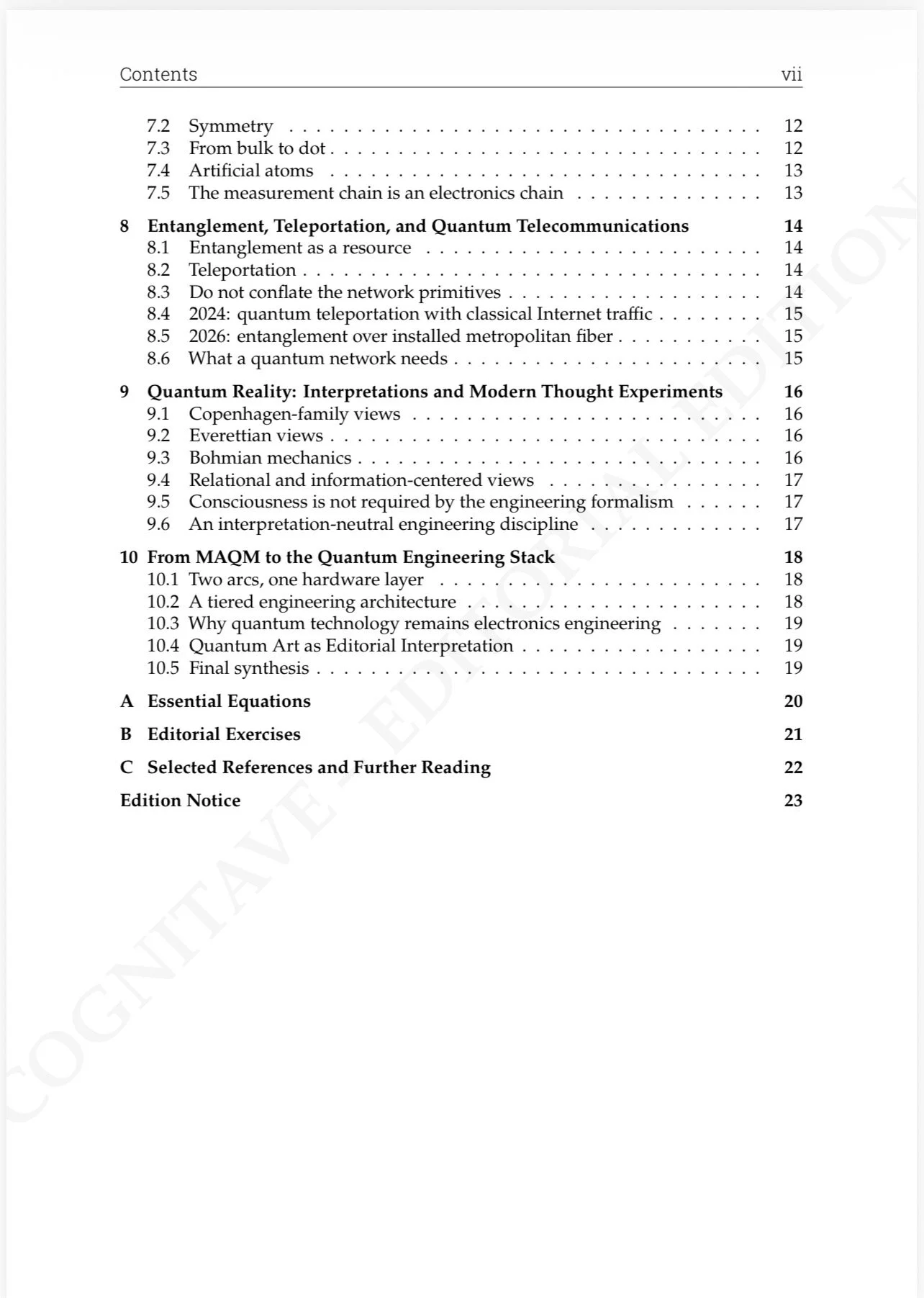
Quantum Algebra → Waves → Tunneling → Confinement → Quantum Devices
Quantum State → Measurement → EPR/Bell → Entanglement → Quantum Reality → Quantum Networks
Their intersection is quantum engineering: the point where questions about the mathematical structure of reality become requirements for semiconductor structures, photonic interfaces, control electronics, detectors, communication channels, and complete mixed quantum-classical systems.
MAQM Essential Lectures therefore occupies an uncommon position between textbook, engineering reader, foundations survey, and visual-philosophical essay. It is designed for readers who want more than a popular account of quantum “mysteries,” but who also want to see beyond formal derivation to understand why the mathematics has changed both our conception of physical reality and the technologies engineers can build.
Cover reference:
Harvard Art Museums, Calderwood Courtyard; Carlos Amorales, Triangle Constellation, 2015.
Source article: https://harvardartmuseums.org/article/over-our-heads
Collection record: https://harvardartmuseums.org/collections/object/352128
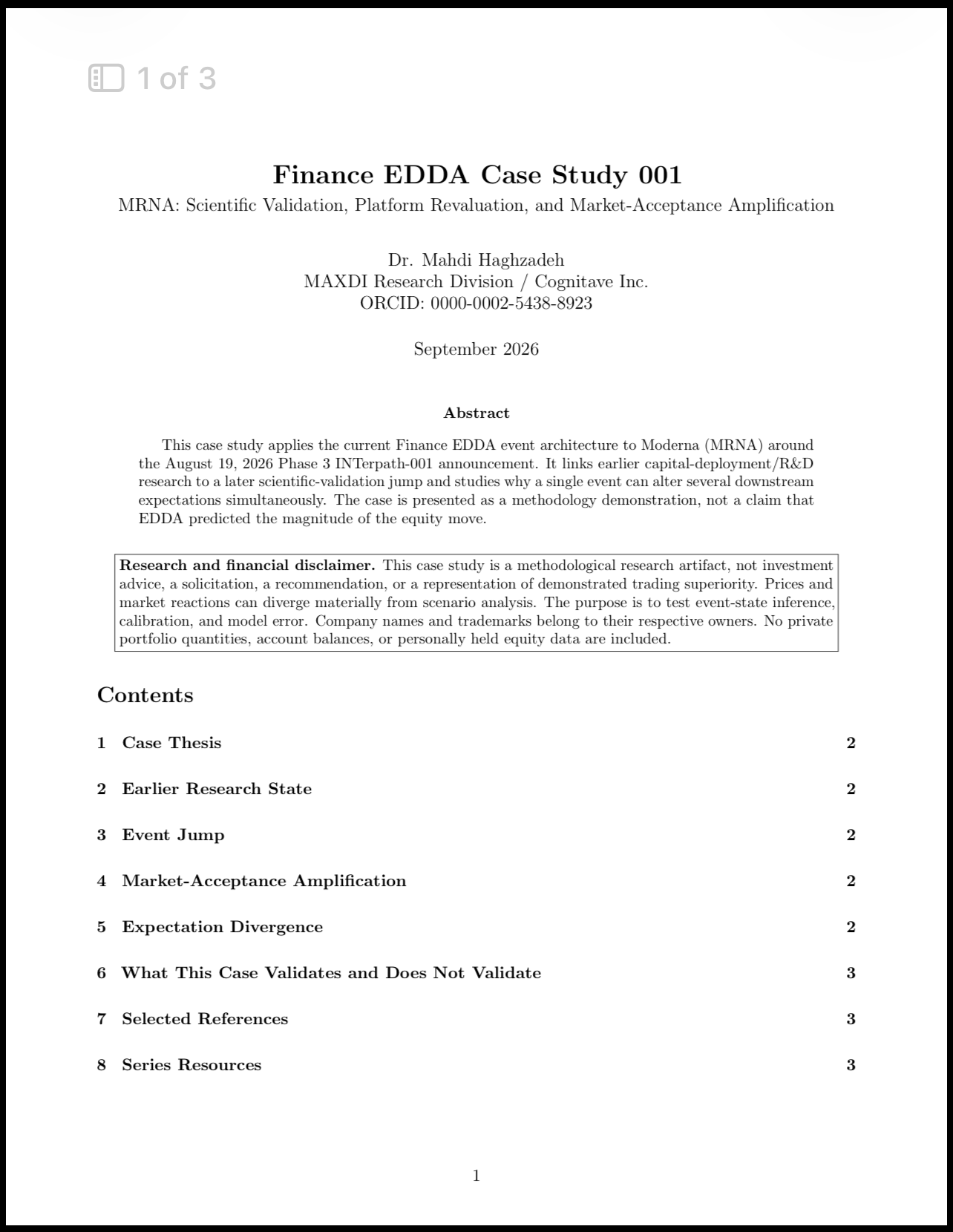
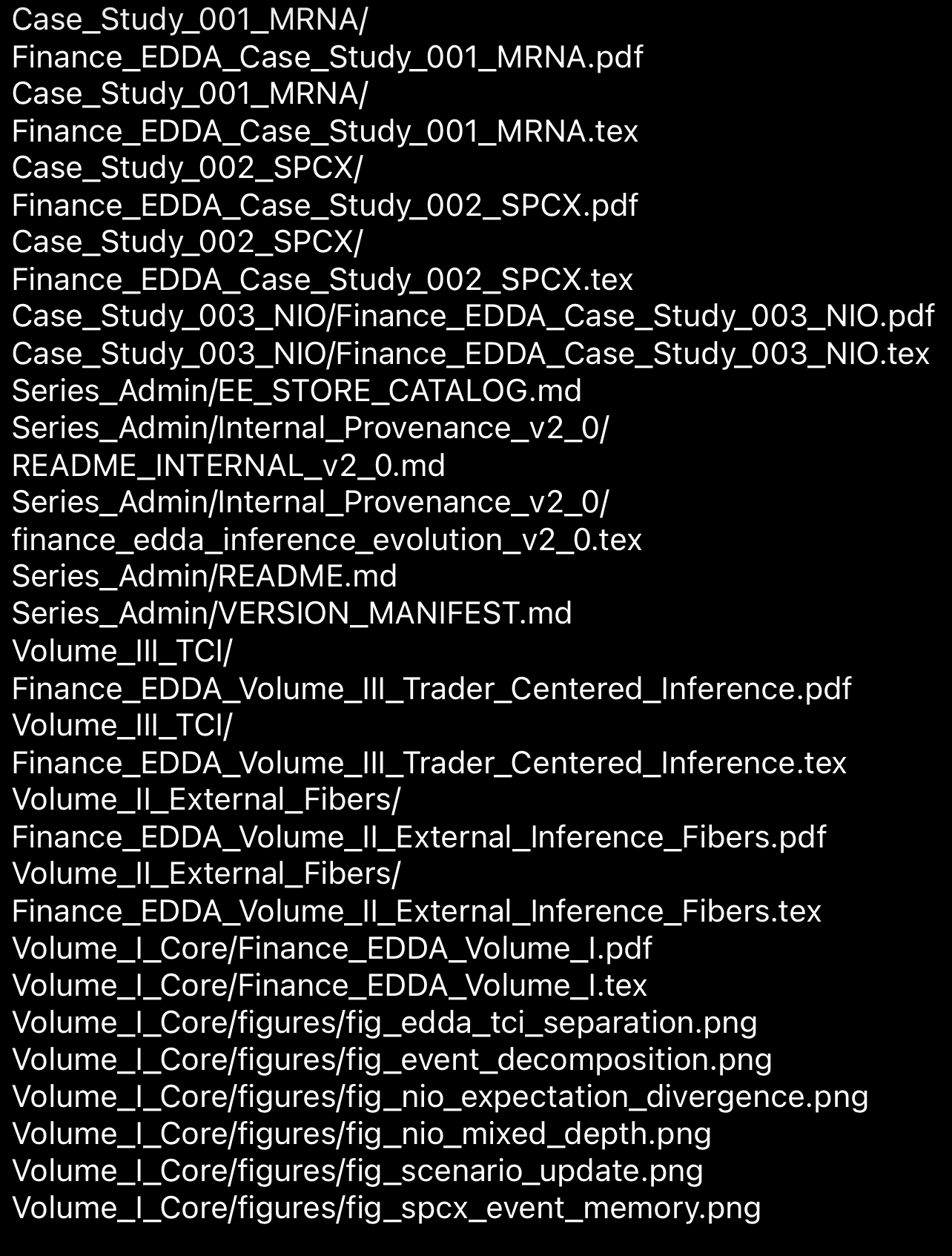
Finance EDDA Case Study 001 examines Moderna (MRNA) as an example of a scientific event entering a financial inference system and producing a discontinuous reassessment of downstream states.
The case follows the relationship between accumulated R&D expectations, unresolved clinical probability, scientific validation, commercialization implications, and subsequent market acceptance.
Rather than interpreting a large equity movement as evidence that a model successfully “predicted the stock,” the study asks a more disciplined question: what information state existed before the event, what uncertainty did the event actually resolve, and how did the market subsequently transform that resolution into price?
The case demonstrates why event magnitude and price magnitude are separate quantities and provides an applied example of the market-acceptance mechanism developed in Finance EDDA.
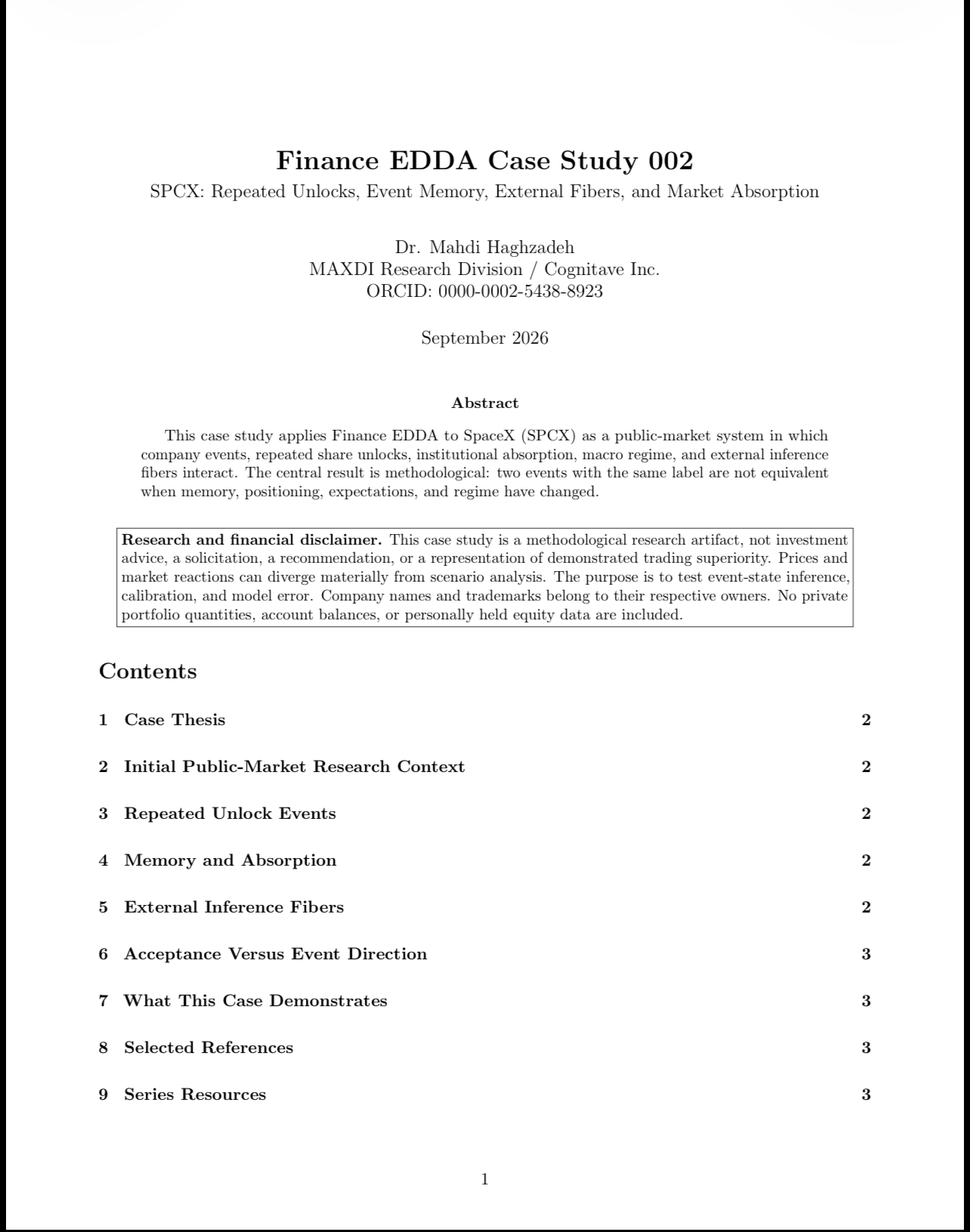
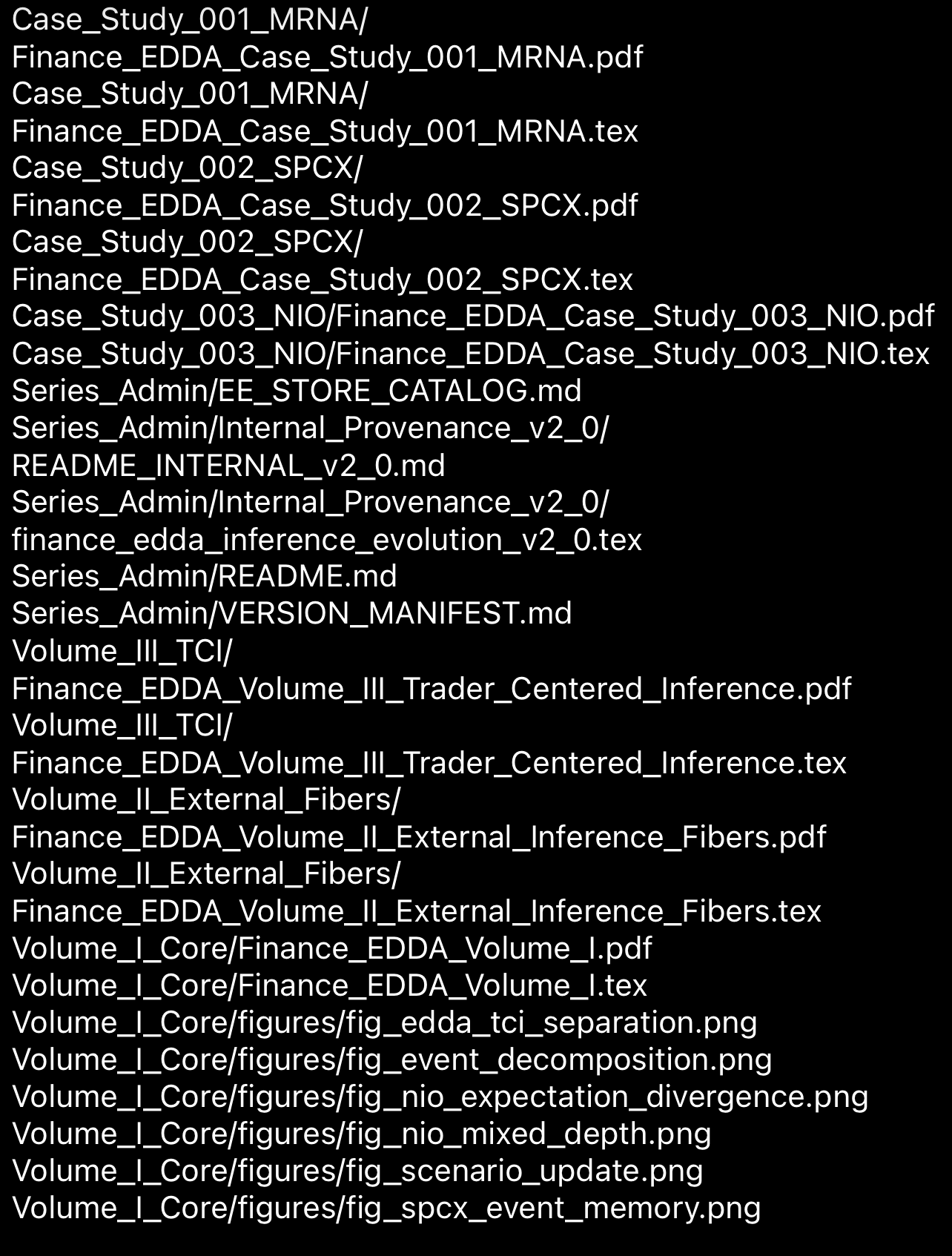
Finance EDDA Case Study 002 examines SPCX through a sequence of market events in which apparently similar catalysts do not produce equivalent price responses.
Share-unlock events provide a particularly useful experimental setting. A mechanical increase in potentially tradable supply can be identified in advance, yet its market effect depends on existing positioning, prior price evolution, demand, liquidity, event memory, macro regime, and the degree to which the event has already entered expectations.
The study uses this setting to demonstrate a central Finance EDDA proposition:
event labels are not event dynamics.
The same nominal event can enter two different system states and generate substantially different trajectories.
The case also illustrates how external inference fibers can couple geopolitical, energy, inflation, interest-rate, and growth-equity conditions into an otherwise company-specific event sequence.
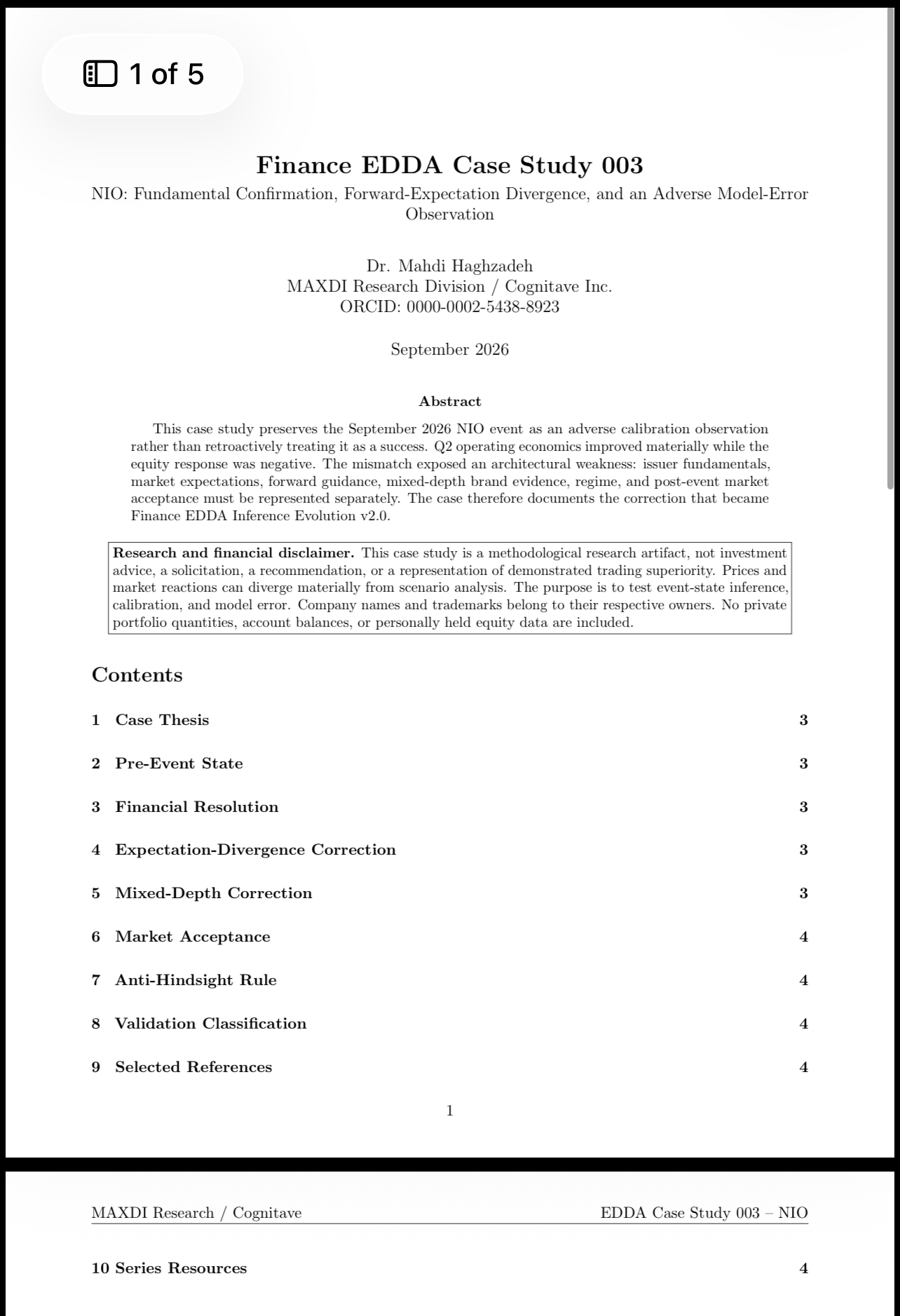
Finance EDDA Case Study 003 is deliberately presented as a model-error and calibration study rather than a retrospective success narrative.
NIO entered its September 2026 earnings event with evidence of substantial operating improvement. The subsequent financial report contained several favorable fundamental observations, while forward expectations and market response resolved considerably less favorably.
The resulting divergence exposed an important weakness in an earlier Finance EDDA decision formulation: an improving fundamental state had been given too direct a pathway toward an expected positive price state.
The case motivates several changes incorporated into the current Finance EDDA architecture: explicit expectation divergence, separate treatment of realized and forward information, mixed-depth decomposition, regime conditioning, and post-event market acceptance.
NIO therefore serves an important role in the research program—not because the framework correctly forecast every outcome, but because the discrepancy between inference and observation revealed where the framework required correction.
No results found
No results match your search. Try removing a few filters.
ENGINEERING - COMPUTATION - APPLIED RESEARCH
ENGINEERING - COMPUTATION - APPLIED RESEARCH
The complete CRE-RF I + II engineering series: twenty chapters spanning classical RF representation, electromagnetic fields, microwave networks and scattering through deformation dynamics, robustness, recoverability, stochastic RF, model fidelity, arrays, radar, EDFS execution, MXD-COGN inference and adaptive intelligent radar.
CRE-RF Complete Two-Volume Graduate Engineering Set
2 volumes · 902 publication pages · 20 chapters · Complete CRE-RF theory sequence
Volume I — Representational Foundations and the Deformed RF Object
Volume II — Deformation Dynamics, Robustness, Control and Inference
Canonical RF Theory & Training Reference for EDFS 2026 R1
COGNITAVE RF ENGINEERING
CRE-RF I + II
Complete Graduate Engineering Series
Volume I: 423 pages
Volume II: 479 pages
Volume II begins on PDF page 424
CRE-RF-II extends the deformed RF object into dynamics, event trajectories, robustness, recoverability, stochastic deformation, model fidelity, arrays, radar, graph-native EDFS execution, MXD-COGN inference and adaptive intelligent radar systems.
MODERN APPLIED QUANTUM MECHANICS (MAQM) — ESSENTIAL LECTURES
Expanded Quantum Reality & Engineering Edition
Mahdi Haghzadeh, PhD | Cognitave Inc.
MAQM Essential Lectures is not simply an abridged version of the original Modern Applied Quantum Mechanics textbook. It is an editorial reinterpretation of MAQM’s mathematical core, viewed simultaneously through engineering, quantum foundations, and the philosophy of physical reality.
The original MAQM develops an applied-physics progression from Hilbert spaces, eigenvalue problems, Hermitian operators, and Dirac notation through Schrödinger dynamics, measurement, quantum waves, special potentials, transfer matrices, tunneling, resonant structures, and multidimensional semiconductor confinement. Essential Lectures retains that technical spine but turns the reader’s angle of view: the same mathematics is used to ask what a quantum state means, why measurement context matters, what Bell experiments exclude, how interference and alternative histories differ from classical possibilities, how decoherence changes accessible observations, and how these ideas become physical devices and quantum communications infrastructure.
A distinctive three-tier reading system separates Physical Intuition, MAQM Mathematics, and Foundations & Interpretation. This allows the book to move from an equation to its experimental meaning and then to its philosophical implications without confusing those levels of description.
The expanded edition introduces EPR and Bell/CHSH correlations, contextuality, delayed-choice and quantum-eraser reasoning, Schrödinger’s cat, Wigner’s friend, decoherence, Copenhagen-family interpretations, Everettian relative states, Bohmian mechanics, entanglement, teleportation, QKD, and quantum networking. These editorial expansions are clearly distinguished from the source-derived MAQM material.
The cover establishes another unusual dimension of the edition: art as an interpretive companion to quantum theory, never as scientific evidence. The photograph was taken inside the Calderwood Courtyard of the Harvard Art Museums in Cambridge, Massachusetts. Suspended through the multi-level courtyard is Carlos Amorales’s Triangle Constellation (2015), a commissioned mobile of graduated chrome-plated steel triangles, painted steel, and rope. The Harvard Art Museums describe the work as occupying the five-level courtyard beneath the Renzo Piano Building Workshop glass roof and as creating a visual idea of sound while tying together the museum’s interior spaces.
For MAQM, Triangle Constellation becomes a carefully bounded visual metaphor for relation, balance, multiplicity, projection, nonseparability, and changing viewpoint. The artwork is not presented as a representation of quantum mechanics and no quantum intention is attributed to the artist. Instead, its relational structure provides a visual counterpoint to a book concerned with states, basis projections, interference, entanglement, measurement, and the distinction between constituent properties and global structure.
This produces two parallel trajectories:
Quantum Algebra → Waves → Tunneling → Confinement → Quantum Devices
Quantum State → Measurement → EPR/Bell → Entanglement → Quantum Reality → Quantum Networks
Their intersection is quantum engineering: the point where questions about the mathematical structure of reality become requirements for semiconductor structures, photonic interfaces, control electronics, detectors, communication channels, and complete mixed quantum-classical systems.
MAQM Essential Lectures therefore occupies an uncommon position between textbook, engineering reader, foundations survey, and visual-philosophical essay. It is designed for readers who want more than a popular account of quantum “mysteries,” but who also want to see beyond formal derivation to understand why the mathematics has changed both our conception of physical reality and the technologies engineers can build.
Cover reference:
Harvard Art Museums, Calderwood Courtyard; Carlos Amorales, Triangle Constellation, 2015.
Source article: https://harvardartmuseums.org/article/over-our-heads
Collection record: https://harvardartmuseums.org/collections/object/352128
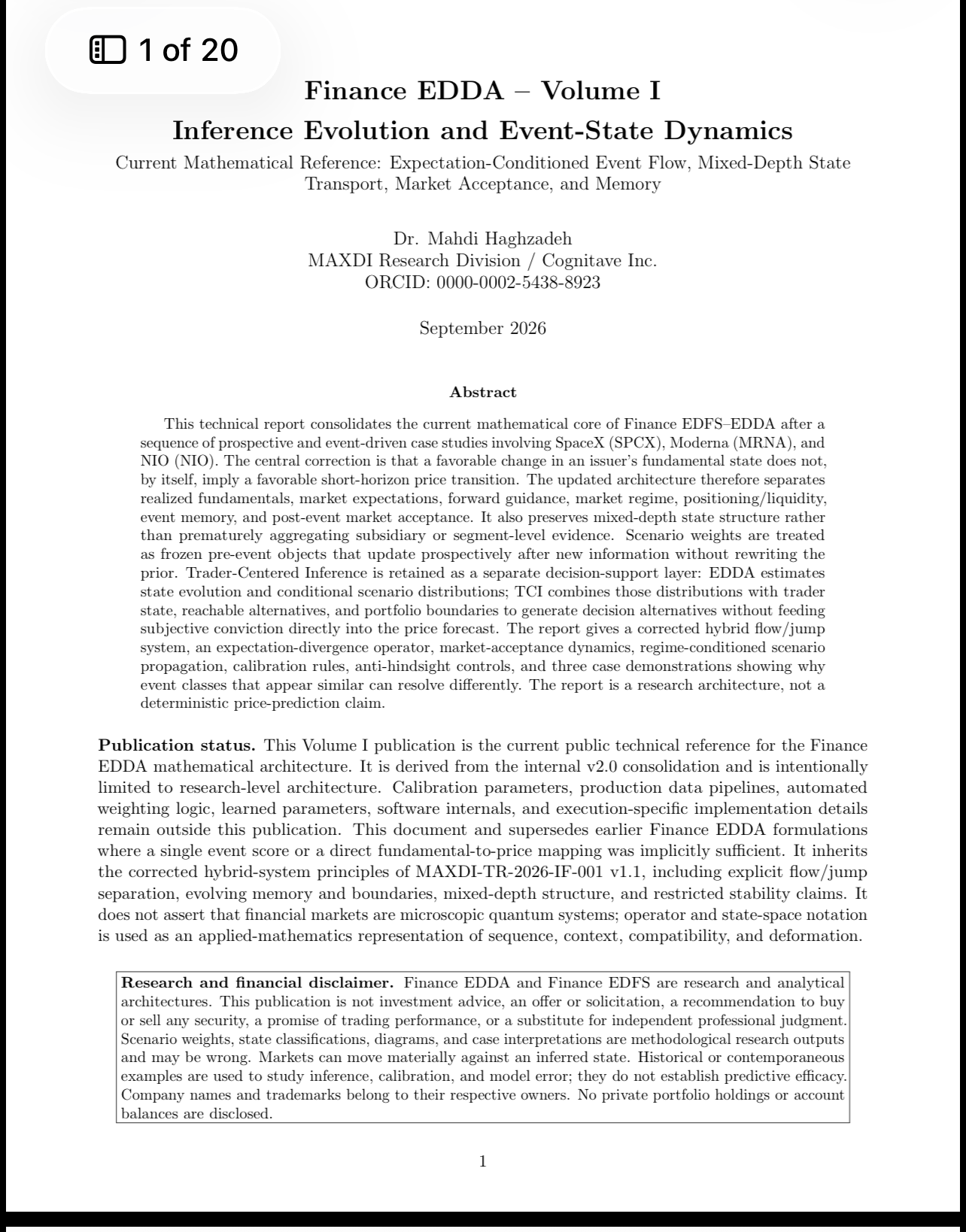
Finance EDDA: Inference Evolution and Event-State Dynamics presents the current core mathematical architecture of Finance EDDA, an event-driven inference framework developed within the MXD–COGN and EDFS research program.
The publication treats financial markets as evolving mixed-domain systems in which observed price is only one projection of a larger state. Realized fundamentals, consensus expectations, forward guidance, macroeconomic and geopolitical regime, positioning and liquidity, market acceptance, event memory, and scenario probability are represented as distinct but interacting state components.
A central contribution is the separation of fundamental improvement from market-price inference. The framework introduces explicit expectation-divergence and market-acceptance mechanisms so that favorable company results do not mechanically imply favorable price evolution.
The volume develops continuous evolution, discrete event jumps, regime-conditioned scenario updating, mixed-depth state decomposition, memory transport, and the separation between Finance EDDA inference and Trader-Centered Inference decision support.
MRNA, SPCX, and NIO are used as contrasting demonstrations of scientific-event amplification, repeated-event absorption, expectation divergence, and model-calibration error.
This publication is intended as the principal theoretical reference for the Finance EDDA Research Series. Implementation-specific calibration parameters, production algorithms, EDFS backend source code, and proprietary graph construction remain outside the publication.
Finance EDDA Case Study 002 examines SPCX through a sequence of market events in which apparently similar catalysts do not produce equivalent price responses.
Share-unlock events provide a particularly useful experimental setting. A mechanical increase in potentially tradable supply can be identified in advance, yet its market effect depends on existing positioning, prior price evolution, demand, liquidity, event memory, macro regime, and the degree to which the event has already entered expectations.
The study uses this setting to demonstrate a central Finance EDDA proposition:
event labels are not event dynamics.
The same nominal event can enter two different system states and generate substantially different trajectories.
The case also illustrates how external inference fibers can couple geopolitical, energy, inflation, interest-rate, and growth-equity conditions into an otherwise company-specific event sequence.
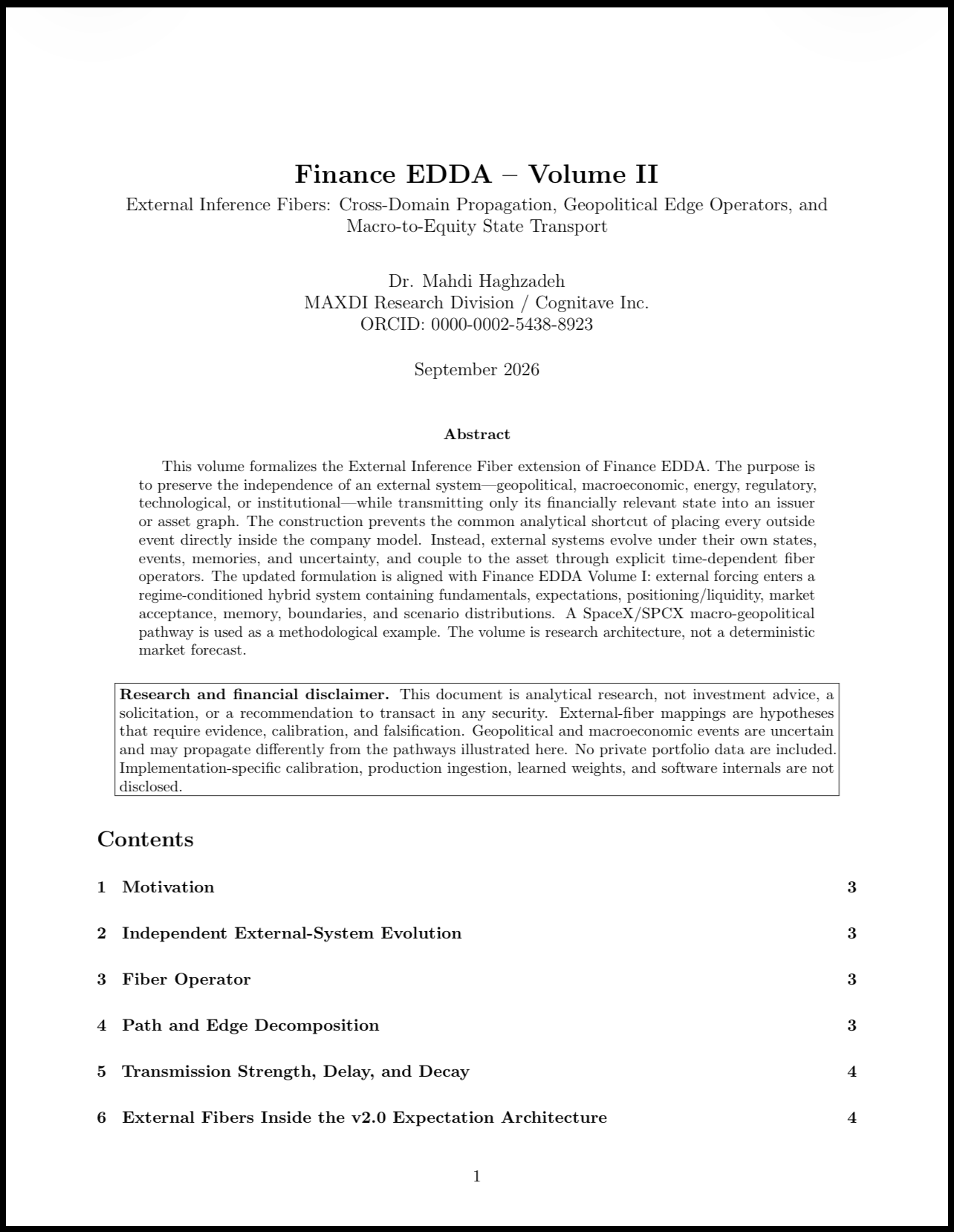
Financial assets do not evolve solely from information generated by the companies that issue them. Energy shocks, interest rates, geopolitical events, regulation, supply chains, monetary policy, technological change, and institutional behavior can enter an asset’s inference state through indirect and time-dependent pathways.
External Inference Fibers formalizes this problem within Finance EDDA.
The publication introduces external fibers as structured information pathways connecting domains that may initially appear remote from the security being analyzed. Rather than treating macroeconomic or geopolitical variables as generic background factors, the framework considers how information propagates through intermediate states before deforming expectations, discount rates, operating assumptions, positioning, and ultimately market acceptance.
An external event therefore need not map directly to price. Its influence may be delayed, amplified, attenuated, redirected, or rendered irrelevant by the state through which it travels.
The volume develops the conceptual architecture connecting external fibers to the wider MXD–COGN/EDFS inference-flow formulation and illustrates why event attribution requires preserving both domain and depth.
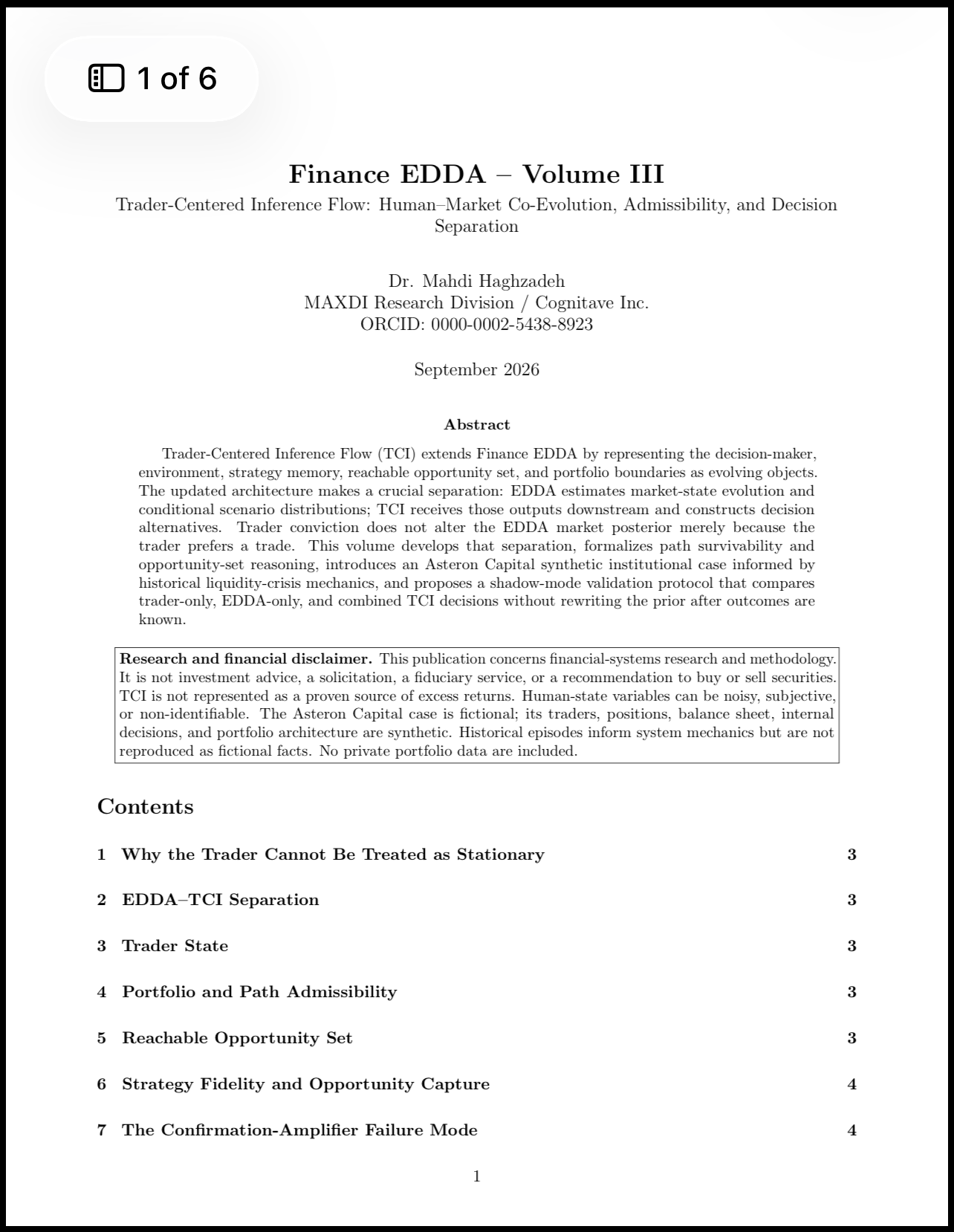
Most quantitative financial models place the decision-maker outside the system being modeled. Trader-Centered Inference Flow (TCI) investigates what changes when the trader is instead represented as an evolving participant embedded within the same information environment.
The trader carries strategy memory, conviction, uncertainty, timing sensitivity, opportunity awareness, operational constraints, and accumulated experience. Market events alter this state, while the trader’s resulting actions alter exposure to subsequent events.
TCI therefore studies the coupled relationship among market state, opportunity state, portfolio state, environment, and human decision state.
The updated formulation makes an important architectural distinction: TCI does not modify the Finance EDDA market posterior merely because a trader holds a strong belief. Finance EDDA first constructs the conditional market-state distribution. Trader state then enters a downstream decision layer in which reachable alternatives can be compared.
This separation is intended to preserve human trading information without turning conviction into a confirmation mechanism.
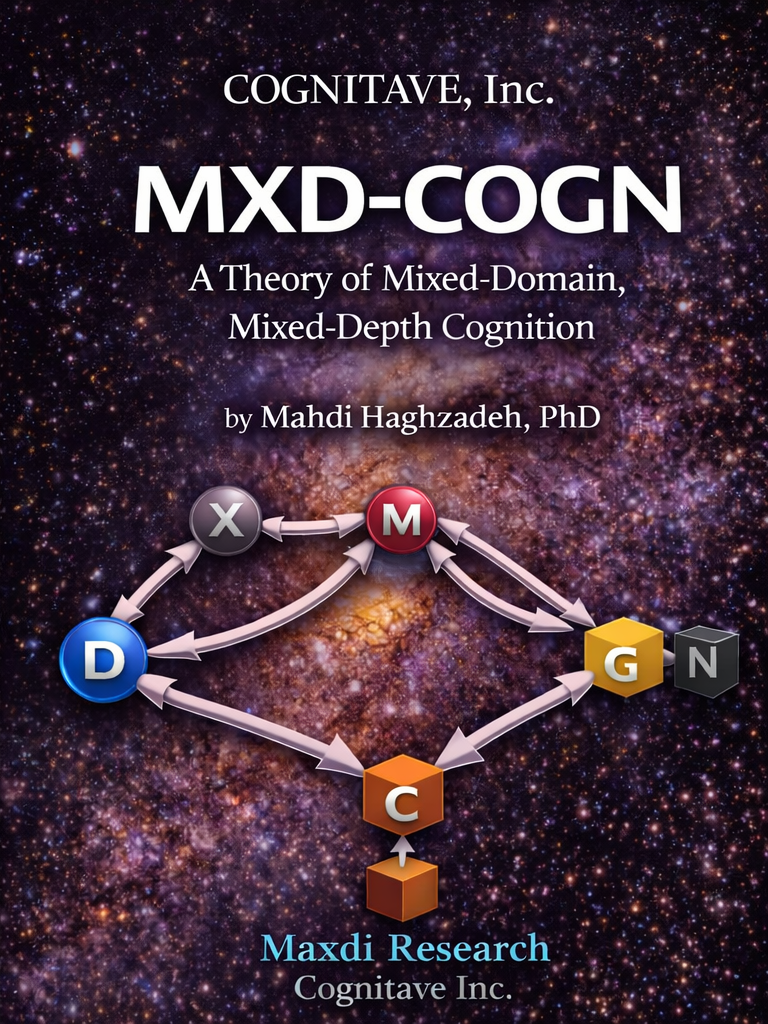
MXD-COGN: A Theory of Mixed-Domain, Mixed-Depth Cognition is the foundational reference for coherence engineering and deformation-controlled inference in complex systems. This work is not a conventional academic textbook, nor is it a software manual. It is a formal, graph-native theory of how inference executes, deforms, stabilizes, and fails across heterogeneous domains and depths of abstraction.
At its core, MXD-COGN introduces a mathematical language for treating inference as a first-class dynamical object. Systems are modeled as executable graphs governed by order parameters, deformation fields, and coherence constraints rather than isolated equations or static optimization targets. This perspective enables rigorous reasoning about stability, metastability, collapse, and early warning in systems that evolve over time, adapt to stress, and span physical, computational, and organizational layers.
The theory is intentionally domain-agnostic. It applies equally to RF and microwave systems, cyber-physical control architectures, artificial intelligence, socio-technical organizations, and large-scale engineered infrastructures. By unifying these domains under a shared inference geometry, MXD-COGN provides a stable foundation for analyzing systems that cannot be adequately described by classical control, linear stability, or isolated simulation alone.
Cogn-Tex™: A Theoretical Processing Design Kit
MXD-COGN functions as what Maxdi Inc. designates Cogn-Tex™—a theoretical processing design kit for inference and coherence. In the same way that a semiconductor PDK defines design rules, constraints, and interfaces for physical fabrication, Cogn-Tex™ defines the mathematical structures, invariants, and execution semantics required to reason about inference under deformation.
Cogn-Tex™ enables engineers, researchers, and institutions to encode systems into formal inference graphs, evaluate coherence margins, reason about deformation envelopes, and predict failure modes before collapse occurs. While the theory itself is fully specified in this text, its value compounds when paired with internal tools, simulation engines, or large language models capable of operating within the MXD-COGN framework.
This deliberate openness is not a loss of intellectual property; it is the foundation of it. By publishing the canonical theory, Maxdi Inc. establishes the reference standard upon which certified tools, execution engines, and institutional practices can be built.
Scope and Intent
MXD-COGN is written for advanced practitioners: researchers, system architects, and organizations confronting the limits of traditional modeling and control. It is not designed as an introductory survey or a tutorial series. Instead, it provides a closed, internally consistent theoretical framework intended to be cited, extended, and operationalized through companion platforms and certified implementations.
The book concludes at the level of theory. Questions of execution platforms, software engines, certification workflows, and deployment practices are intentionally treated as out-of-scope here and are addressed through separate products and services offered by Maxdi Inc.
In publishing MXD-COGN, Maxdi Inc. releases the mathematical foundation of coherence engineering while retaining the ability to deliver value through execution, certification, and institutional enablement. This text is the reference point from which all MXD-COGN-compliant systems derive legitimacy.
Pricing and Access
MXD-COGN is offered under an institutional access model, reflecting its role as a foundational theory and processing design kit (Cogn-Tex™) rather than a conventional retail textbook.
Institutional License (Primary Offering)
Institutions—including universities, research laboratories, defense organizations, and corporate R&D groups—may license MXD-COGN for internal research, teaching, and architectural development.
Institutional Access Fee:
USD $2,500 per year
Includes:
Full digital access to MXD-COGN: A Theory of Mixed-Domain, Mixed-Depth Cognition
Internal institutional use for research and instruction
Eligibility for MXD-COGN–aligned tooling, certification, and execution platforms
This model ensures that MXD-COGN remains a stable, authoritative reference while enabling institutions to build compliant systems and curricula on top of the theory.
Individual Researchers and Enterprise Access
Individual researchers, independent scholars, and commercial enterprises seeking direct access or broader usage rights should contact Maxdi Inc. to discuss appropriate licensing and enablement options.
📧 Contact: tex@cognitave.com
Enterprise engagements may include:
Extended usage rights
Integration with execution engines and design tools
Certification pathways and technical onboarding
Pricing for these engagements is determined based on scope, scale, and intended application.
MAQM — Modern Applied Quantum Mechanics is best understood but as an engineering distillation of quantum mechanics from operator algebra toward semiconductor-scale device analysis. Its distinguishing feature is the sequence it establishes: abstract Hilbert-space mathematics is introduced first, translated into matrix, wave-function, and Dirac representations, and then progressively converted into calculational machinery for confinement, tunneling, periodic structures, resonant transport, quantum wells, and ultimately three-dimensional semiconductor quantum structures. The uploaded volume contains seven substantive chapters, despite the cover identifying the edition as “Part I, Chapters 1 to 6.”
The editorial logic of the book can therefore be summarized as:
quantum algebra → operators and states → Schrödinger dynamics → quantum waves → canonical potentials → transfer matrices and tunneling → multidimensional confinement → semiconductor quantum structures.
That progression is particularly relevant to electrical and microelectronics engineering because it does not leave quantum mechanics at the level of philosophical postulates. It develops the mathematical objects that eventually become the working variables of nanoscale device models.
Chapter 1 — Hilbert Space and Algebra of Operators
The opening lecture establishes the mathematical language on which everything else depends. Eigenvalue problems are developed in matrix space, function space, and Bra–Ket space, making explicit the equivalence between Heisenberg matrix mechanics, Schrödinger wave mechanics, and Dirac’s abstract formulation. Hermitian matrices and operators, real eigenvalues, eigenvectors, eigenfunctions, orthogonality, normalization, degeneracy, inner products, Kets, Bras, operator action, identity and null operators, and eigenstates are developed systematically.
This is the first important engineering distillation in MAQM. A semiconductor device ultimately presents an eigenproblem: given material properties, geometry, interfaces, boundary conditions and a Hamiltonian, what electronic states and allowed energies can exist? Chapter 1 builds precisely the algebra required to formulate that question. The book explicitly constructs one-to-one correspondences between matrix, function and Ket-space descriptions rather than treating them as unrelated mathematical conventions.
MAQM-m4-KNj3.pdf
Chapter 2 — The Principles of Quantum Mechanics
Having established the algebra, Chapter 2 turns it into dynamics. The lectures cover evolution equations, Poisson commutators, dual relations in bracket space, and identities/unity relations.
MAQM-m4-KNj3.pdf
The importance of this chapter is that operators cease to be static mathematical definitions. Commutation structure determines how observables relate, while evolution equations establish how quantum states change. This creates the bridge from linear algebra to physical dynamics—the prerequisite for understanding how electronic states respond to Hamiltonians, potentials and other governing parameters.
For an engineering reader, Chapters 1 and 2 together form a compact quantum algebra toolkit. They supply the state space, operators, basis transformations, commutators and evolution machinery that later reappear in concrete device calculations.
Chapter 3 — Schrödinger Equation
Chapter 3 brings the preceding algebra into the central governing equation of nonrelativistic quantum mechanics. The chapter develops the Schrödinger equation in Bra–Ket space and then treats quantum measurement, uncertainty relations, time-independent solutions, time-dependent solutions, and energy eigenstates.
An especially useful feature is the comparison among abstract bracket-space, spatial-function and momentum representations of the Hamiltonian. The manuscript emphasizes that these mathematical representations look different while describing the same physical quantum system.
This is the point at which MAQM becomes directly recognizable as a device-physics foundation. In microelectronics, the Schrödinger equation becomes the computational engine from which one obtains confined states, subband energies and wavefunctions. Geometry and materials enter through the potential and effective Hamiltonian; device behavior emerges through their eigenstates.
Chapter 4 — Quantum Wave
The fourth lecture gives physical and mathematical content to the wavefunction. It treats the free particle, wave envelope/wave packet, and probability density, followed by a substantial problem set.
This chapter is more consequential for engineering than the simple title “Quantum Wave” suggests. Wave packets introduce dispersion and localization; probability density converts an abstract state into a spatially interpretable electronic distribution; and the exercises extend the discussion toward probability flux, refraction and reflection of matter waves, energy expectation and energy-state density.
Those concepts later become recognizable semiconductor quantities: carrier confinement, probability current, reflection/transmission at interfaces, dispersion relations and density of states.
Chapter 5 — Special Problems
Chapter 5 moves decisively from foundations into solvable physical models. It studies even-symmetry potentials, the Pöschl–Teller potential, Dirac potential, hydrogen molecular ion, harmonic oscillator and periodic problems. The harmonic oscillator is deliberately examined in Bra–Ket, momentum and function-space representations and extended to three dimensions.
Editorially, this chapter serves as the book’s laboratory. Instead of introducing new formalism for its own sake, it demonstrates how the formalism behaves under representative potential landscapes. Symmetry reduces complexity; exact potentials teach boundary behavior; the oscillator establishes quantized spectra and ladder-like energy structure; and periodicity anticipates crystalline solids.
For semiconductor engineering, this chapter develops the intuition needed to recognize that different physical structures are fundamentally different potential-energy landscapes posed to the same quantum machinery.
Chapter 6 — General One-Dimensional Problems
Chapter 6 is arguably the strongest bridge between MAQM’s quantum algebra and practical nano/microelectronic analysis. It develops analytical approximations, Wilson–Bohr–Sommerfeld quantization, optimized solutions, transfer matrices, transitions through boundaries, wave reflection and transmission, consecutive interfaces, tunneling, symmetric square wells, resonant tunneling, Dirac transfer matrices, periodic potentials, finite periodicity, the Dirac crystal and the differential transfer matrix.
This is recognizably an engineering toolkit. A heterostructure can be represented as a sequence of regions possessing different potentials and material parameters. Instead of solving the entire structure from scratch, interfaces and propagation regions can be represented by matrices and cascaded. Transmission and reflection then become calculable properties of the assembled structure.
That machinery leads naturally to quantum wells, barriers, superlattices and resonant-tunneling structures. Tunneling is therefore not presented merely as the familiar paradox of a particle crossing a classically forbidden barrier; it becomes a quantitatively exploitable transport mechanism. Periodic potentials then extend the same reasoning toward crystal and artificial-lattice structures.
Chapter 7 — Multidimensional Problems
The final chapter expands the one-dimensional machinery into realistic confinement geometries. It introduces the variational method, separable potentials, potential boxes, axial symmetry, angular momentum, cylindrical quantum points/dots, radial symmetry, rotational momentum, spherical oscillators, boundary conditions, the three-dimensional harmonic oscillator, the hydrogen atom and radial momentum.
Here the semiconductor-device destination of the preceding mathematics becomes explicit. In the section on the cylindrical quantum structure, the text considers electrons and holes confined in three dimensions. It describes a narrow semiconductor cylinder such as GaAs, laterally confined by the surrounding potential and vertically bounded by a larger-bandgap semiconductor such as AlGaAs, producing a zero-dimensional quantum dot.
This is an important culmination of the book. Hilbert spaces and eigenvectors introduced in Chapter 1 have now become confined carrier states inside an engineered semiconductor geometry. Eigenvalues have become allowable device energies. Boundary conditions have become semiconductor interfaces. Probability functions describe where carriers reside. Transfer matrices describe propagation through layered structures. Tunneling becomes a transport mechanism. Symmetry determines solvability and degeneracy. Three-dimensional confinement produces quantum dots.
The central accomplishment of Modern Applied Quantum Mechanics is therefore its compression of the conceptual distance between quantum algebra and electronic-device physics.
Rather than organizing quantum mechanics as a sequence of historical discoveries, MAQM organizes much of the subject as a chain of mathematical abstractions that become progressively more operational:
Hilbert space supplies the state space.
Operator algebra supplies measurable quantities.
Eigenproblems supply allowable states and values.
The Hamiltonian encodes the physical system.
The Schrödinger equation supplies its dynamics.
Wavefunctions supply spatial representation.
Probability density and flux supply physical interpretation.
Boundary conditions encode fabricated structures and interfaces.
Transfer matrices make multilayer structures computationally tractable.
Tunneling and resonance introduce nanoscale transport.
Periodic potentials lead toward crystalline and engineered periodic media.
Multidimensional confinement leads finally to quantum wells and quantum-dot-type semiconductor structures.
That is what is distilled in these lectures: the algebra of quantum mechanics is progressively converted into an engineering language for designing and analyzing matter at electronic and semiconductor dimensions.
Modernapplied quantum-mechanics bridge between mathematical operator theory and micro/nanoelectronic device physics. Its value lies in showing why the abstract mathematics matters: the Ket eventually represents an electronic state; the operator becomes a physical observable; the eigenvalue becomes an allowed energy; the potential becomes a device structure; and the boundary-value problem becomes the mathematical representation of an engineered semiconductor.
That gives MAQM a much clearer identity within the Cognitave engineering curriculum: quantum algebra distilled into calculational methods for electronic states, waves, barriers, tunneling, periodic structures and semiconductor confinement.
Modern Applied QM (MAQM) mathematics and numerical tools presented in this technical Cognitave ee-store publication are applied in consumer electronics, telecommunications and aerospace industries to solve design and engineering problems in telecommunications or for environmental threats mitigation and counter measures.
Access related on-demand EE course at:

Technology Report - Microelectronics Design Automation w/ License-based & OpenSource CAD
1.99 USD DIGITAL DOWNLOAD TEX-CAD-EDA
a Technology Report presented by Cognitave Inc Department of Electronics
#EDA #MICROELECTRONICS
Mahdi Haghzadeh, PhD
Electronics Department
Cognitave Inc
Keywords: Numerical Computing, Circuit & EM Simulations, RF/MW Integrated Systems
Abstract
This Technological Report presents to microelectronics design engineering professionals in semiconductor and electronics industries latest modern design-workflow tools for simulation, modeling and fabrication.
A complete set of computer-aided micro-electronics design automation (MEDA) tools presented in this technological report that are available open source without paid-for licenses or tokens. The tools are considered industry open-source standards and used across the globe for design, modeling, manufacturing and testing of electronic and computing devices that go into medium to ultra-high complexity systems in consumer electronics, warfare defense and aerospace industries.
Access related on-demand EE course at:

eBooklet - Radar for Advanced Vehicular Systems - RAVS
14.99 USD DIGITAL DOWNLOAD RAVS
a Booklet download entitle above (RAVS) in "*.pdf" format is available to download upon purchase of a token that will be sent to you e-mail inbox.
#RadarSignalProcessing #RSP #RADAR #LIDAR #Automotive #ADAS #OEM #TIER1 #SensorFusion
Mahdi Haghzadeh, PhD
Electronics Department
Cognitave Inc
Keywords: Radar Signal Processing (RSP), FMCW, Tracking, RF/MW Integrated Systems
Abstract
Radar for Advanced Vehicular Systems (RAVS) is a short technical manual on RADAR (Radio Frequency Detection and Ranging) technology used in modern ADAS (Advanced Driver Assistance Systems) and autonomous, driver-less vehicles (cars and drones) under development globally. This manual reviews main Radar sensing techniques and analysis that enable detection and tracking of targets in the front and proximity of a vehicle equipped with this sensor.
An online EE course, Advanced Radar for Autonomous Driving (ARAD), is available for in-depth development of topics and techniques on ADAS, Sensor Fusion, and advanced signal processing algorithms utilizing machine learning and AI.
Access related on-demand EE course at:
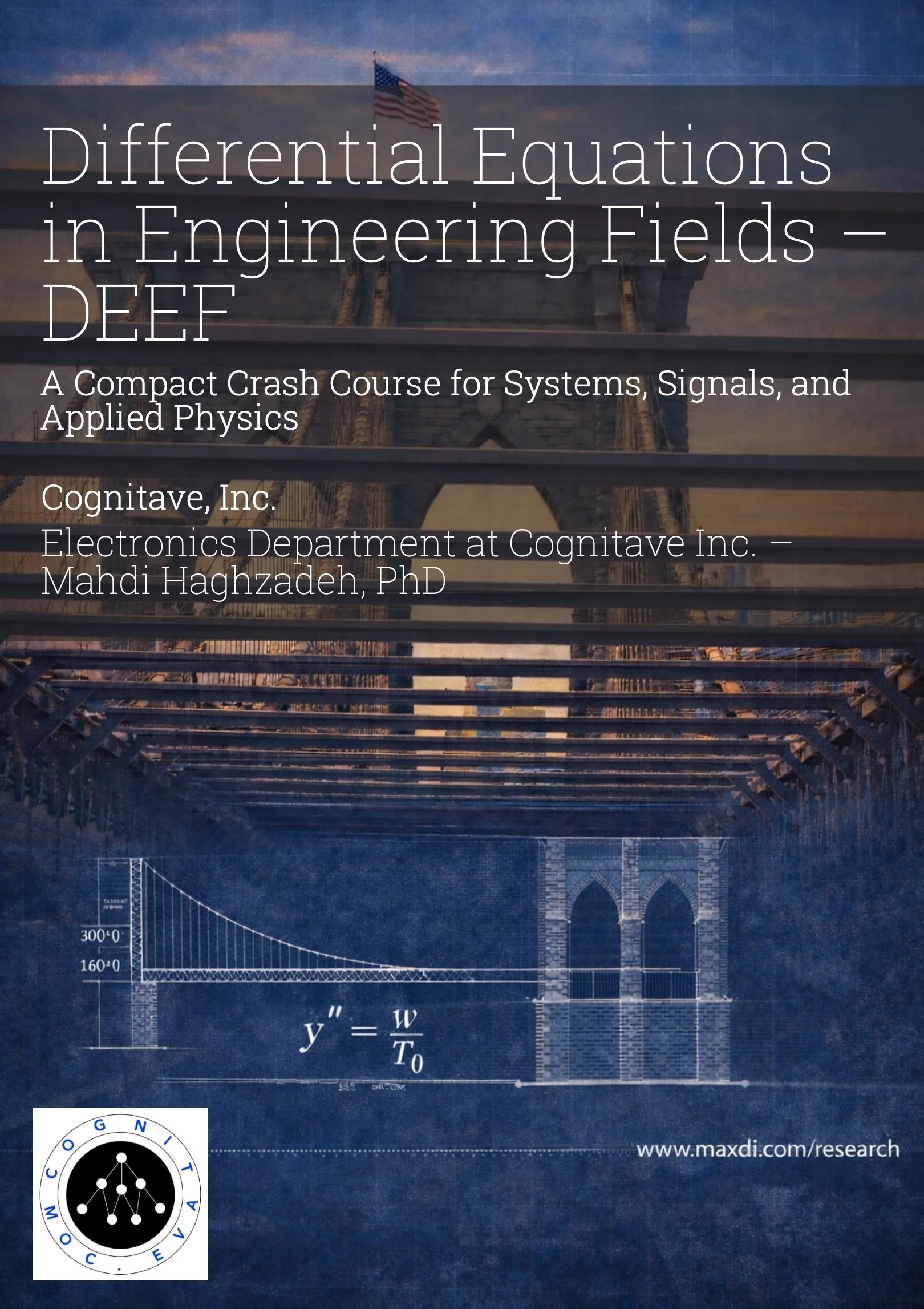
Differential Equations in Engineering Fields is a compact, intensive crash-course ebook designed to cover the core ordinary differential equations (ODE) material taught across engineering disciplines, with emphasis on how these equations are actually used in advanced engineering contexts.
This book originated from a series of accelerated courses taught by Mahdi Haghzadeh between 2008 and 2010 to undergraduate engineering students preparing for graduate-level entrance examinations. The objective of those courses was not breadth, but efficiency: to equip students with the essential differential-equation tools required to succeed in advanced engineering topics within a limited timeframe.
As a result, the ebook focuses on the standard ODE curriculum common to electrical engineering, computer engineering, computer science, and related fields, while consistently framing the material in terms of engineering systems and physical interpretation.
The book develops a streamlined progression through first- and higher-order ordinary differential equations, linear systems with constant coefficients, and homogeneous and non-homogeneous formulations. Responses to impulse, step, and exponential inputs are treated as central modeling cases rather than peripheral examples. Laplace-transform-based methods are introduced early and used systematically as the most effective framework for solving initial-value problems and analyzing system response.
What distinguishes this crash course is its engineering orientation. Solutions are not presented as purely mathematical results; they are interpreted in the context of real systems such as resonant circuits, RF and microwave structures, control systems, and simplified models arising in applied quantum mechanics. The focus is on understanding how differential equations encode dynamics, stability, and transient behavior.
Worked examples are developed fully and concisely, reflecting the pace and structure of an intensive course. In addition, a selected set of original Konkoor problems from the 2008 examination cycle is solved in detail, illustrating how standard ODE techniques are tested in advanced engineering assessments.
This ebook is intended as a rapid yet rigorous reference for students and engineers who already possess basic calculus and linear algebra, and who need a focused review of differential equations as they appear in higher-level engineering applications.
Core Topics Covered
The material develops a coherent progression through:
first- and higher-order ordinary differential equations
linear systems with constant coefficients
homogeneous and non-homogeneous equations
impulse, step, and exponential inputs
Laplace-transform-based solution methods
initial-value problems and system response
engineering interpretation of solutions
Worked examples are fully developed, and problem sets are aligned with advanced engineering expectations.
Key Features
System-driven approach to differential equations
Transform methods integrated naturally into solution workflows
Emphasis on physical and engineering interpretation
Fully worked examples and solved problem sets
Consistent notation and mathematical typography
Designed for advanced undergraduate and graduate ECE
Format
Digital textbook (PDF)
High-resolution mathematical typesetting
Optimized for screen reading and printing
Pricing
Digital Edition (PDF):
💲 $11.99 USD
Academic and institutional licensing available upon request.
Intended Audience
Electrical and computer engineering students
Graduate-level engineering candidates
Practicing engineers working with dynamic systems
Researchers seeking a compact, rigorous ODE reference
About the Author
Mahdi Haghzadeh, PhD, is an engineer and researcher at Maxdi Research, working on mathematical systems theory, signal analysis, and advanced computational methods for engineering and physics.
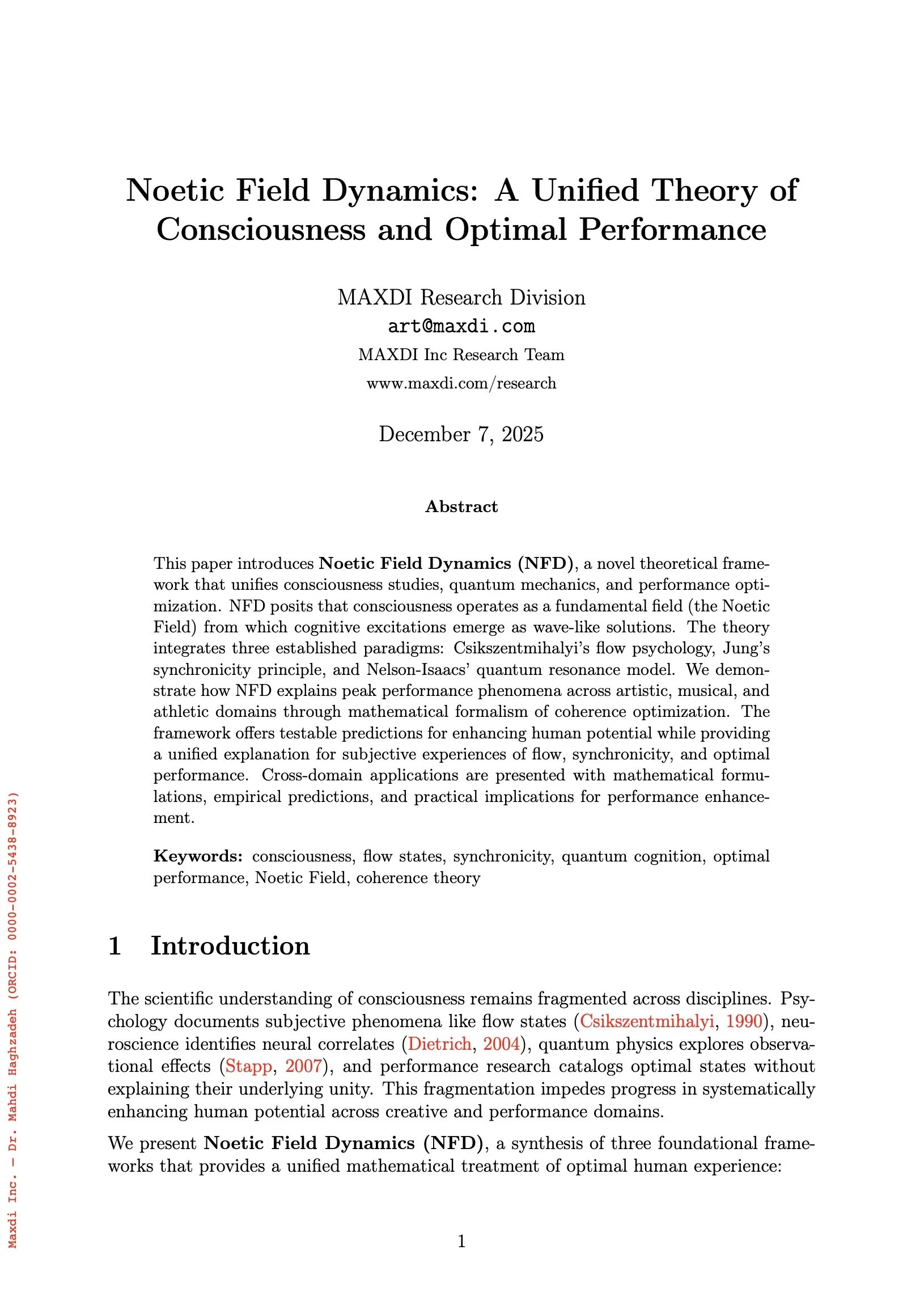
This paper introduces \textbf{Noetic Field Dynamics (NFD)}, a novel theoretical framework that unifies consciousness studies, quantum mechanics, and performance optimization. NFD posits that consciousness operates as a fundamental field (the Noetic Field) from which cognitive excitations emerge as wave-like solutions. The theory integrates three established paradigms: Csikszentmihalyi's flow psychology, Jung's synchronicity principle, and Nelson-Isaacs' quantum resonance model. We demonstrate how NFD explains peak performance phenomena across artistic, musical, and athletic domains through mathematical formalism of coherence optimization. The framework offers testable predictions for enhancing human potential while providing a unified explanation for subjective experiences of flow, synchronicity, and optimal performance. Cross-domain applications are presented with mathematical formulations, empirical predictions, and practical implications for performance enhancement.

Technology Report - Linear ODEs by DTMM for 3D Numerical Modeling in RF/MW Design and Simulation
4.99 USD DIGITAL DOWNLOAD LODE-DTMM
a Technology Report downloadable entitled (LODE-DTMM) in "*.pdf" format is available to download upon purchase of a token that will be sent to your e-mail inbox.
#NumericalProgramming #SignalProcessing #RadarSystems#Electronics #NumericalSimulations #AppliedMathematics
Mahdi Haghzadeh, PhD
Electronics Department
Cognitave Inc
Keywords: Numerical programming, numerical Simulations and Modeling, Integrated Systems, Analysis and Applied Mathematics
Abstract
Linear ODE-DTM special topic presented in Advanced Radar for Autonomous Driving (ARAD) is a technical ee-course in the field of Autonomous Driving and Sensor Fusion of signals and data in-flow from sensing and control modules OEMs deploy in autonomous and semiautonomous systems.
Access this related on-demand EE course here at:

Technology Report - Third Generation Organic and Cost Effective Solar Cells
4.99 USD DIGITAL DOWNLOAD PV-DSSC
a Technology Report downloadable entitled (DSSC-PV) in "*.pdf" format is available to download upon purchase of a token that will be sent to your e-mail inbox.
#SolarCells #Photovoltaic #Silicon #SolidStatePhysics #Electronics #RenewableEnergy #Electricity #Sustainability
Mahdi Haghzadeh, PhD
Electronics Department
Cognitave Inc
Keywords: Solar Cells, Renewable Energy, Solid State Physics, Thin Film, Organic Electronics, Dye Sensitized Solar Cells, Concentrators, Printed Electronics
Abstract
This technology report was first presented at Electrical School of Engineering at Sharif University of Technology on latest technological advancement made in development and fabrication of third generation solar cells, namely Organic Photovoltaic (PV). First generation is inorganic, single junction silicon based solar cells that reach 14—19 percent conversion efficiency for single- and multi-crystal silicon. The payback is 3.5—7 years. Second generation is based on thin film technology that yields 7—11 percent efficiency. The payback is less than a year due to inexpensive development and fabrication costs. The drawback is use of environmentally hazardous material. Third generation is organic thin film technology that can reach up to 30 percent efficiency for multi-junction cells. In this category Dye Sensitized Solar Cells are gaining popularity with a promise to deliver cost effective solar cells.
EDFS RF 2026 R1 is a graph-native RF/MW engineering environment for modeling, executing, validating, and documenting RF workflows.
DFS-RF combines typed RF objects, ports, fibers, numerical kernels, provenance, validation state, and engineering evidence in one executable project structure.
Purchase & Download — $1,495
macOS Intel x86_64
DFS-RF Capabilities
EDFS RF includes:
Graph Schema v2 RF workflows
CRE-RF examples E01–E14
Touchstone S1P/S2P source binding
S, Z, Y, and ABCD conversions
network cascade
renormalization
de-embedding
reference-plane translation
frequency alignment
RF network comparison
RF Evidence contracts
numerical assessment and validation
project persistence and replay
HTML, JSON, LaTeX, and PDF reporting
Python and GNU Octave backend support
CRE-RF E01–E14
The included verification series progresses from fundamental RF representations to deformation, robustness, and recoverability.
E01–E05
RF objects, Z→Γ, Möbius mapping, transmission lines, and reference-plane transport.
E06–E10
Power and matching, de-embedding, S/Z/Y/ABCD conversion, network closure, Jacobians, and static RF deformation.
E11–E14
RF dynamics, event trajectories, robustness, and bounded recovery/control.
RF Network Engineering
DFS-RF provides reusable graph-native network operators for:
S↔Z,S↔Y,S↔ABCD
Source identity, reference impedance, reference planes, topology, and provenance remain associated with the engineering data throughout the workflow.
Numerical Backends
EDFS RF supports:
GNU Octave — numerical authority where declared by CRE-RF kernels.
Python 3.12 — graph execution, orchestration, QA, and approved numerical implementations.
EDFS does not silently replace an unavailable authoritative backend.
Validation & Evidence
DFS-RF distinguishes:
execution
numerical verification
physical validation
engineering closure
causality assessment
Successful execution alone is not presented as physical validation.
Reporting
RF Report Model v2 produces:
HTML · JSON · LaTeX · PDF
Reports preserve project, graph, source, backend, numerical-result, and provenance information without recomputing engineering results.
Project Integrity
Validated projects preserve historical qualification evidence.
After reopening:
REQUIRES_RERUN
After relevant project modification:
STALE_PROJECT_CHANGED
This prevents old results from being silently treated as current validation.
Release Validation
EDFS RF 2026 R1 Release 1.0.0 completed the Intel release-validation program:
261 / 261 engineering regression tests passed
2 / 2 packaging-policy tests passed
RC1 persistence lifecycle — PASS
RC1 source pre-freeze acceptance — PASS
Native runtime verification — PASS
macOS x86_64 binary — VERIFIED
DMG integrity — VERIFIED
System Requirements
Current release: macOS Intel x86_64
Apple Silicon arm64 distribution will be provided separately after its corresponding release acceptance.
GNU Octave is required for workflows that declare Octave numerical authority.
License
EDFS RF 2026 R1
Professional Single-User License
Includes EDFS RF software, DFS-RF workspace, CRE-RF E01–E14 examples, RF network operators, RF Evidence, reporting, documentation, and downloadable macOS installer.
Purchase & Download
For the actual webpage, I would keep the title around H1, make every section above H3-sized, and reserve larger typography only for the product name and $1,495 price. This will read much more like a professional EDA product page and less like a technical white paper.