 Image 1 of 2
 Image 2 of 2
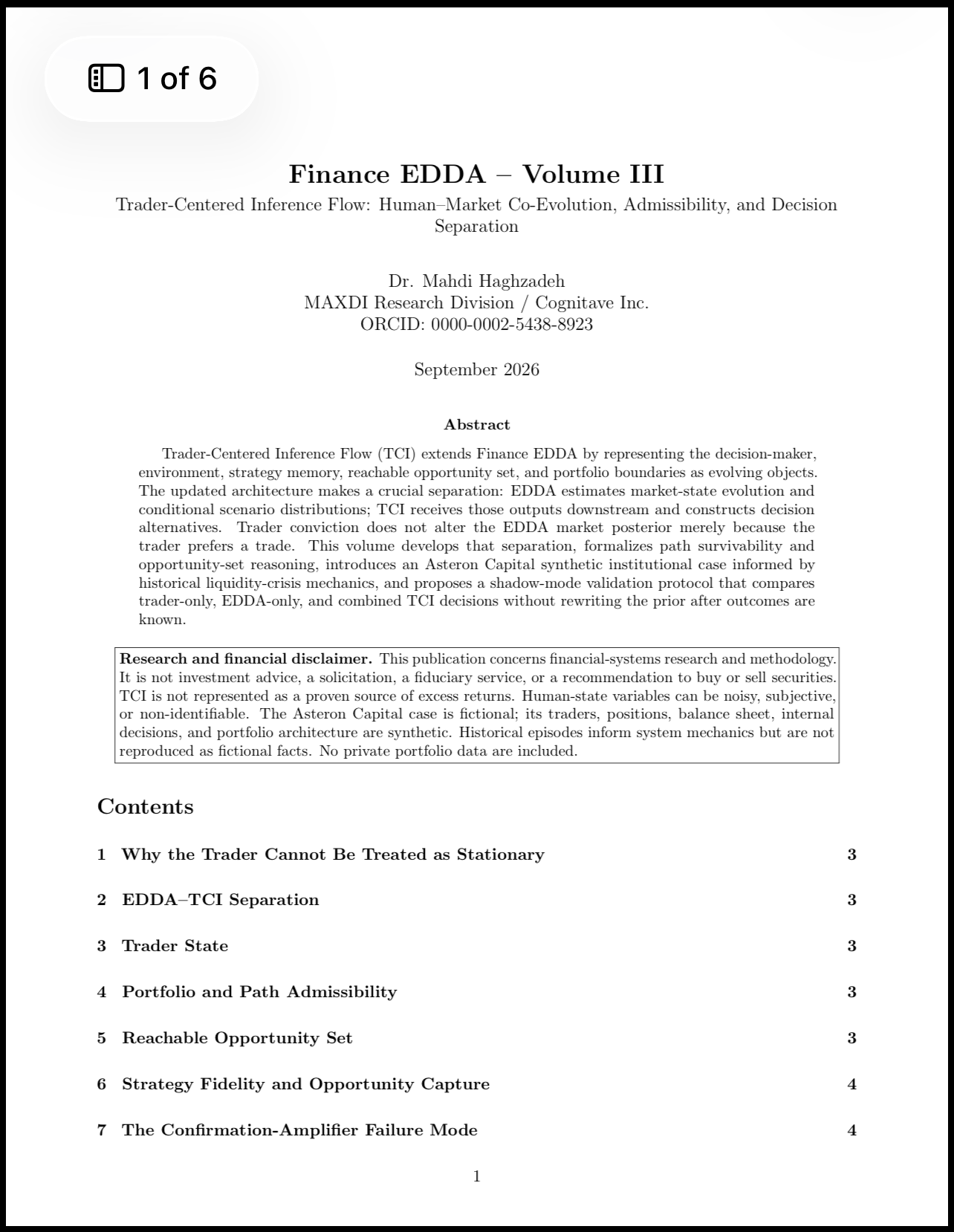
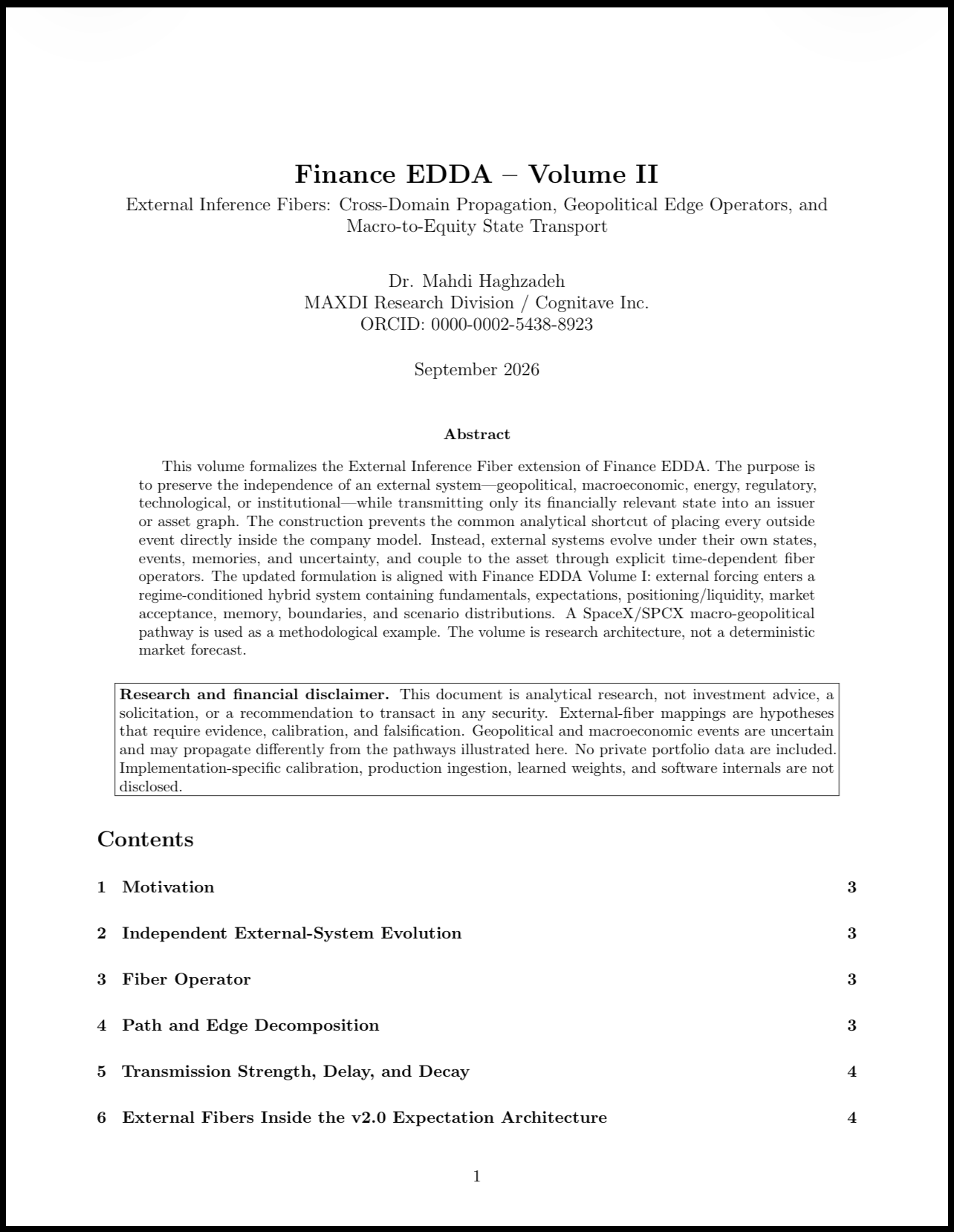
Financial assets do not evolve solely from information generated by the companies that issue them. Energy shocks, interest rates, geopolitical events, regulation, supply chains, monetary policy, technological change, and institutional behavior can enter an asset’s inference state through indirect and time-dependent pathways.
External Inference Fibers formalizes this problem within Finance EDDA.
The publication introduces external fibers as structured information pathways connecting domains that may initially appear remote from the security being analyzed. Rather than treating macroeconomic or geopolitical variables as generic background factors, the framework considers how information propagates through intermediate states before deforming expectations, discount rates, operating assumptions, positioning, and ultimately market acceptance.
An external event therefore need not map directly to price. Its influence may be delayed, amplified, attenuated, redirected, or rendered irrelevant by the state through which it travels.
The volume develops the conceptual architecture connecting external fibers to the wider MXD–COGN/EDFS inference-flow formulation and illustrates why event attribution requires preserving both domain and depth.
Financial assets do not evolve solely from information generated by the companies that issue them. Energy shocks, interest rates, geopolitical events, regulation, supply chains, monetary policy, technological change, and institutional behavior can enter an asset’s inference state through indirect and time-dependent pathways.
External Inference Fibers formalizes this problem within Finance EDDA.
The publication introduces external fibers as structured information pathways connecting domains that may initially appear remote from the security being analyzed. Rather than treating macroeconomic or geopolitical variables as generic background factors, the framework considers how information propagates through intermediate states before deforming expectations, discount rates, operating assumptions, positioning, and ultimately market acceptance.
An external event therefore need not map directly to price. Its influence may be delayed, amplified, attenuated, redirected, or rendered irrelevant by the state through which it travels.
The volume develops the conceptual architecture connecting external fibers to the wider MXD–COGN/EDFS inference-flow formulation and illustrates why event attribution requires preserving both domain and depth.