



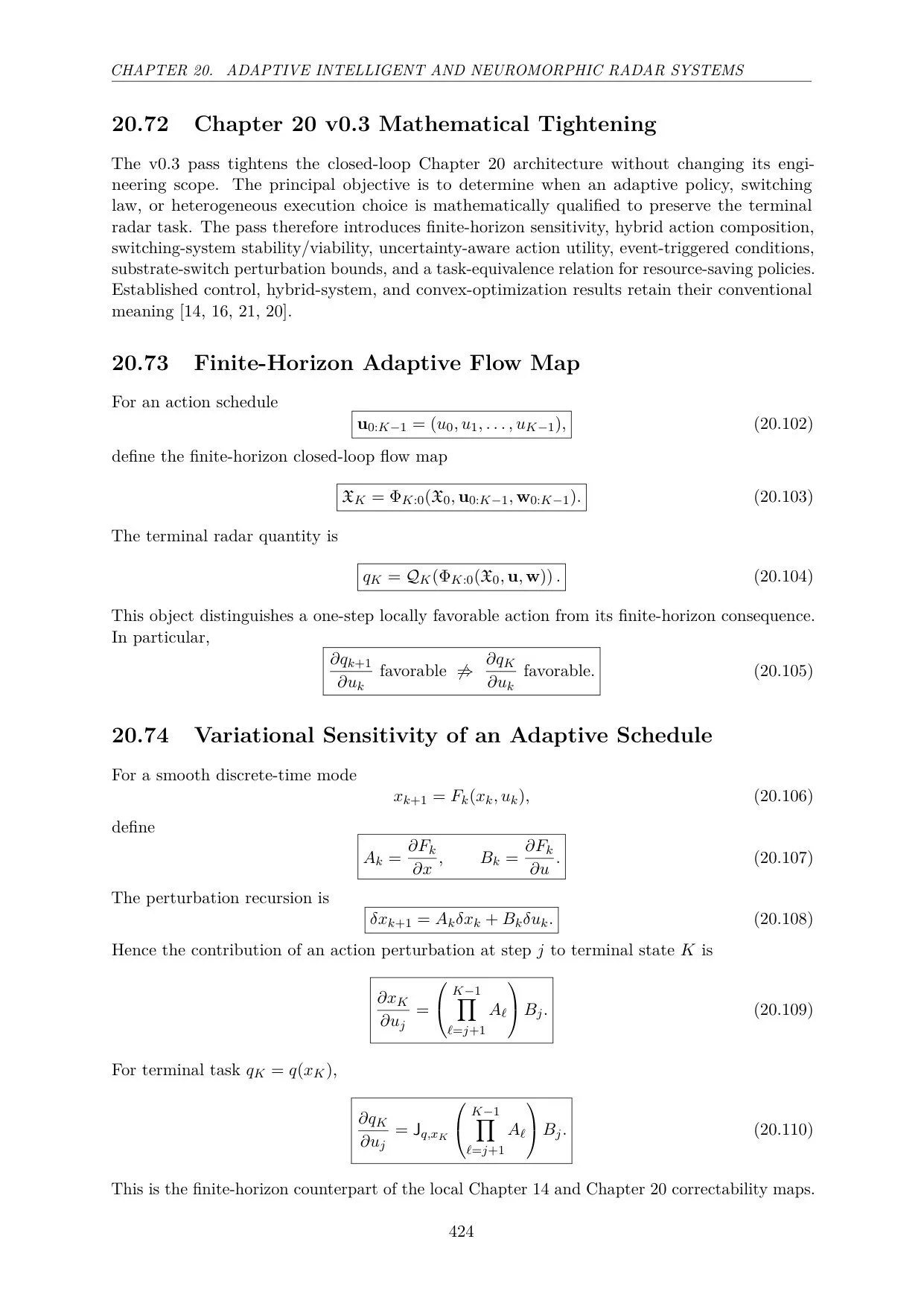
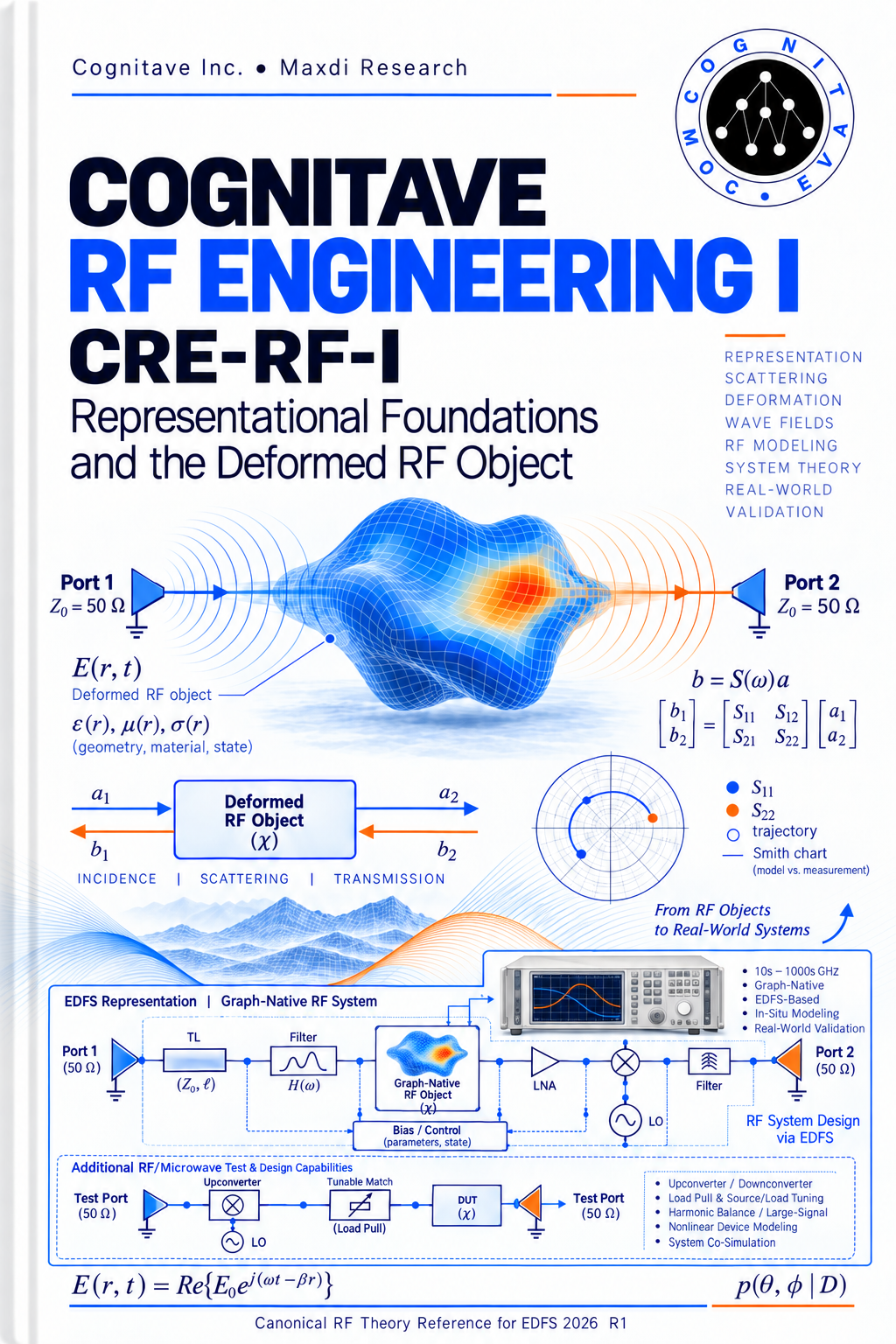
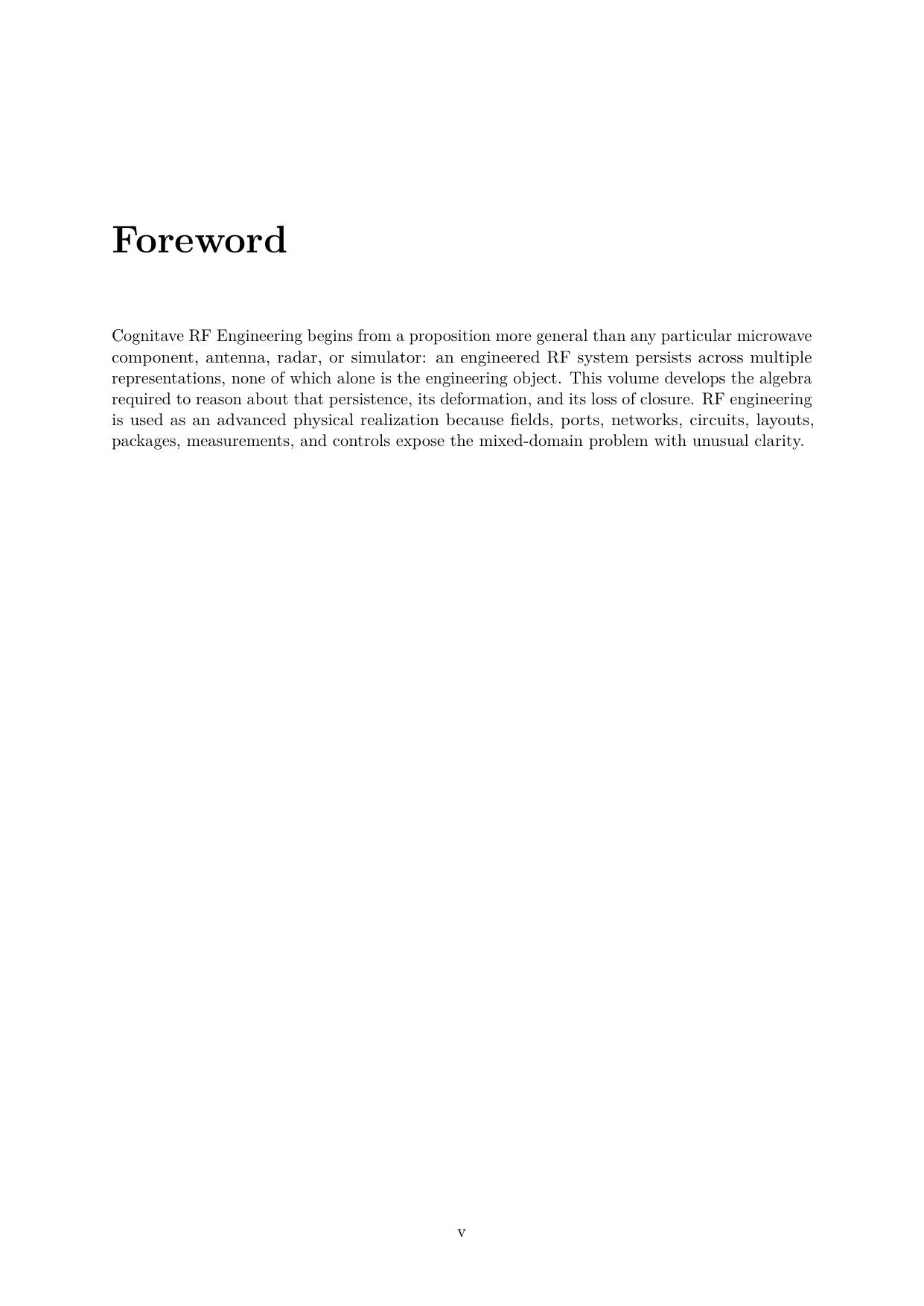
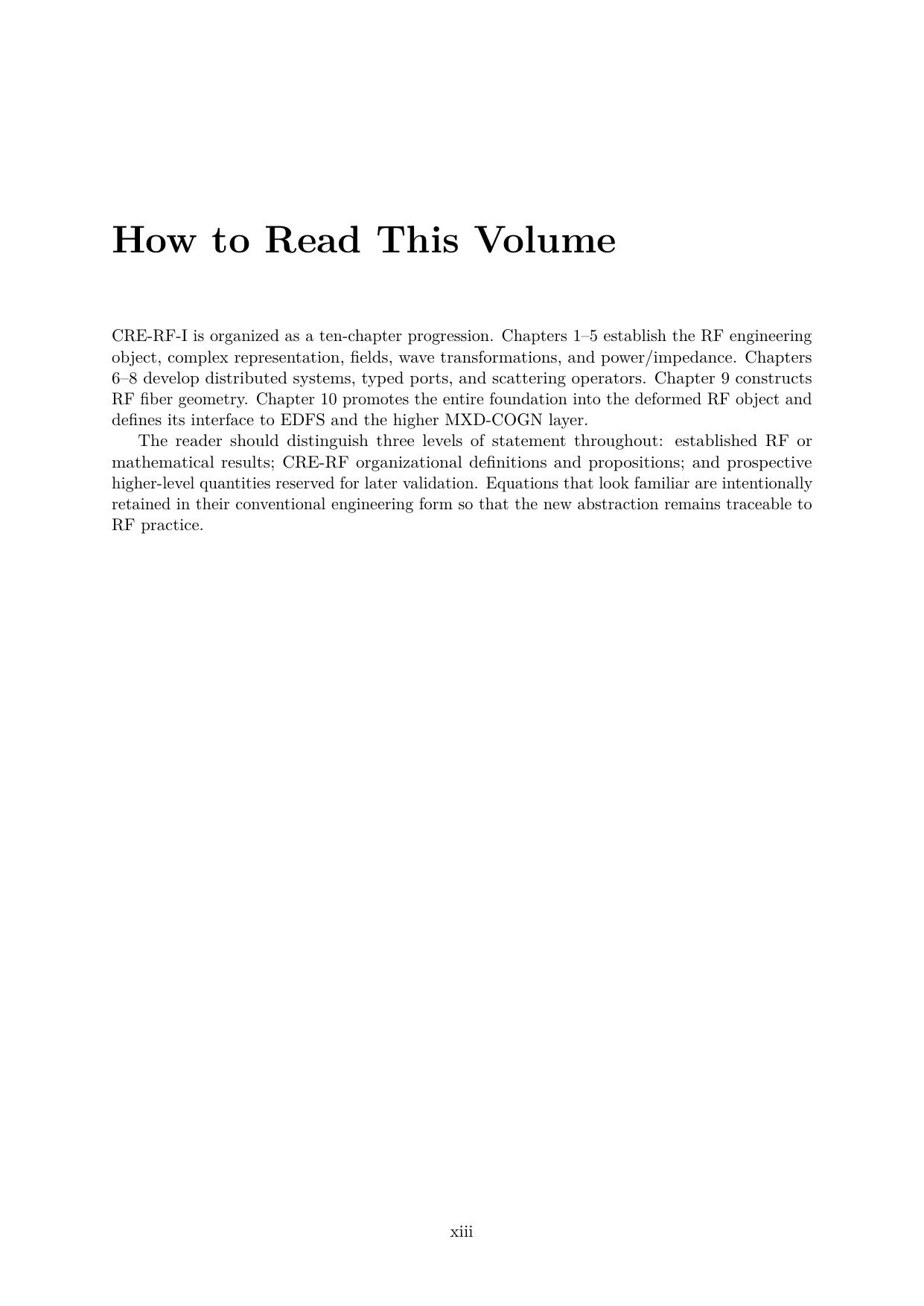

















Electronics Engineering Store
- All |
- Mathematics |
- MGSSSG |
- Maxdi Journals |
- Maxdi Reports |
- Financial Reports |
- eBooks |
- Hard Copy Books |
- Technology Reports |
- EE Courses |
- EDA Software |
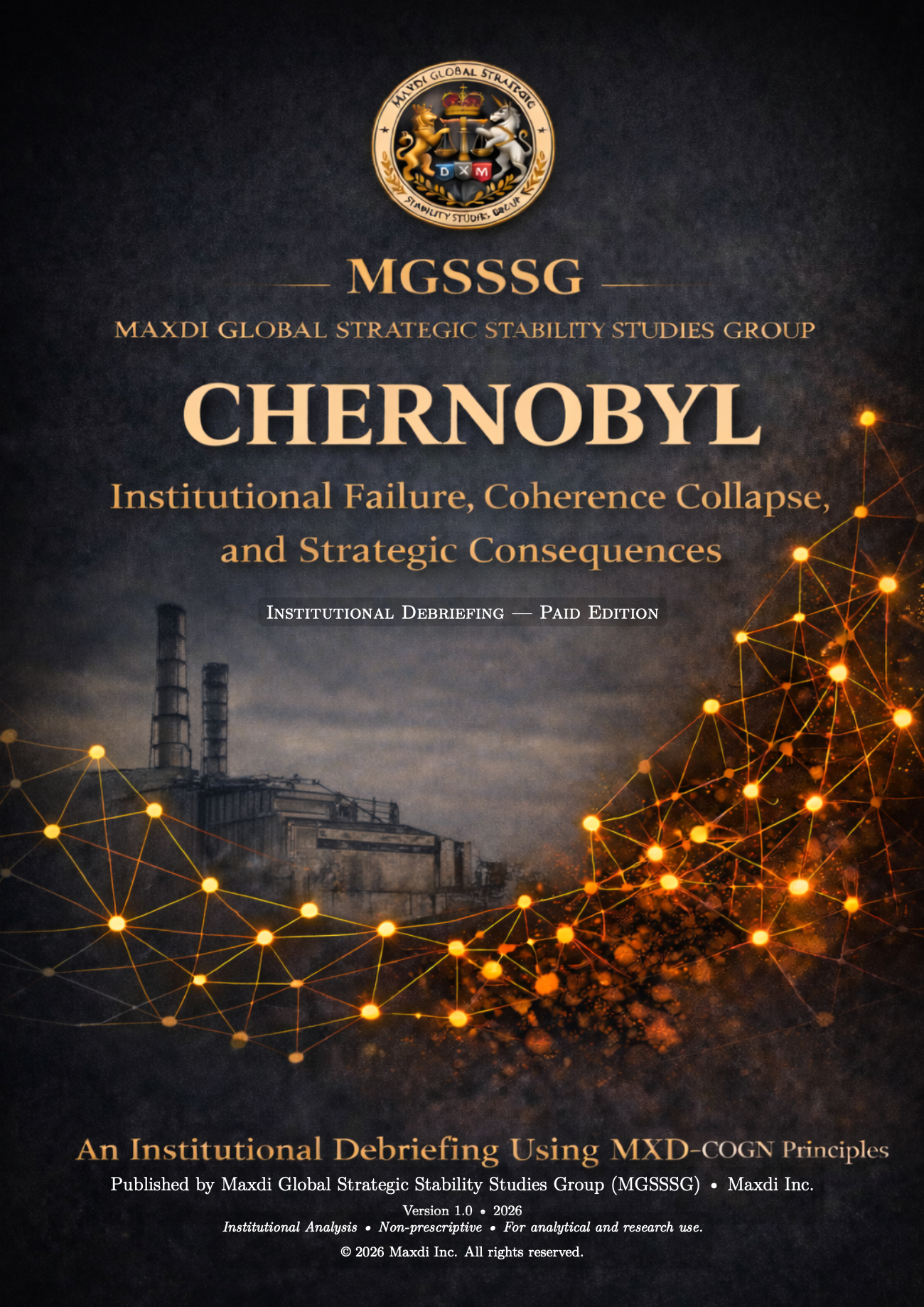
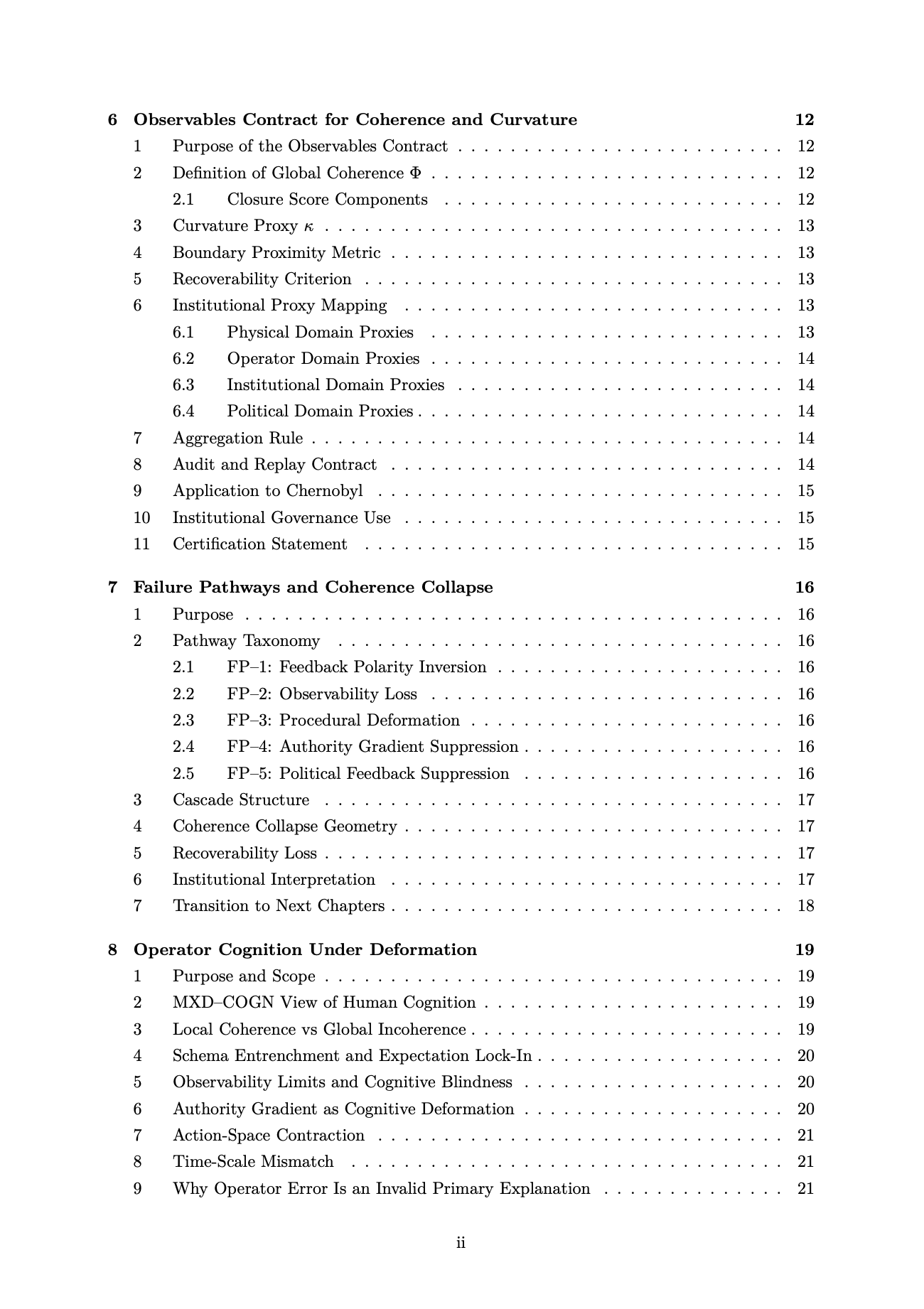
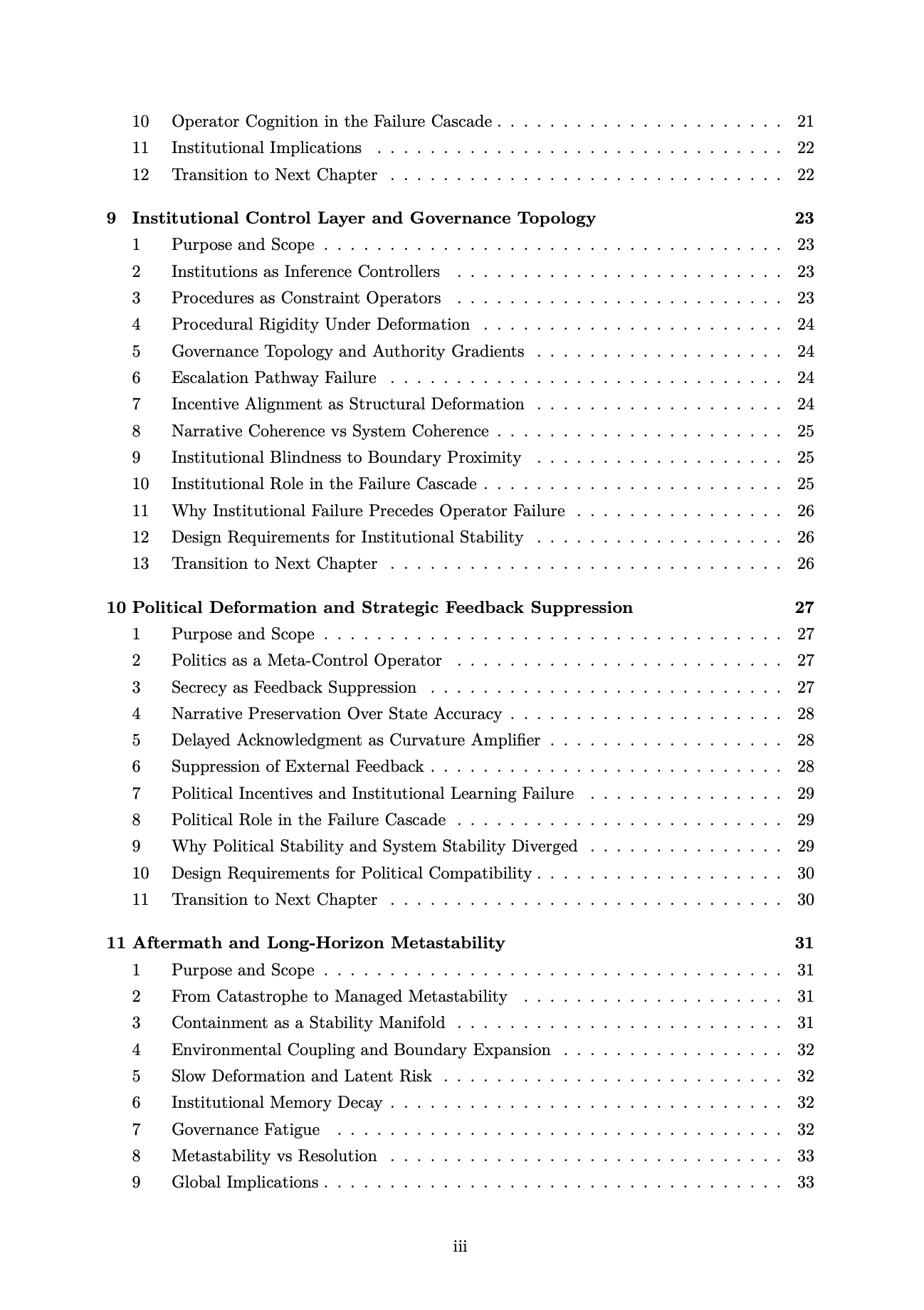
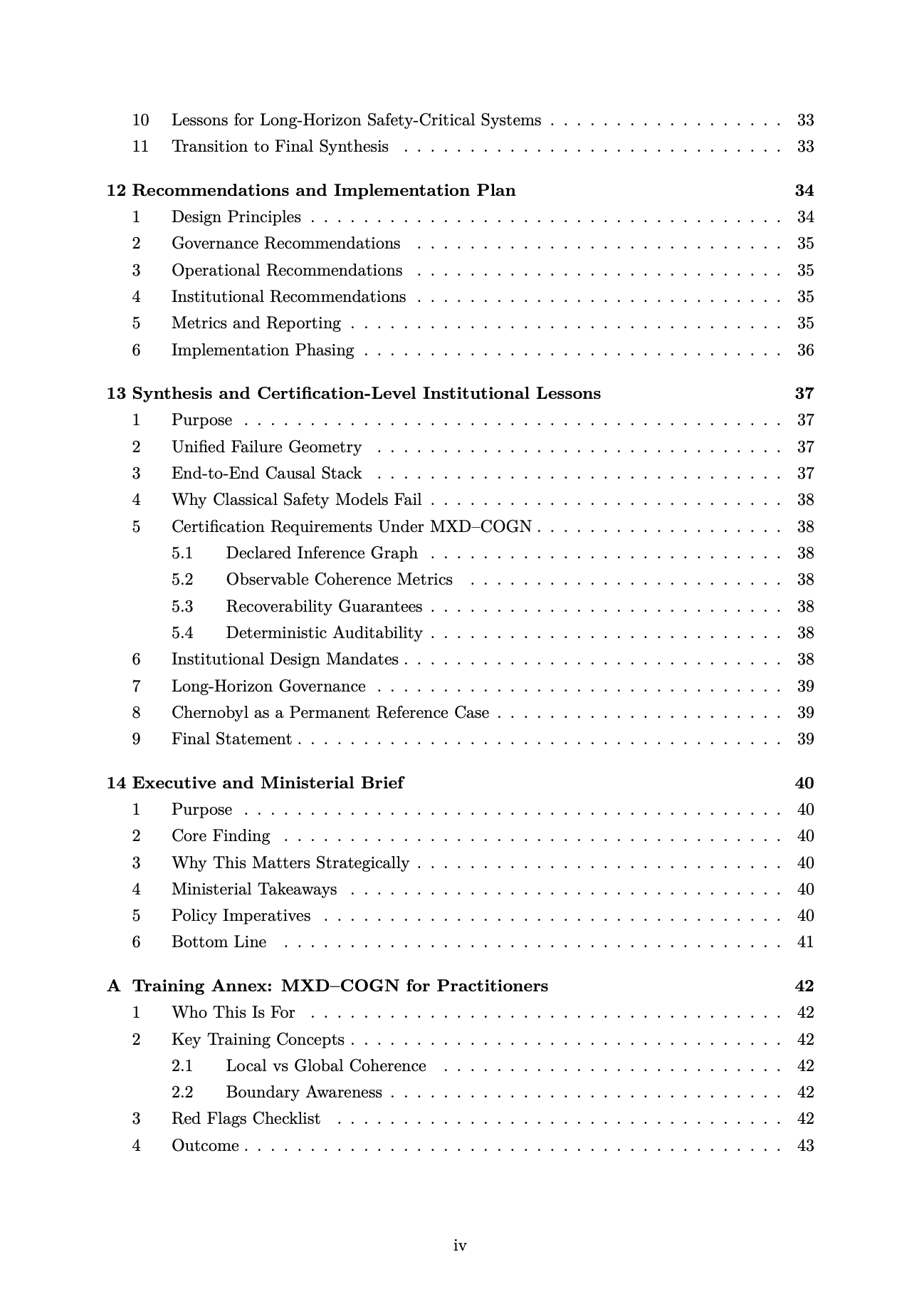
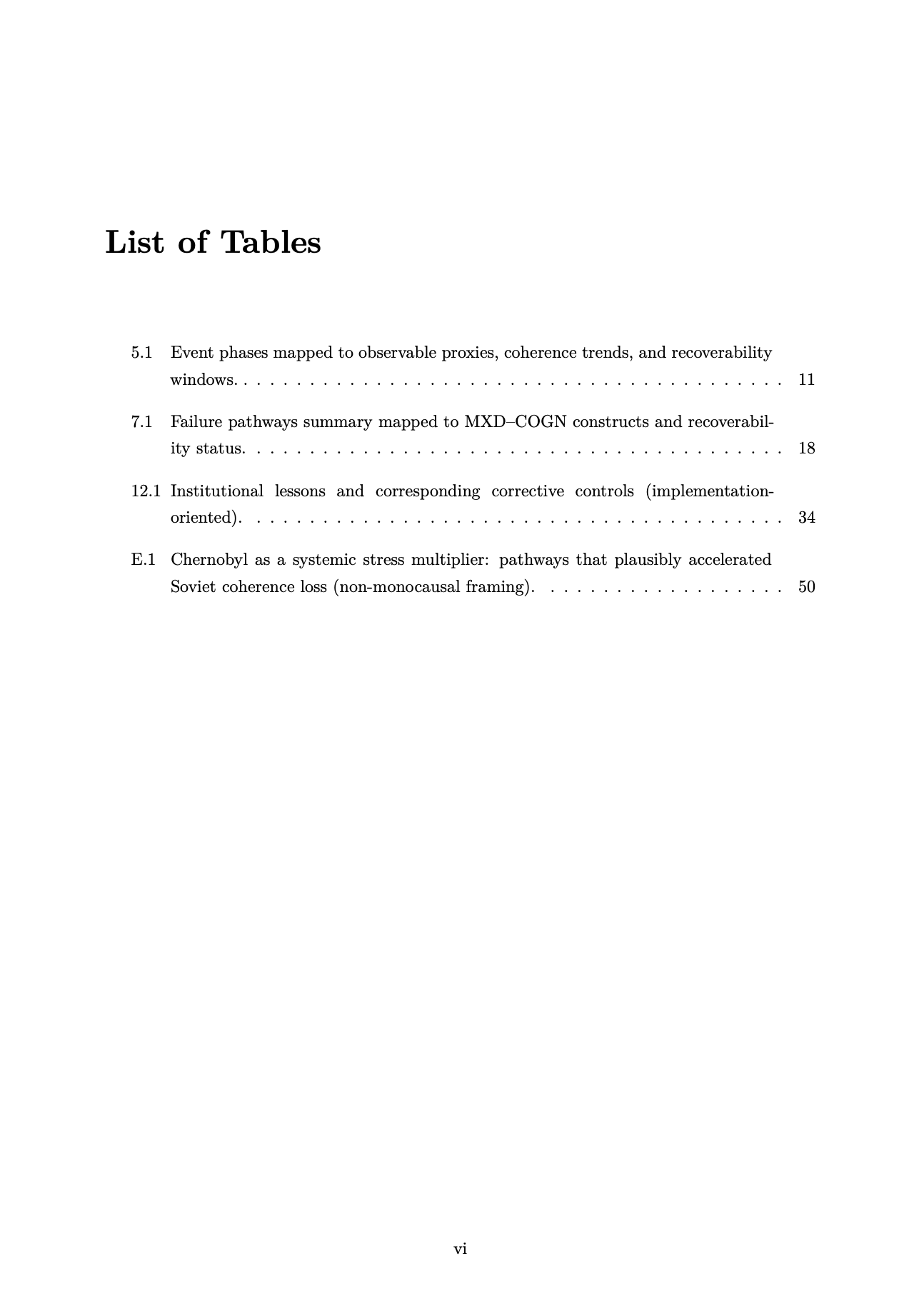
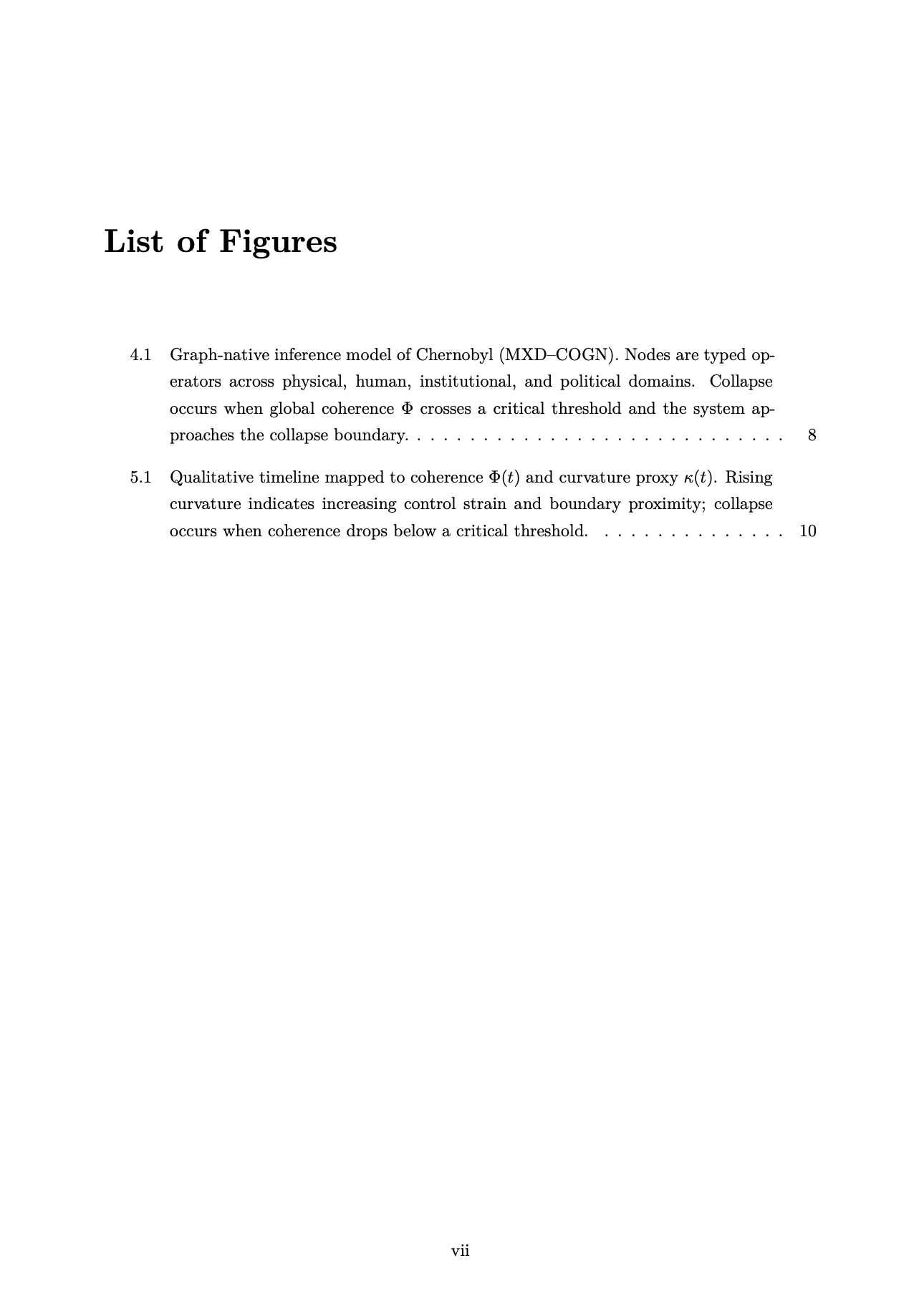
CHERNOBYL: Institutional Failure, Coherence Collapse, and Strategic Consequences is a comprehensive institutional debriefing applying MXD-COGN coherence analysis to one of the most consequential socio-technical failures of the modern era.
Rather than retelling events, this report examines how and why institutional recoverability was lost across physical, cognitive, procedural, and political layers. Chernobyl is treated not as an isolated technical accident, but as a coherence collapse in which observability degraded, action sets narrowed, escalation pathways failed, and institutional feedback was suppressed.
Using graph-native inference models, curvature-mapped timelines, and multi-domain failure taxonomies, the report reconstructs how locally rational decisions coexisted with global instability—and why recovery became impossible once critical boundaries were crossed.
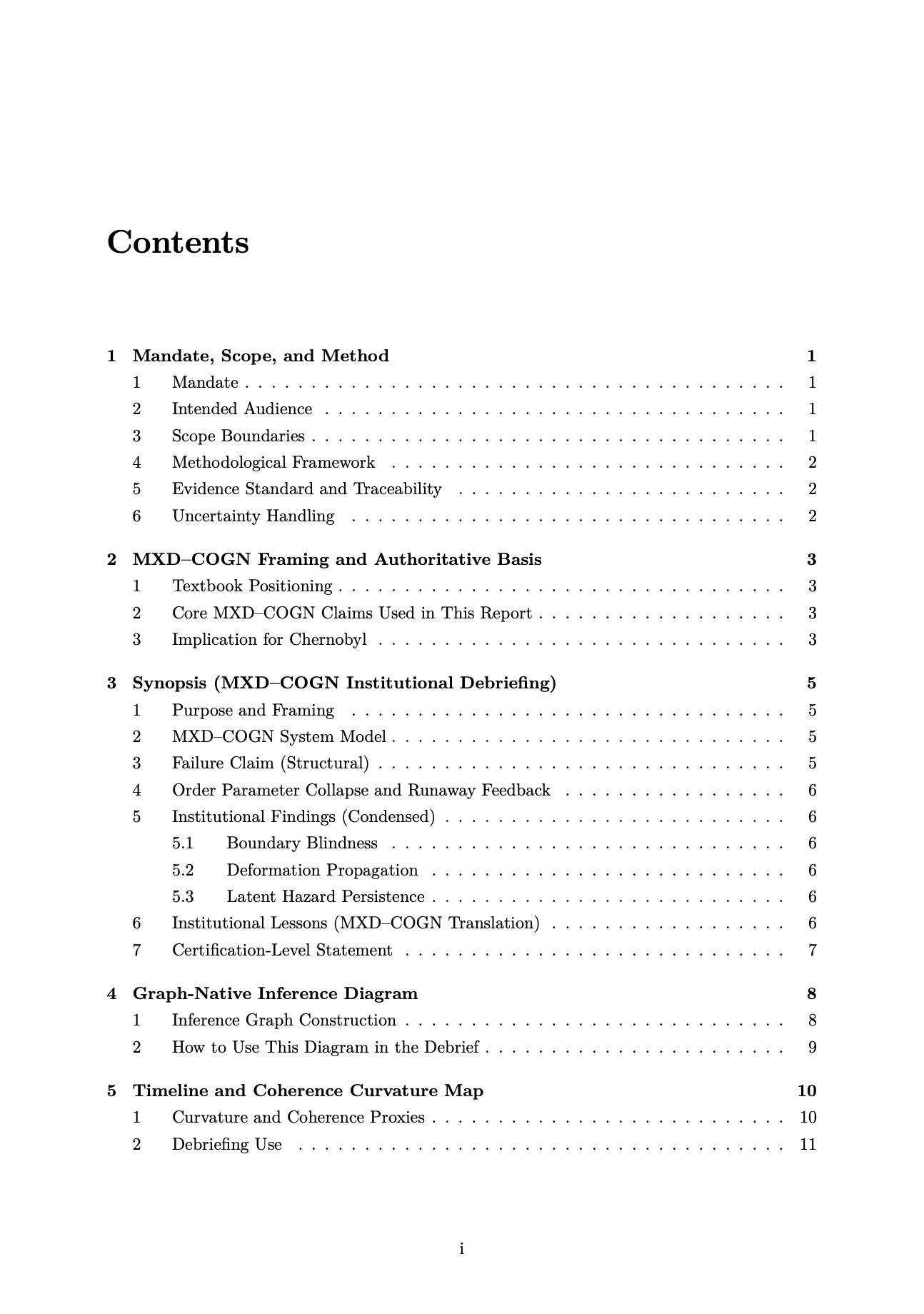
What this report delivers
A graph-native MXD-COGN system model of Chernobyl
A timeline mapped to coherence curvature and recoverability windows
A multi-domain failure taxonomy (physical, cognitive, institutional, political)
An institutional lessons matrix with corrective controls
A long-horizon aftermath analysis (containment, remediation, metastability)
An appendix analyzing Chernobyl as a systemic stressor in Soviet state stability (non-monocausal)
Intended audience
Institutional risk and safety analysts
Strategic planners and regulators
Researchers studying systemic failure and resilience
Professionals in nuclear, energy, and high-reliability domains
Scope and limitations
This report is:
Non-prescriptive
Non-operational
Analytical in nature
It is designed for institutional understanding, not technical operation or policy advocacy.
Format: PDF
Length: ~50–60 pages
Methodology: MXD-COGN (Mixed-Domain, Mixed-Depth Coherence Analysis)
Use: Institutional, academic, and analytical
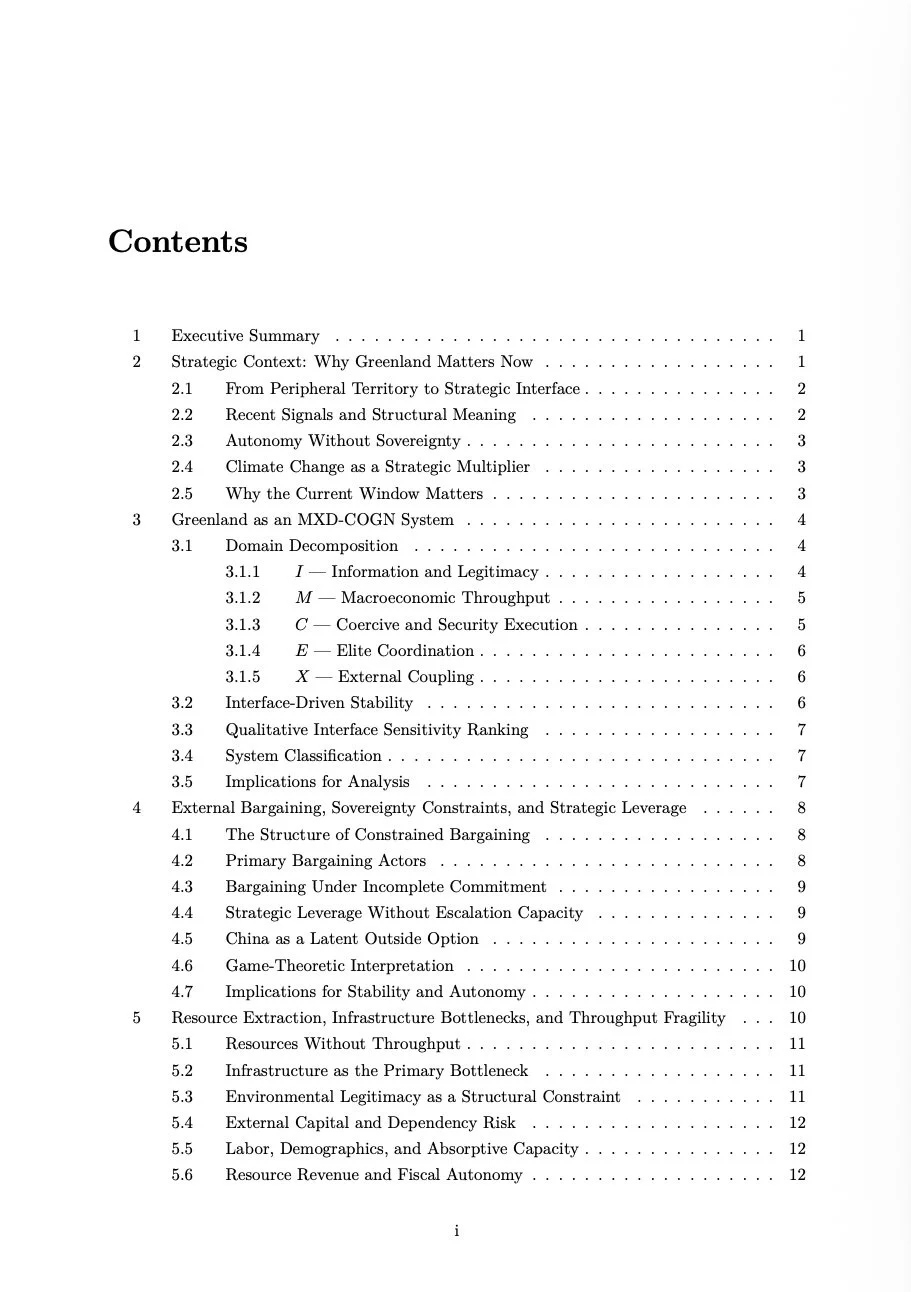
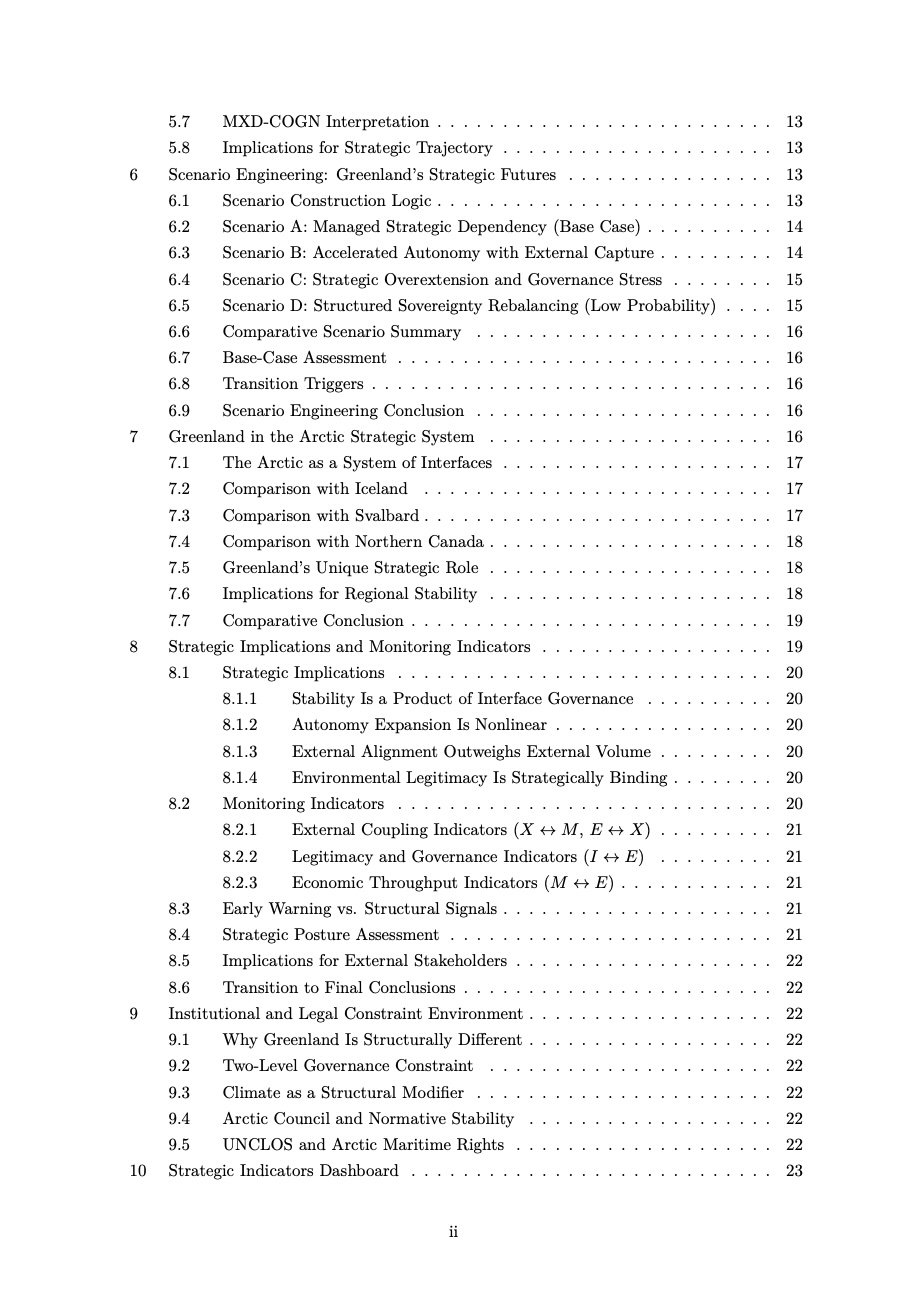
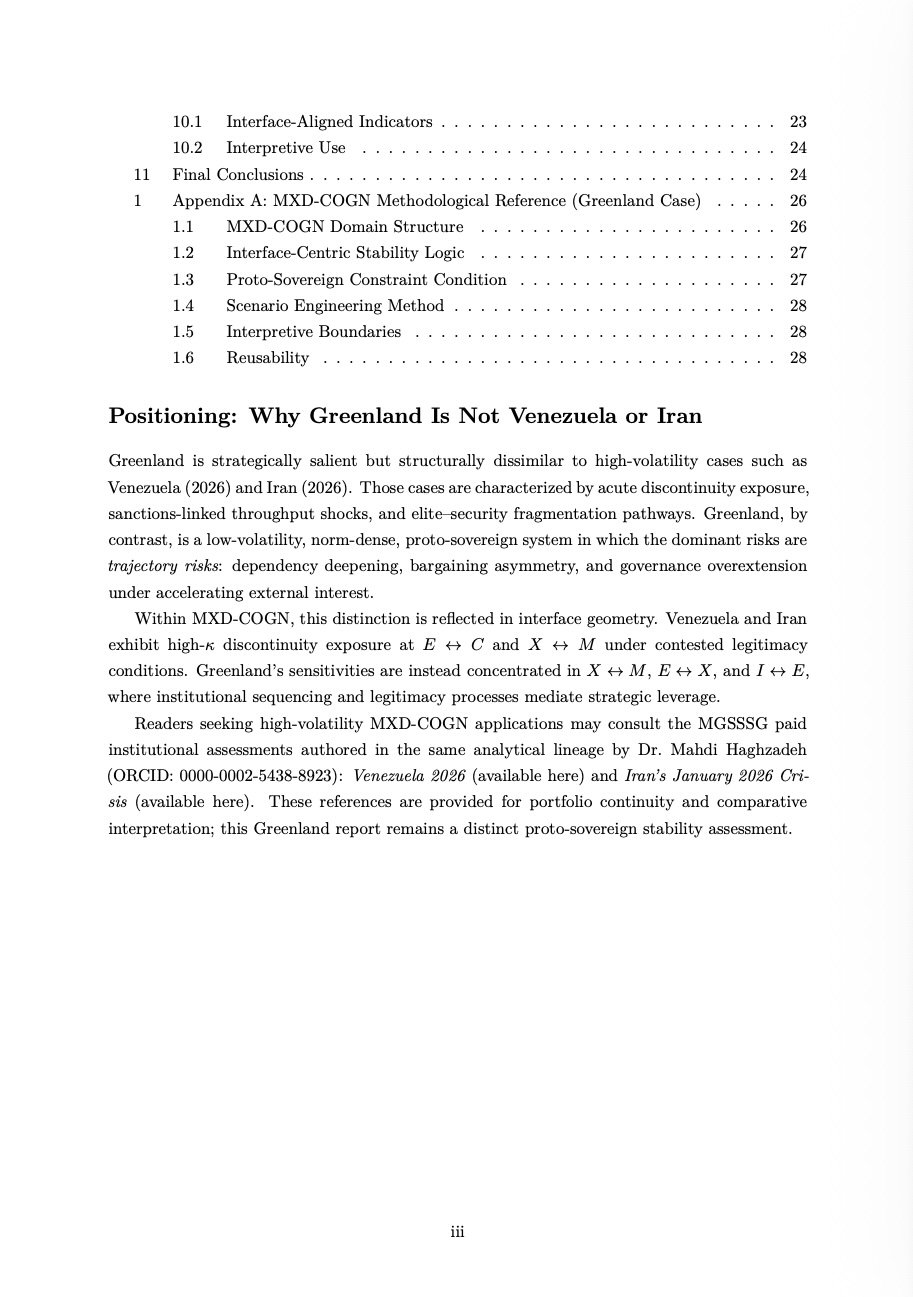
Greenland occupies a uniquely sensitive position in the global strategic system: rich in critical resources, central to Arctic security architecture, yet operating under constrained sovereignty and delegated defense arrangements. Unlike crisis-driven cases, Greenland’s challenge is not instability, but how stability is preserved—or eroded—under accelerating external interest.
This institutional report applies the MXD-COGN (Mixed-Domain, Mixed-Depth Coherence Engineering) framework to model Greenland as a proto-sovereign system, where long-term outcomes are governed by interface dynamics among legitimacy, elite coordination, economic throughput, and external bargaining power.
Rather than forecasting disruption, the report identifies equilibrium families that define Greenland’s plausible strategic futures, ranging from managed strategic dependency to structured sovereignty rebalancing. It evaluates how resource extraction, infrastructure bottlenecks, climate governance, and Arctic security norms interact to shape autonomy trajectories over the coming decade.
Key features include:
Greenland-specific MXD-COGN domain modeling
External bargaining and sovereignty-constraint analysis
Resource extraction and infrastructure throughput assessment
Full scenario engineering framework (4 scenarios)
Arctic system comparative positioning
Strategic indicators dashboard for ongoing monitoring
This report is designed for institutional investors, policymakers, defense and energy analysts, and strategic plannersseeking disciplined, non-speculative analysis of Arctic stability and long-horizon geopolitical risk.
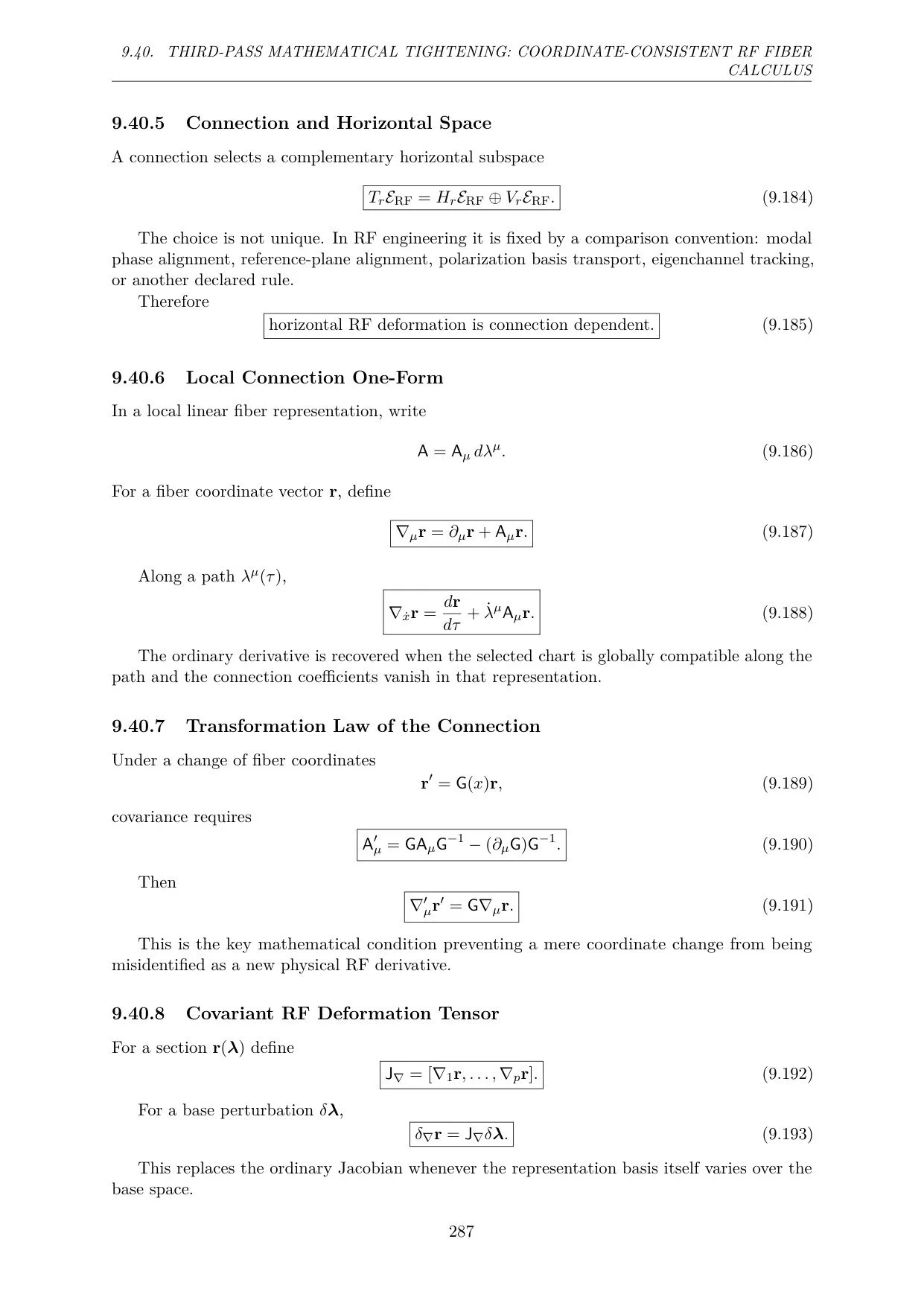
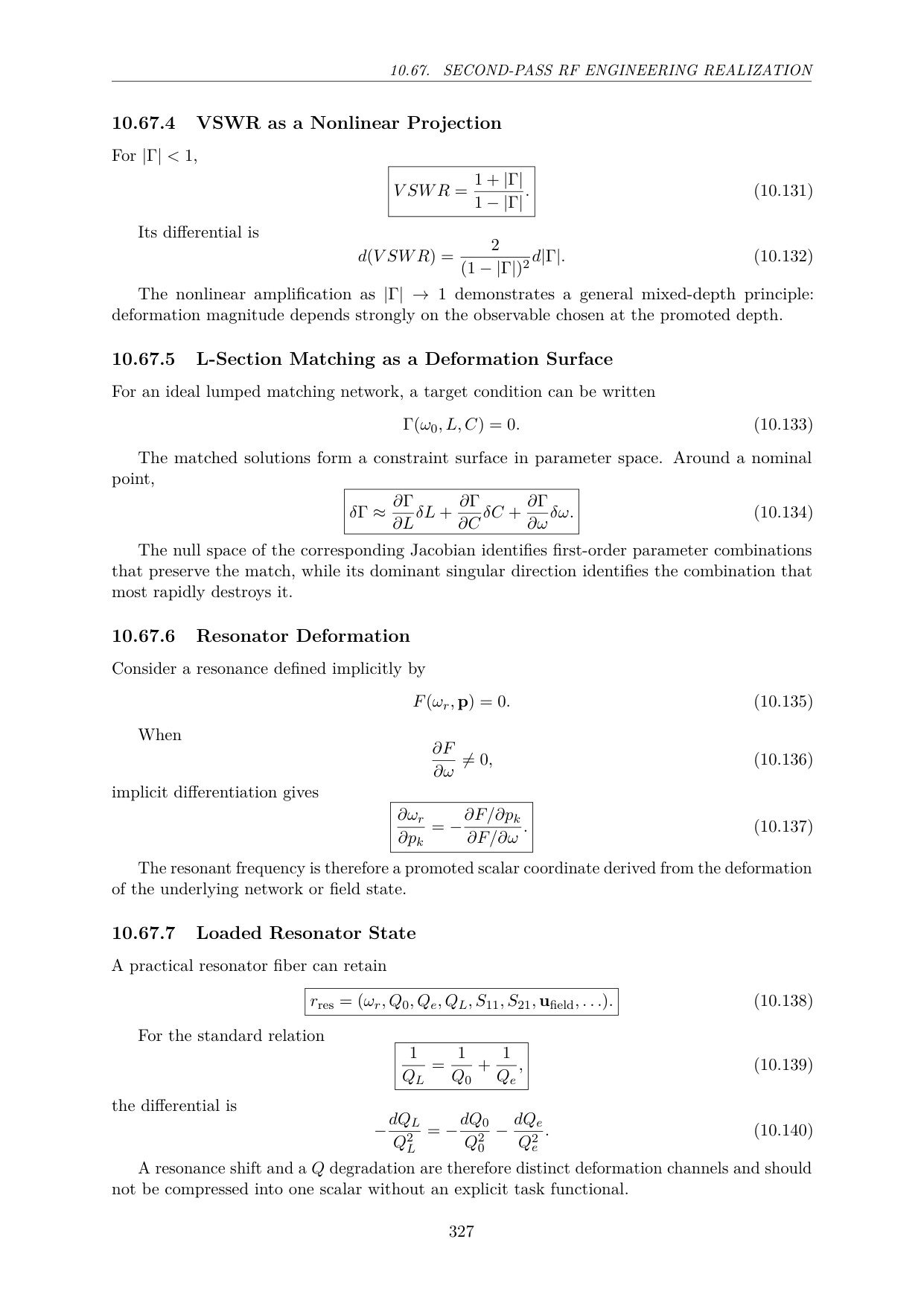
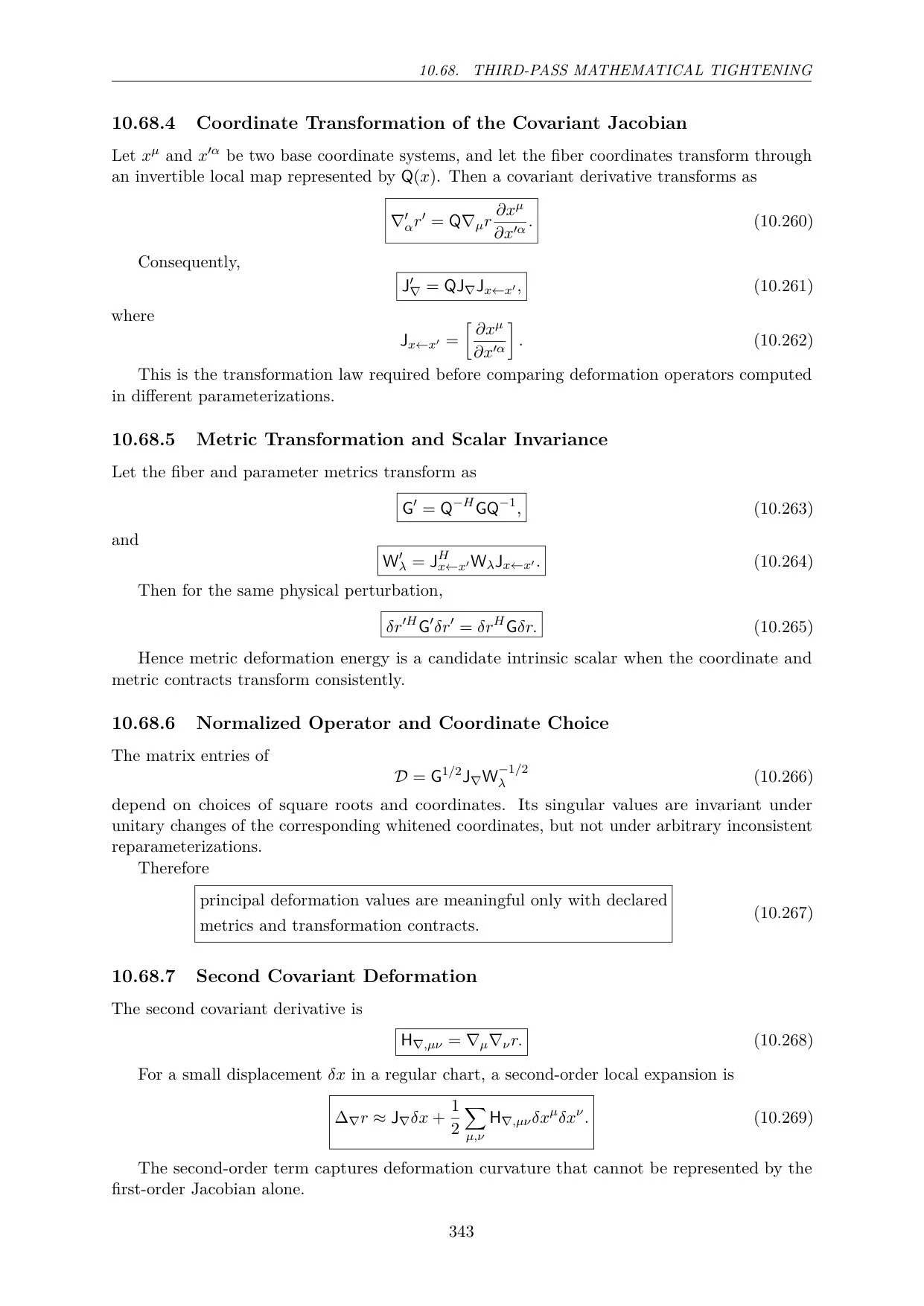
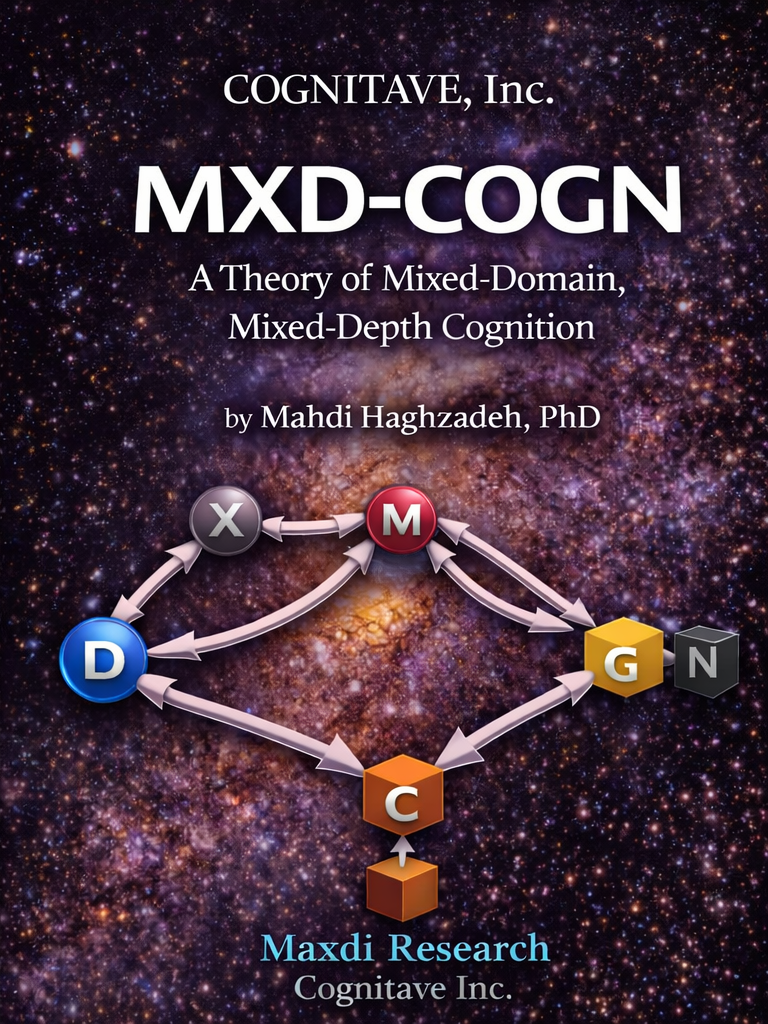
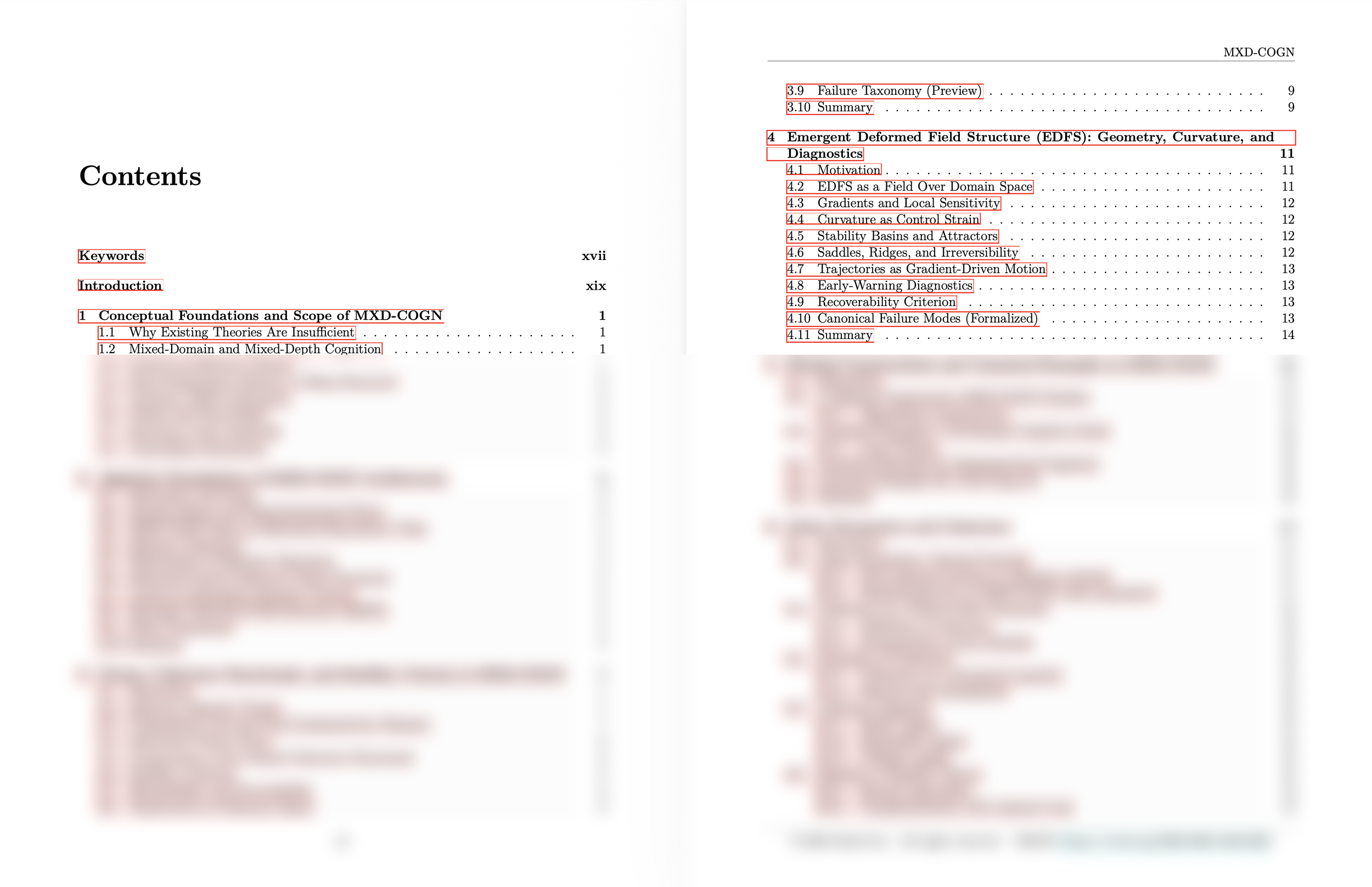
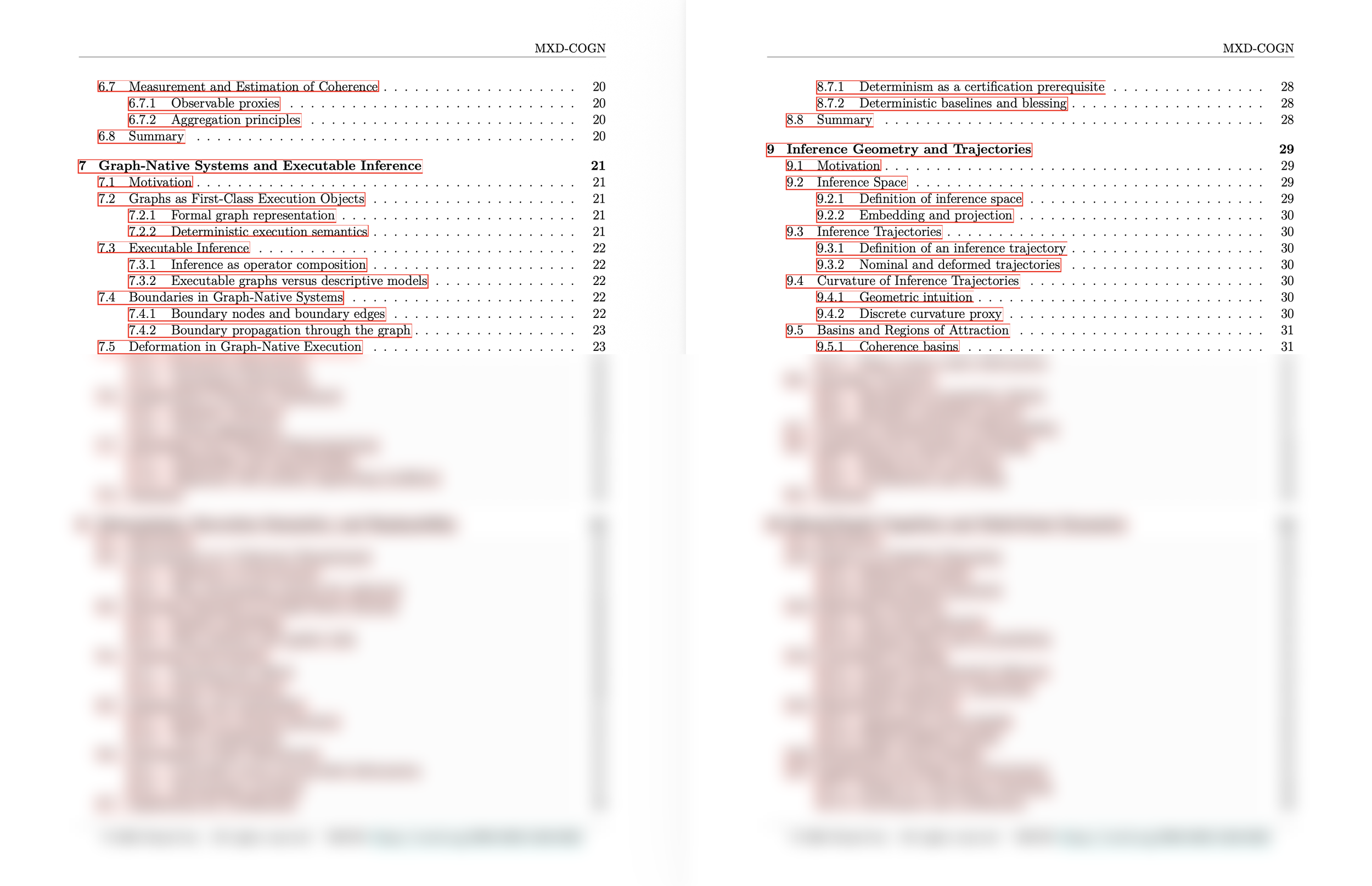
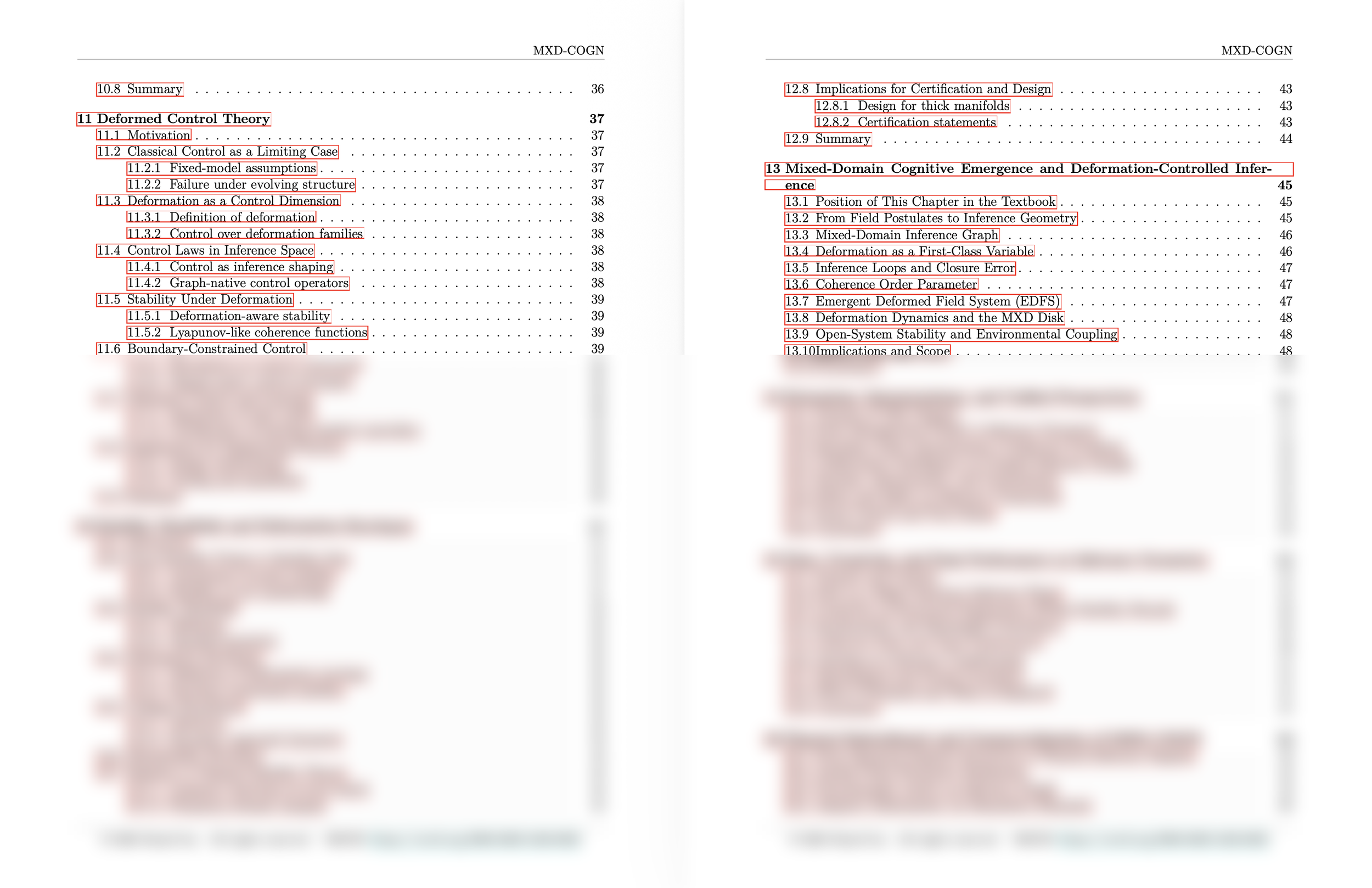
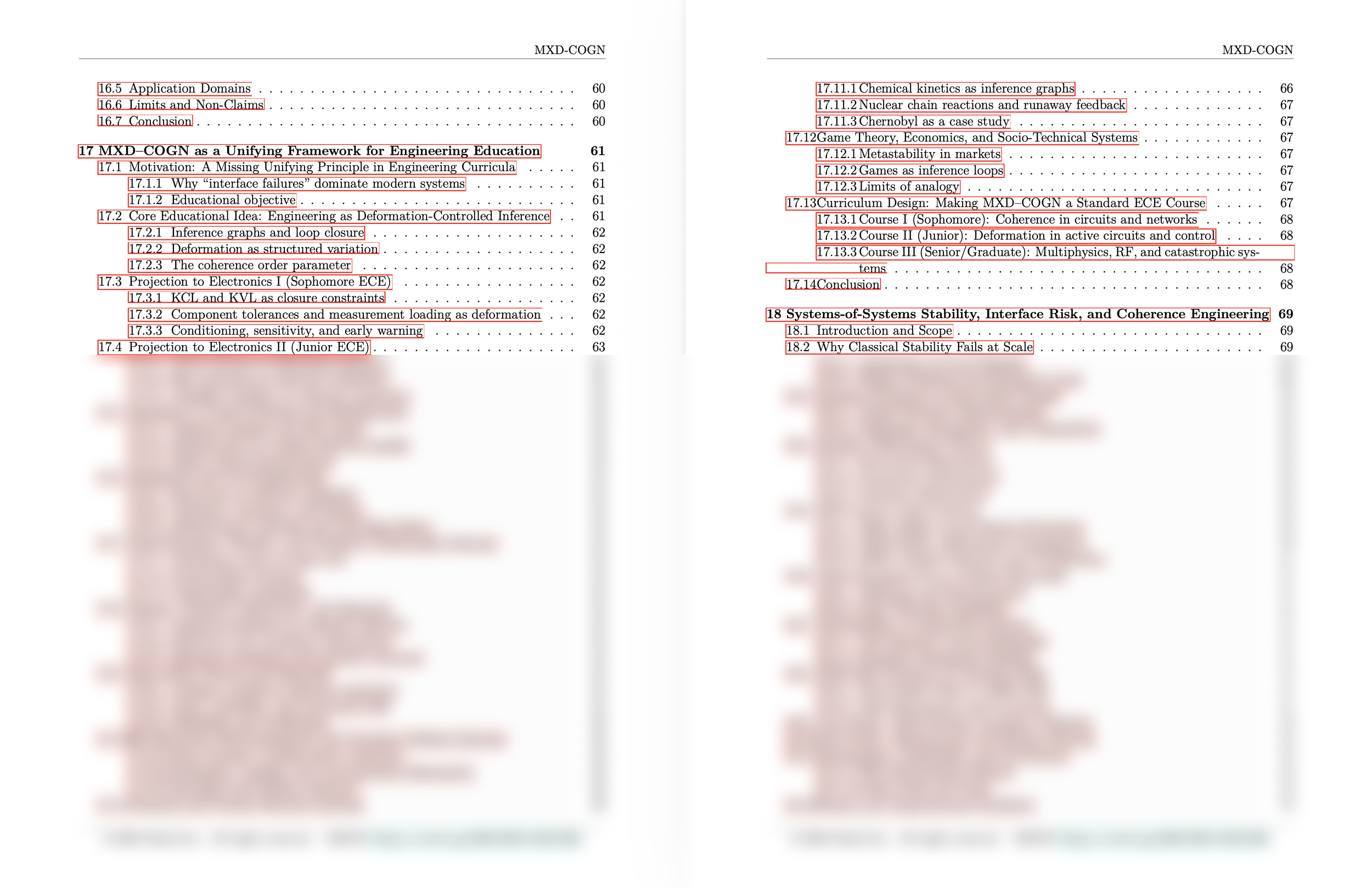
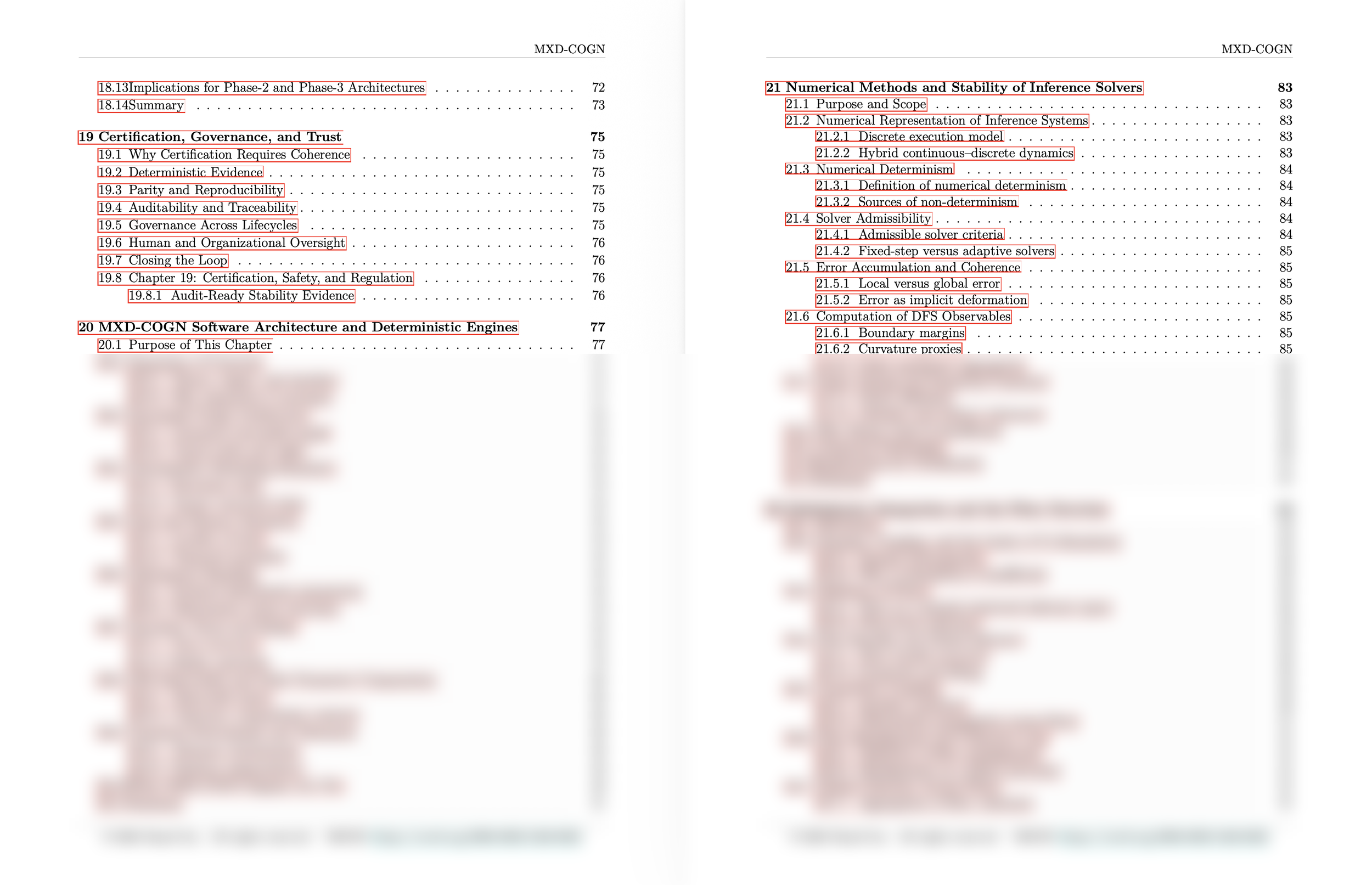
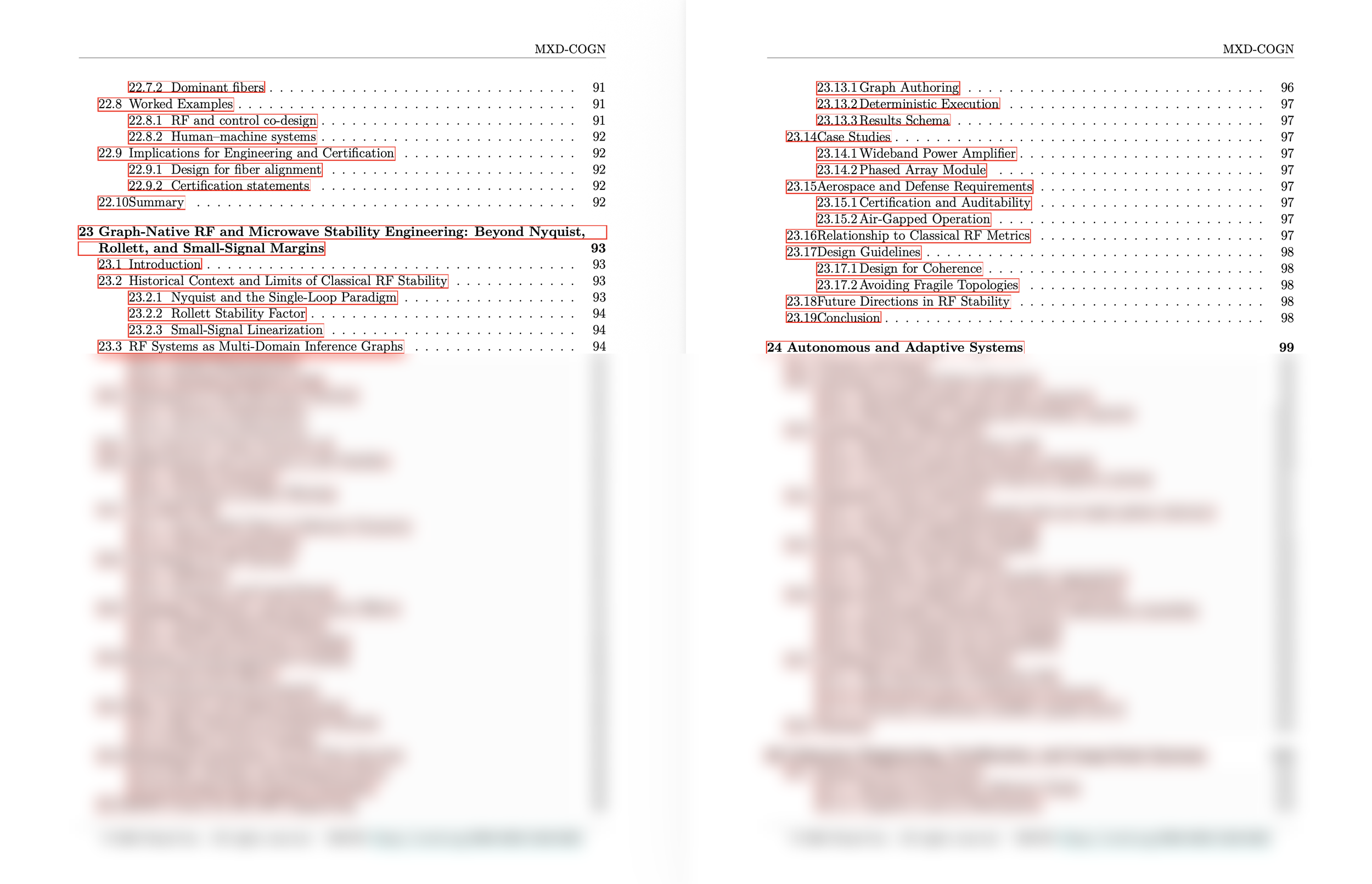
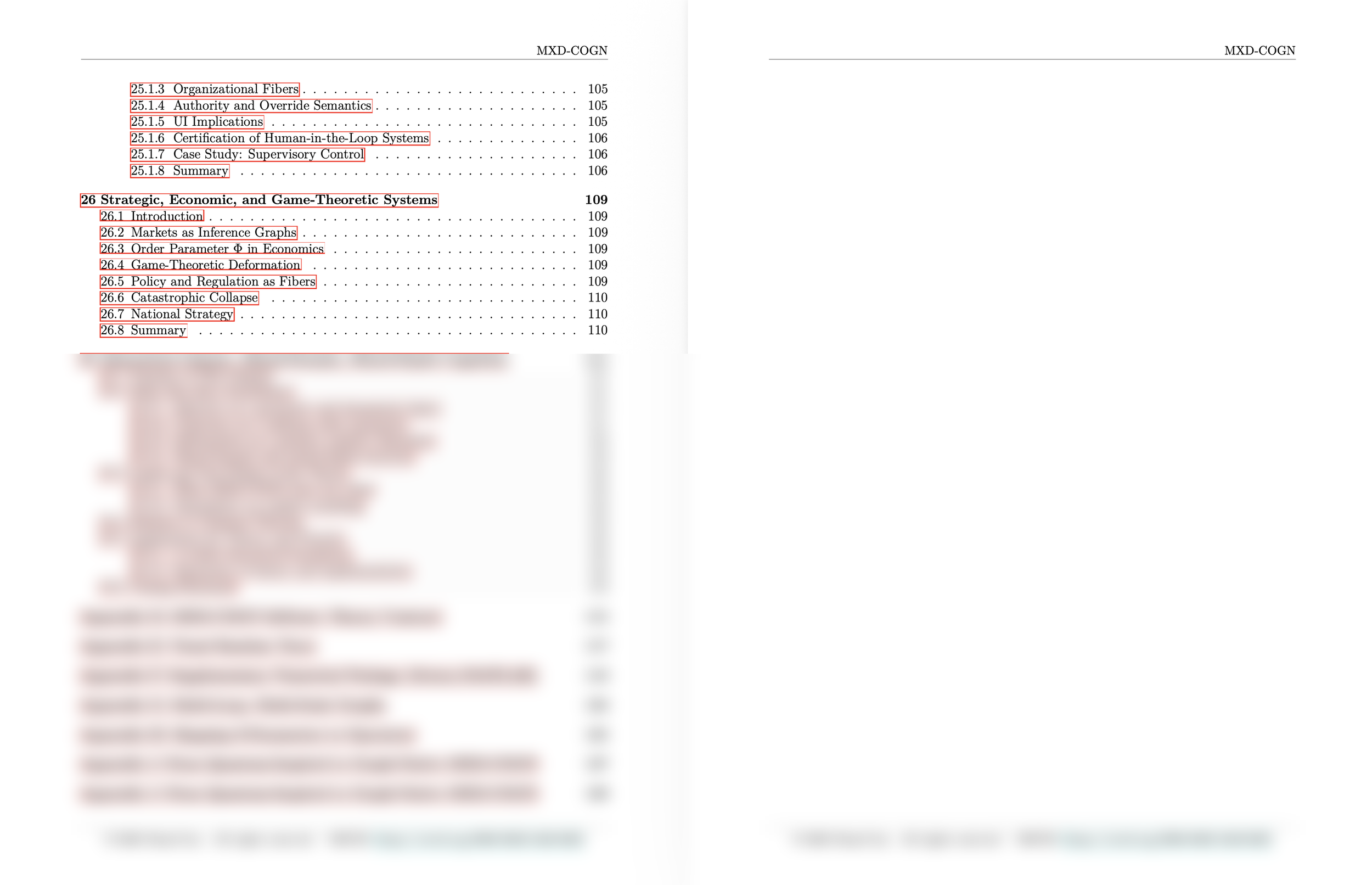
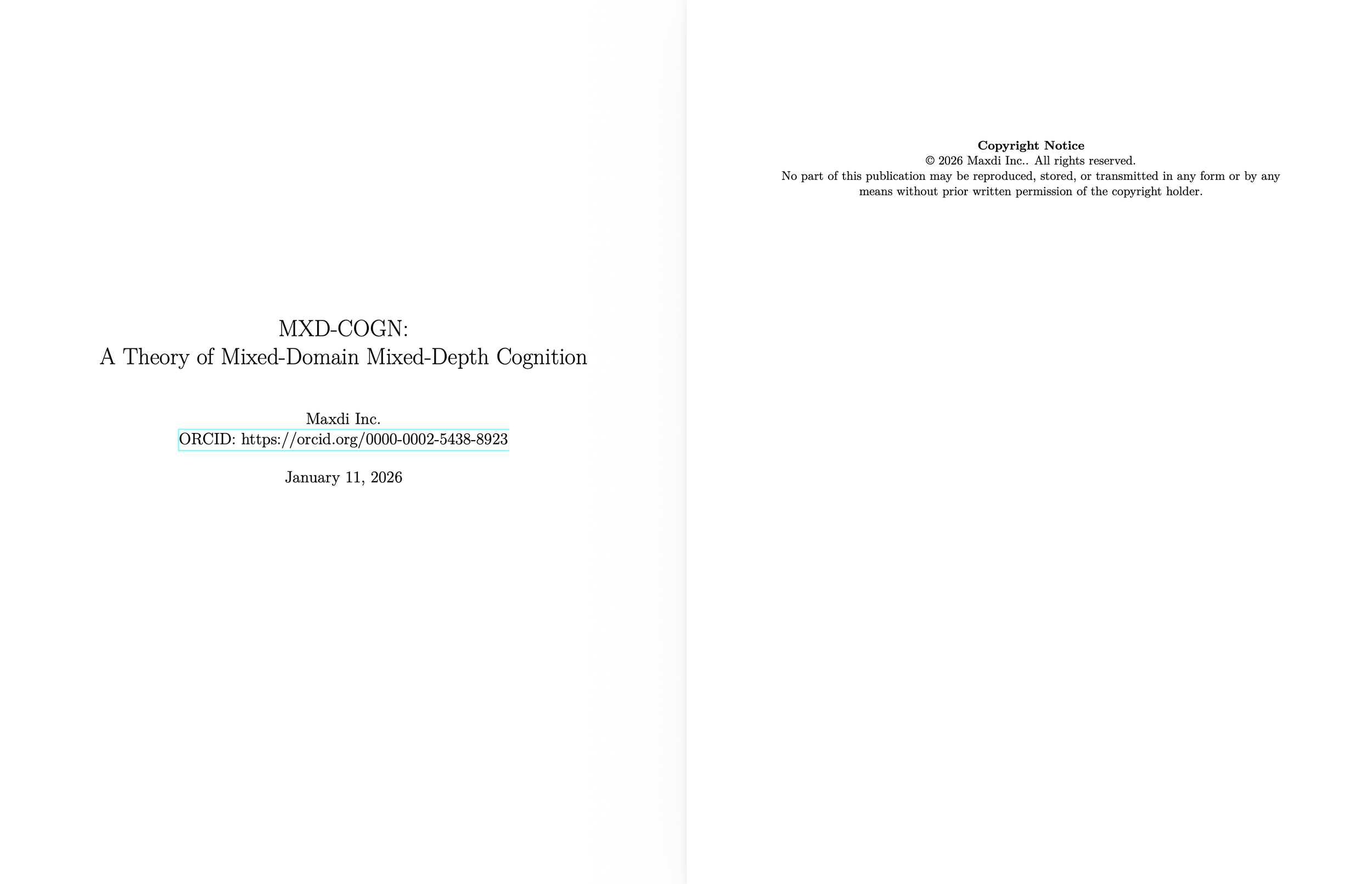
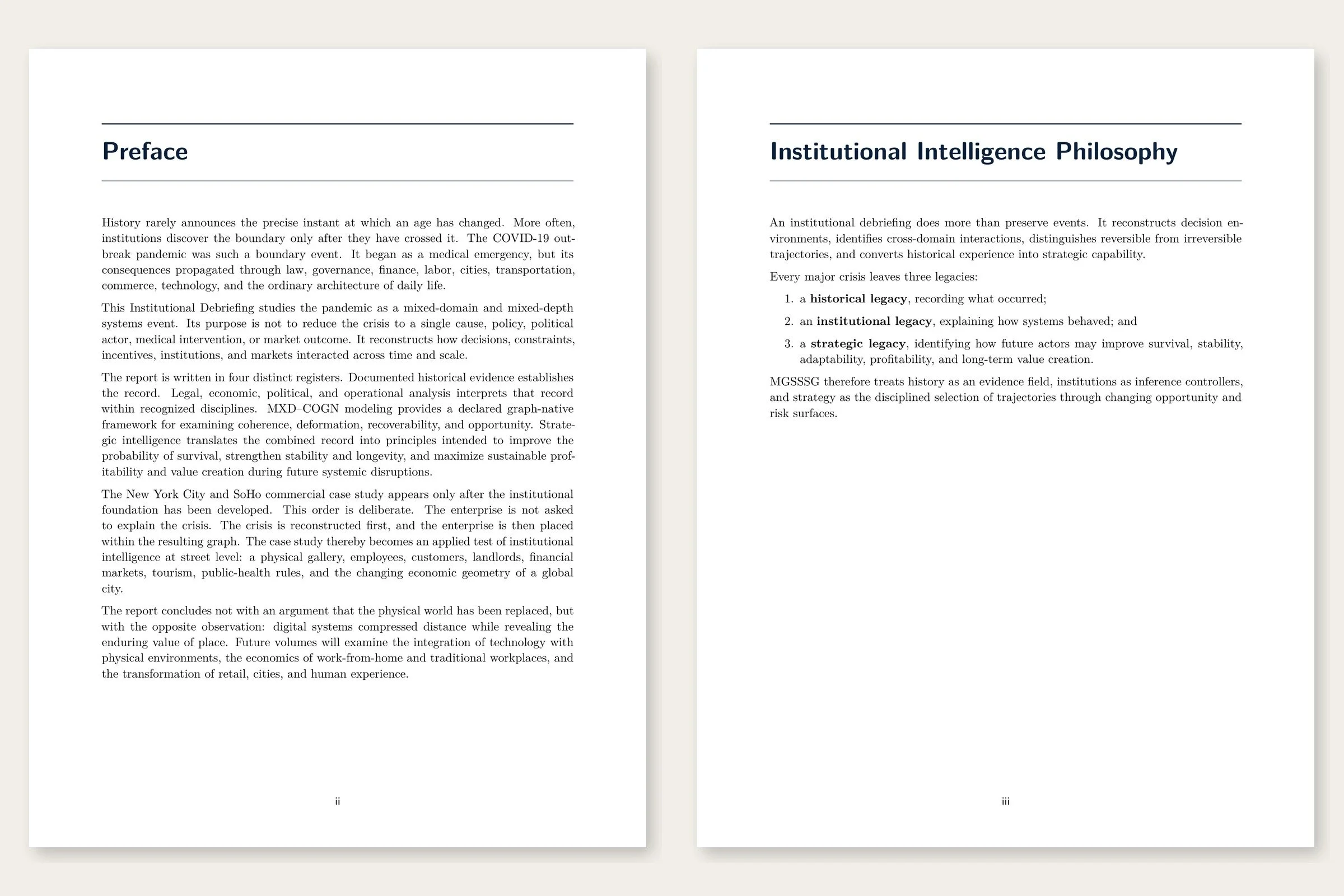
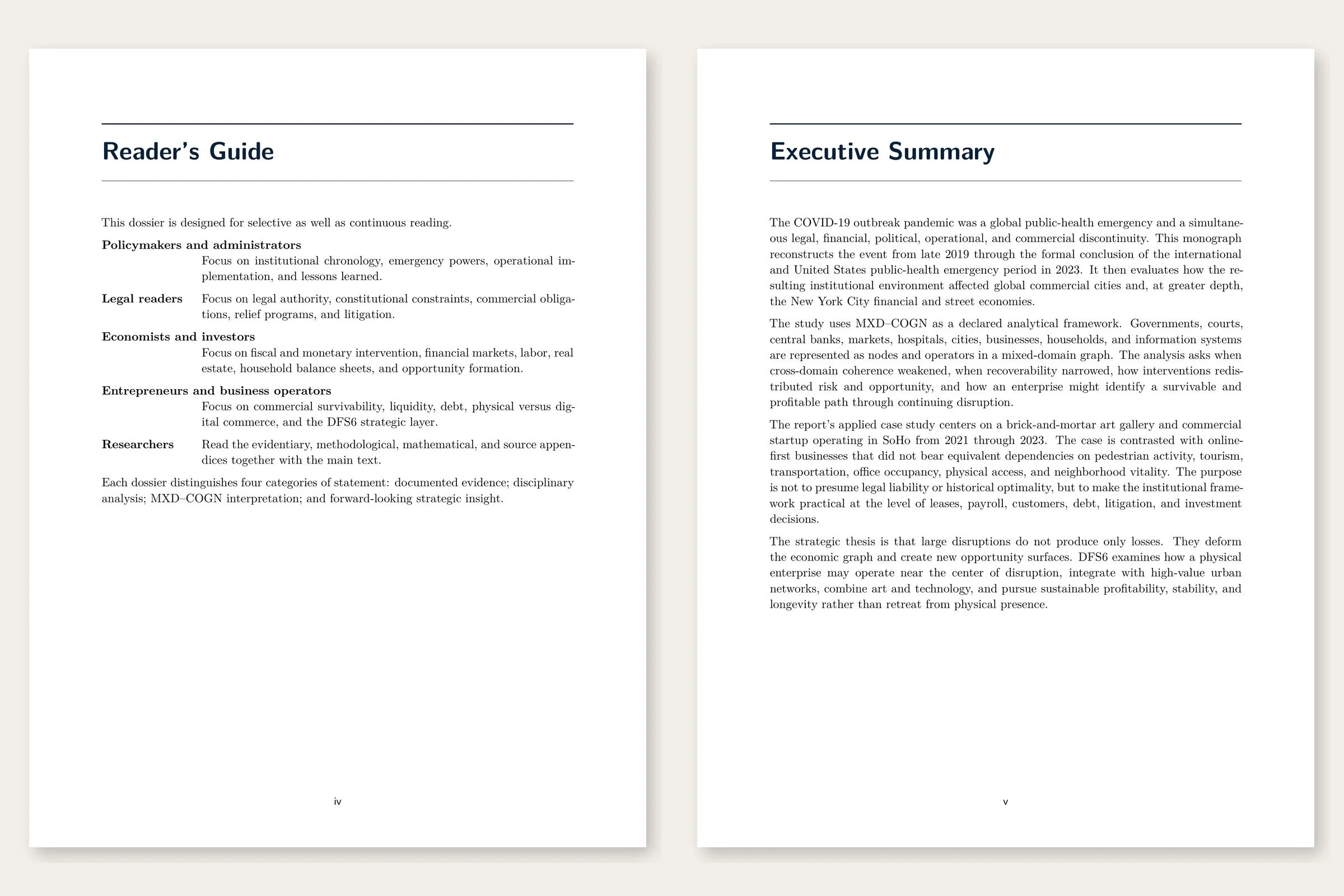
MXD-COGN: A Theory of Mixed-Domain, Mixed-Depth Cognition is the foundational reference for coherence engineering and deformation-controlled inference in complex systems. This work is not a conventional academic textbook, nor is it a software manual. It is a formal, graph-native theory of how inference executes, deforms, stabilizes, and fails across heterogeneous domains and depths of abstraction.
At its core, MXD-COGN introduces a mathematical language for treating inference as a first-class dynamical object. Systems are modeled as executable graphs governed by order parameters, deformation fields, and coherence constraints rather than isolated equations or static optimization targets. This perspective enables rigorous reasoning about stability, metastability, collapse, and early warning in systems that evolve over time, adapt to stress, and span physical, computational, and organizational layers.
The theory is intentionally domain-agnostic. It applies equally to RF and microwave systems, cyber-physical control architectures, artificial intelligence, socio-technical organizations, and large-scale engineered infrastructures. By unifying these domains under a shared inference geometry, MXD-COGN provides a stable foundation for analyzing systems that cannot be adequately described by classical control, linear stability, or isolated simulation alone.
Cogn-Tex™: A Theoretical Processing Design Kit
MXD-COGN functions as what Maxdi Inc. designates Cogn-Tex™—a theoretical processing design kit for inference and coherence. In the same way that a semiconductor PDK defines design rules, constraints, and interfaces for physical fabrication, Cogn-Tex™ defines the mathematical structures, invariants, and execution semantics required to reason about inference under deformation.
Cogn-Tex™ enables engineers, researchers, and institutions to encode systems into formal inference graphs, evaluate coherence margins, reason about deformation envelopes, and predict failure modes before collapse occurs. While the theory itself is fully specified in this text, its value compounds when paired with internal tools, simulation engines, or large language models capable of operating within the MXD-COGN framework.
This deliberate openness is not a loss of intellectual property; it is the foundation of it. By publishing the canonical theory, Maxdi Inc. establishes the reference standard upon which certified tools, execution engines, and institutional practices can be built.
Scope and Intent
MXD-COGN is written for advanced practitioners: researchers, system architects, and organizations confronting the limits of traditional modeling and control. It is not designed as an introductory survey or a tutorial series. Instead, it provides a closed, internally consistent theoretical framework intended to be cited, extended, and operationalized through companion platforms and certified implementations.
The book concludes at the level of theory. Questions of execution platforms, software engines, certification workflows, and deployment practices are intentionally treated as out-of-scope here and are addressed through separate products and services offered by Maxdi Inc.
In publishing MXD-COGN, Maxdi Inc. releases the mathematical foundation of coherence engineering while retaining the ability to deliver value through execution, certification, and institutional enablement. This text is the reference point from which all MXD-COGN-compliant systems derive legitimacy.
Pricing and Access
MXD-COGN is offered under an institutional access model, reflecting its role as a foundational theory and processing design kit (Cogn-Tex™) rather than a conventional retail textbook.
Institutional License (Primary Offering)
Institutions—including universities, research laboratories, defense organizations, and corporate R&D groups—may license MXD-COGN for internal research, teaching, and architectural development.
Institutional Access Fee:
USD $2,500 per year
Includes:
Full digital access to MXD-COGN: A Theory of Mixed-Domain, Mixed-Depth Cognition
Internal institutional use for research and instruction
Eligibility for MXD-COGN–aligned tooling, certification, and execution platforms
This model ensures that MXD-COGN remains a stable, authoritative reference while enabling institutions to build compliant systems and curricula on top of the theory.
Individual Researchers and Enterprise Access
Individual researchers, independent scholars, and commercial enterprises seeking direct access or broader usage rights should contact Maxdi Inc. to discuss appropriate licensing and enablement options.
📧 Contact: tex@cognitave.com
Enterprise engagements may include:
Extended usage rights
Integration with execution engines and design tools
Certification pathways and technical onboarding
Pricing for these engagements is determined based on scope, scale, and intended application.
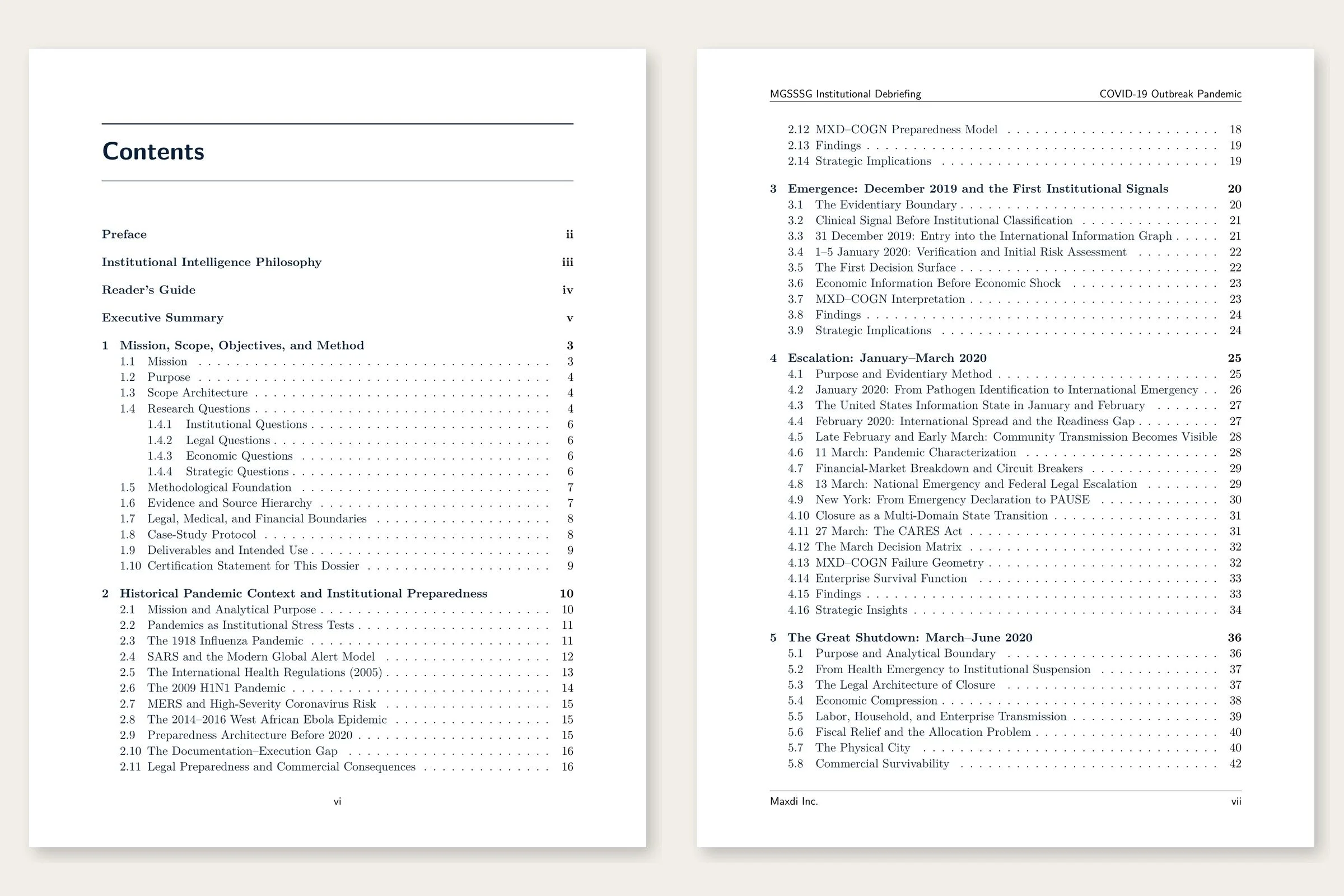
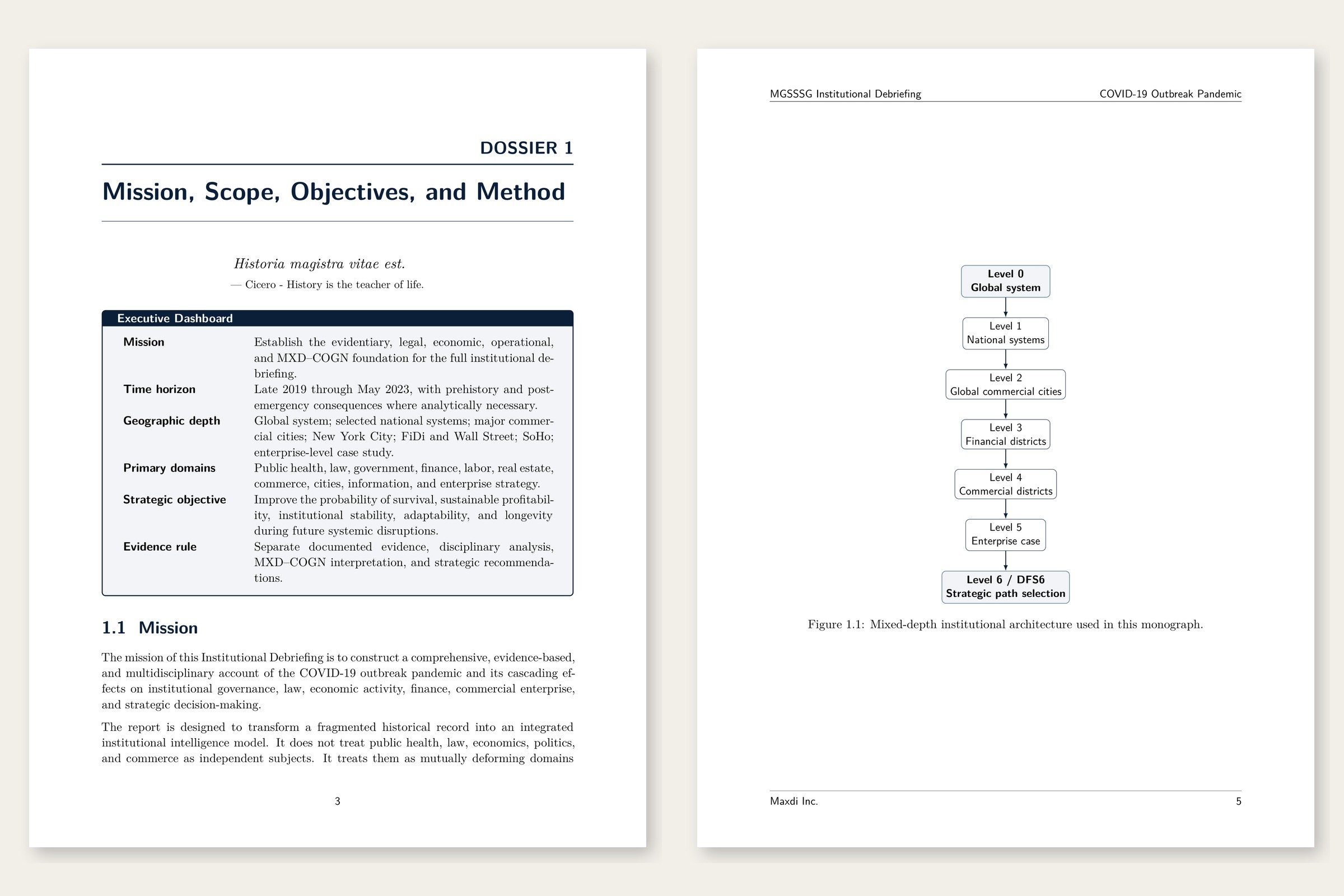
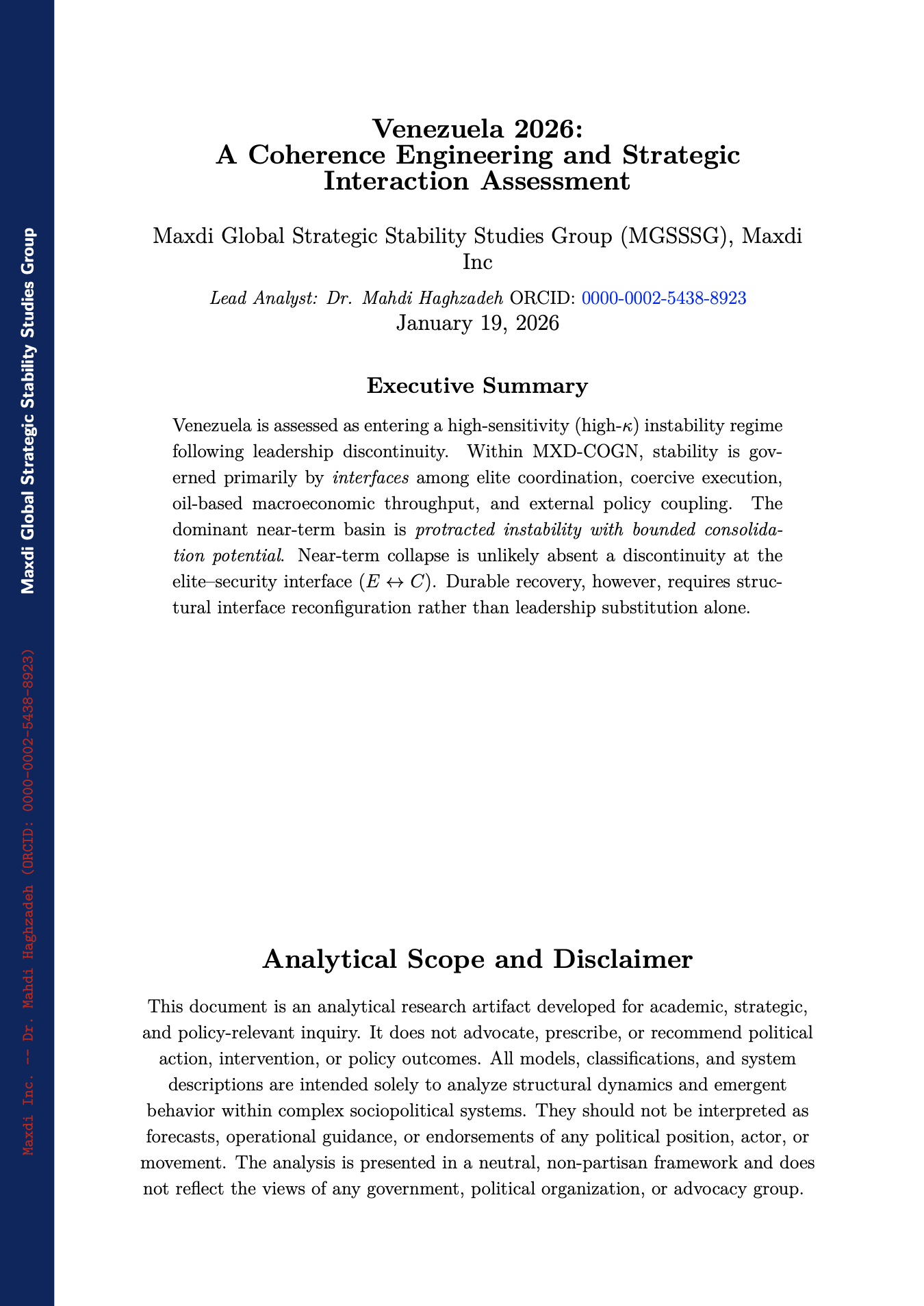
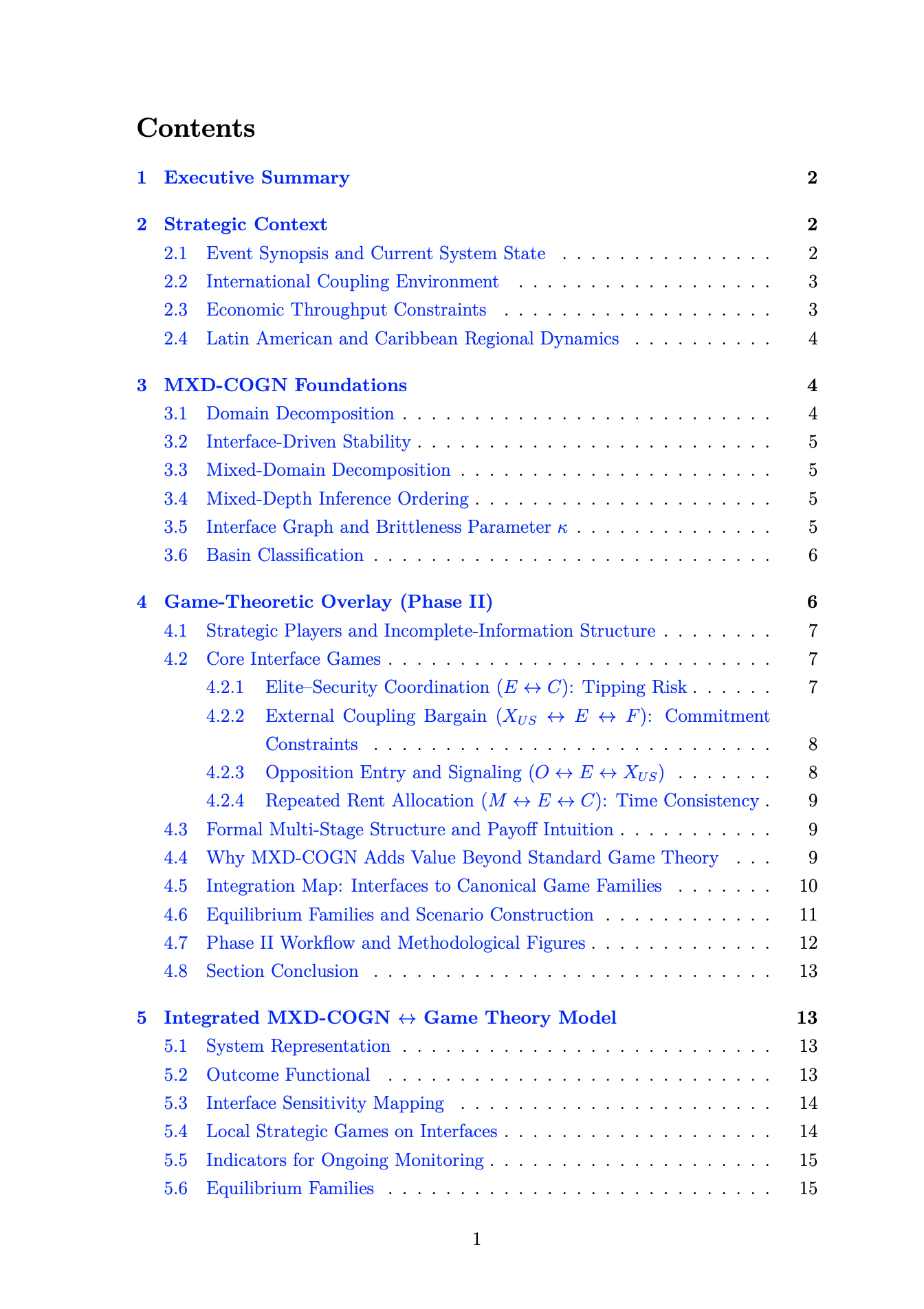
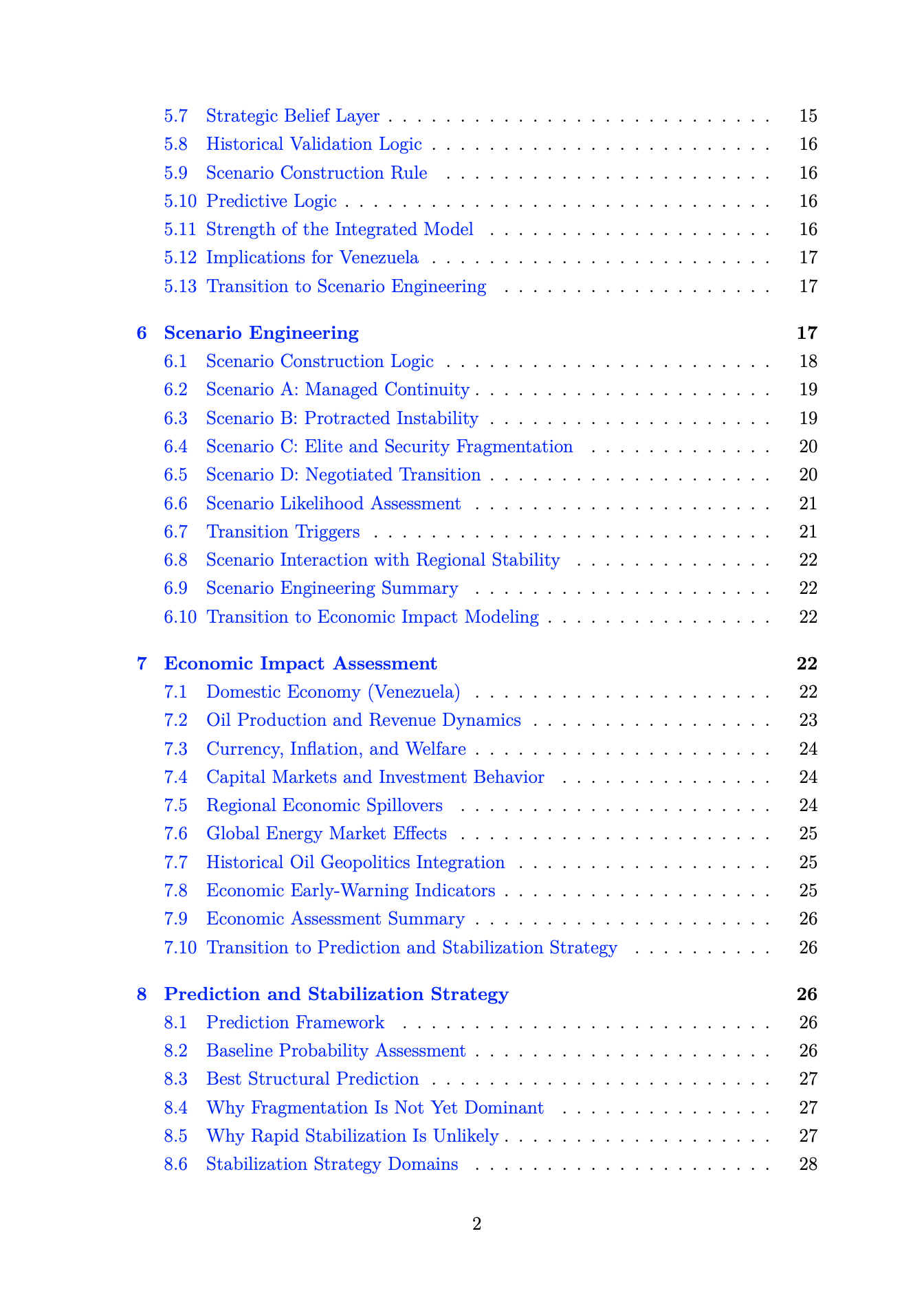
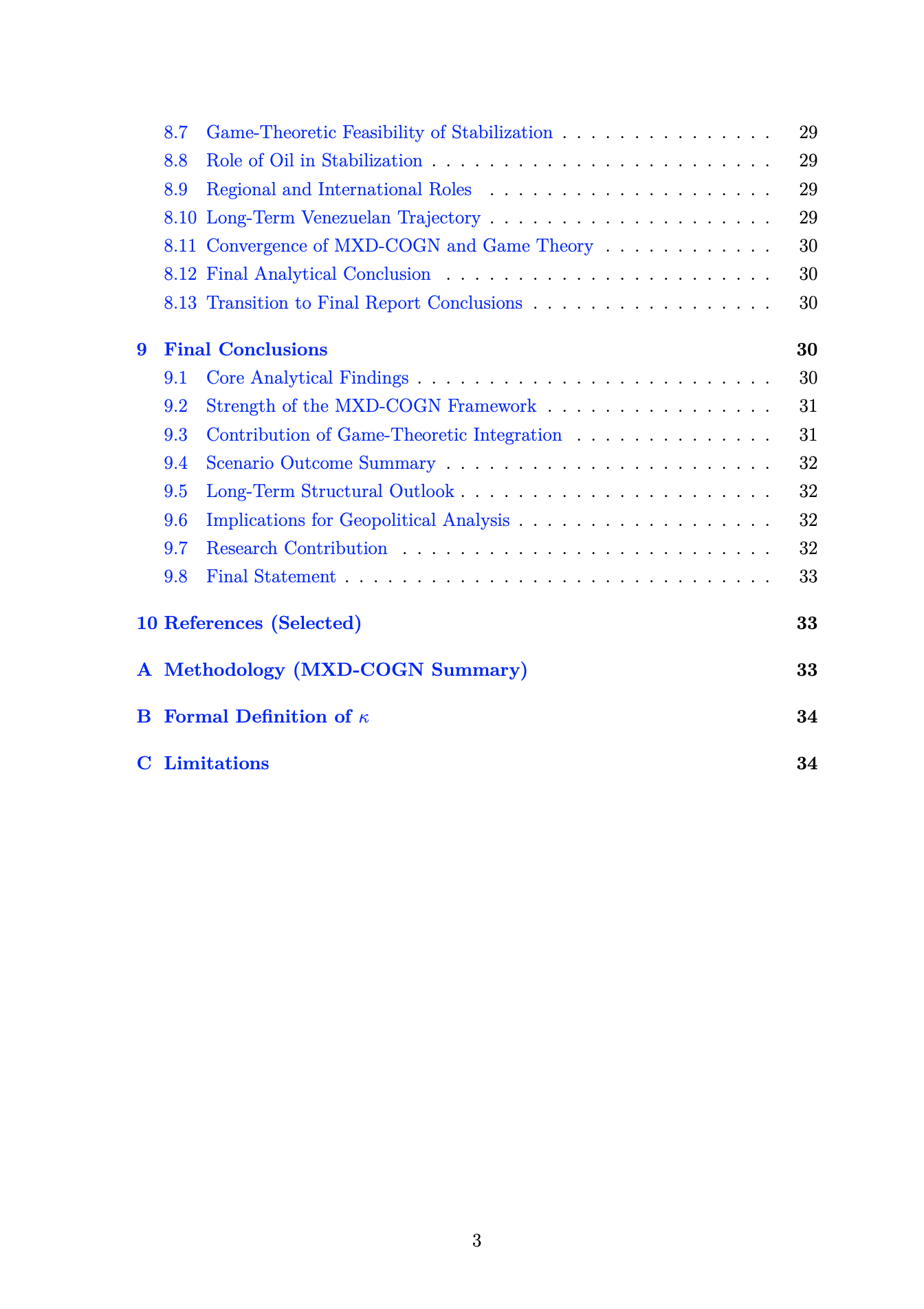
Venezuela 2026 is a paid institutional research report published by the Maxdi Global Strategic Stability Studies Group (MGSSSG). The report applies the MXD-COGN coherence-engineering framework, integrated with a formal game-theoretic overlay, to analyze Venezuela’s instability environment following leadership discontinuity and intensified external intervention dynamics.
Rather than offering narrative forecasts or policy prescriptions, the assessment models Venezuela as a high-sensitivity (high-κ) system, where outcomes are governed by interactions across elite coordination, coercive execution, oil-based macroeconomic throughput, legitimacy formation, and external policy coupling. The report identifies structural instability basins, interface brittleness, and equilibrium families that define Venezuela’s near- and medium-term trajectories.
Core analytical focus areas include oil sector control and revenue governance, sanctions and licensing dynamics, elite–security coordination risk, opposition signaling constraints, civilian welfare implications, and regional spillover pathways. Scenario engineering is conducted as a function of interface sensitivity and belief dynamics, not leadership symbolism or event-driven speculation.
This report is intended for institutional analysts, policy professionals, investors, and research organizations requiring disciplined, non-prescriptive structural analysis under conditions of contested information and political volatility.
Format: Institutional PDF
Length: ~50 pages
Classification: Restricted institutional analysis (non-prescriptive)
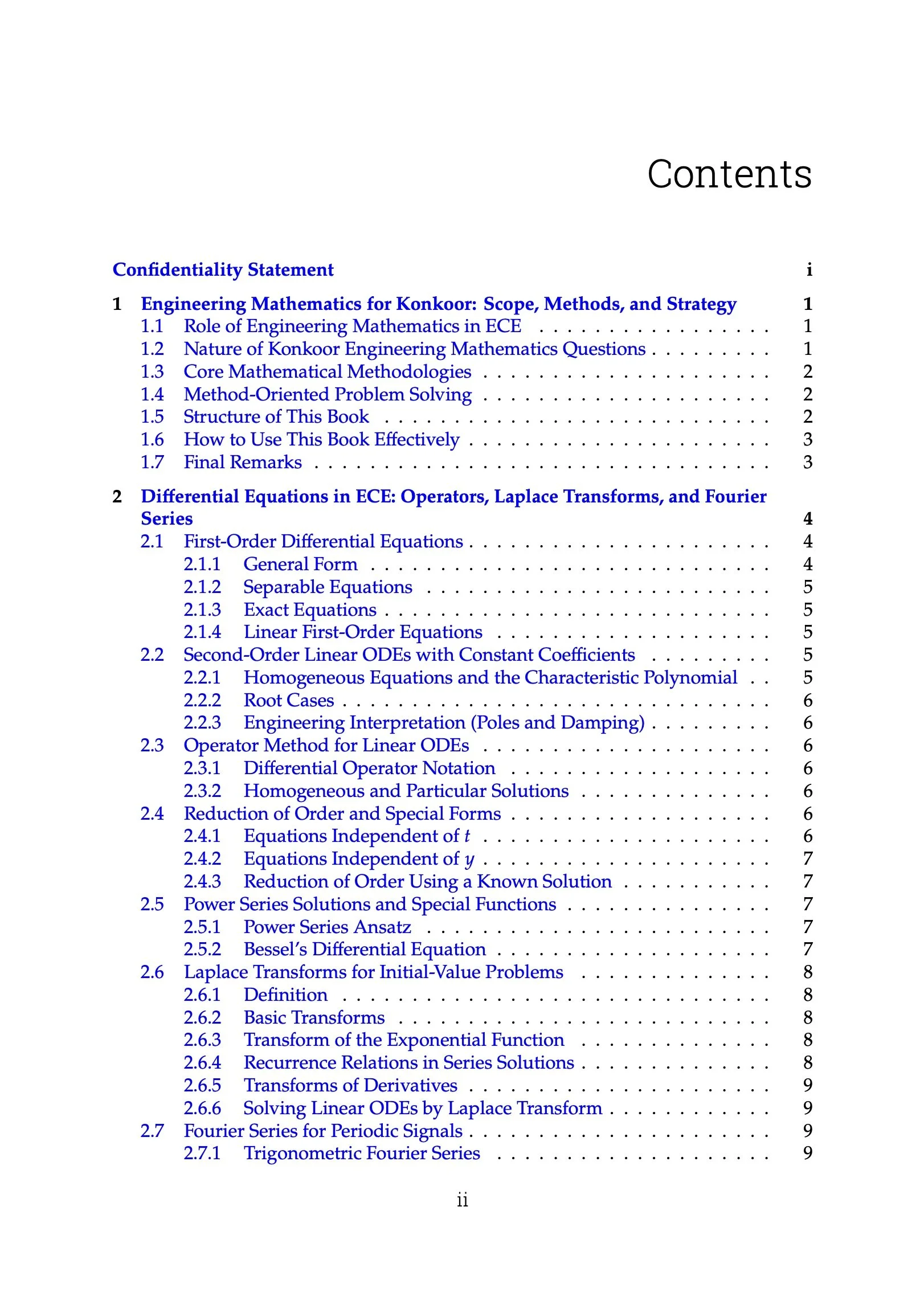
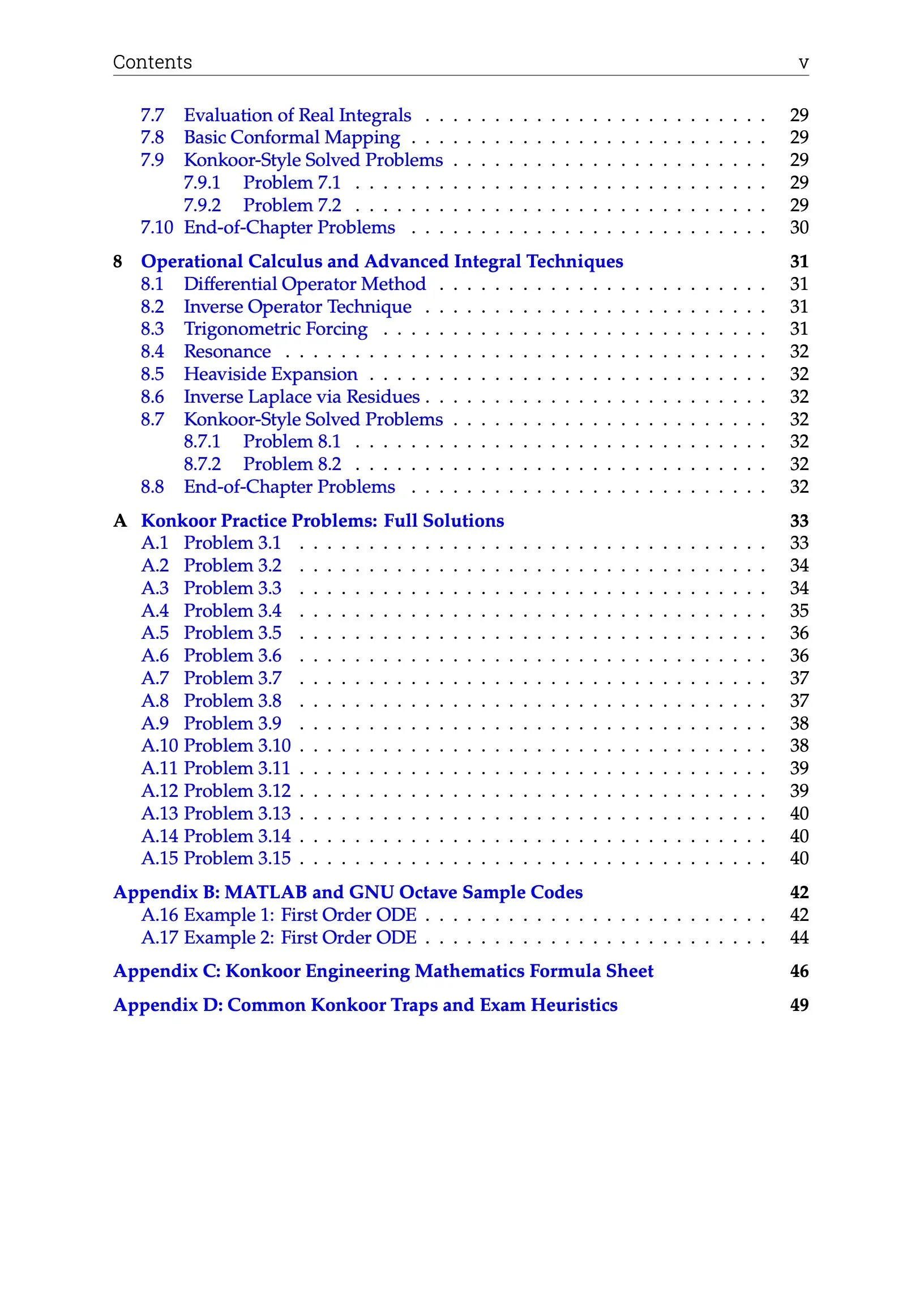
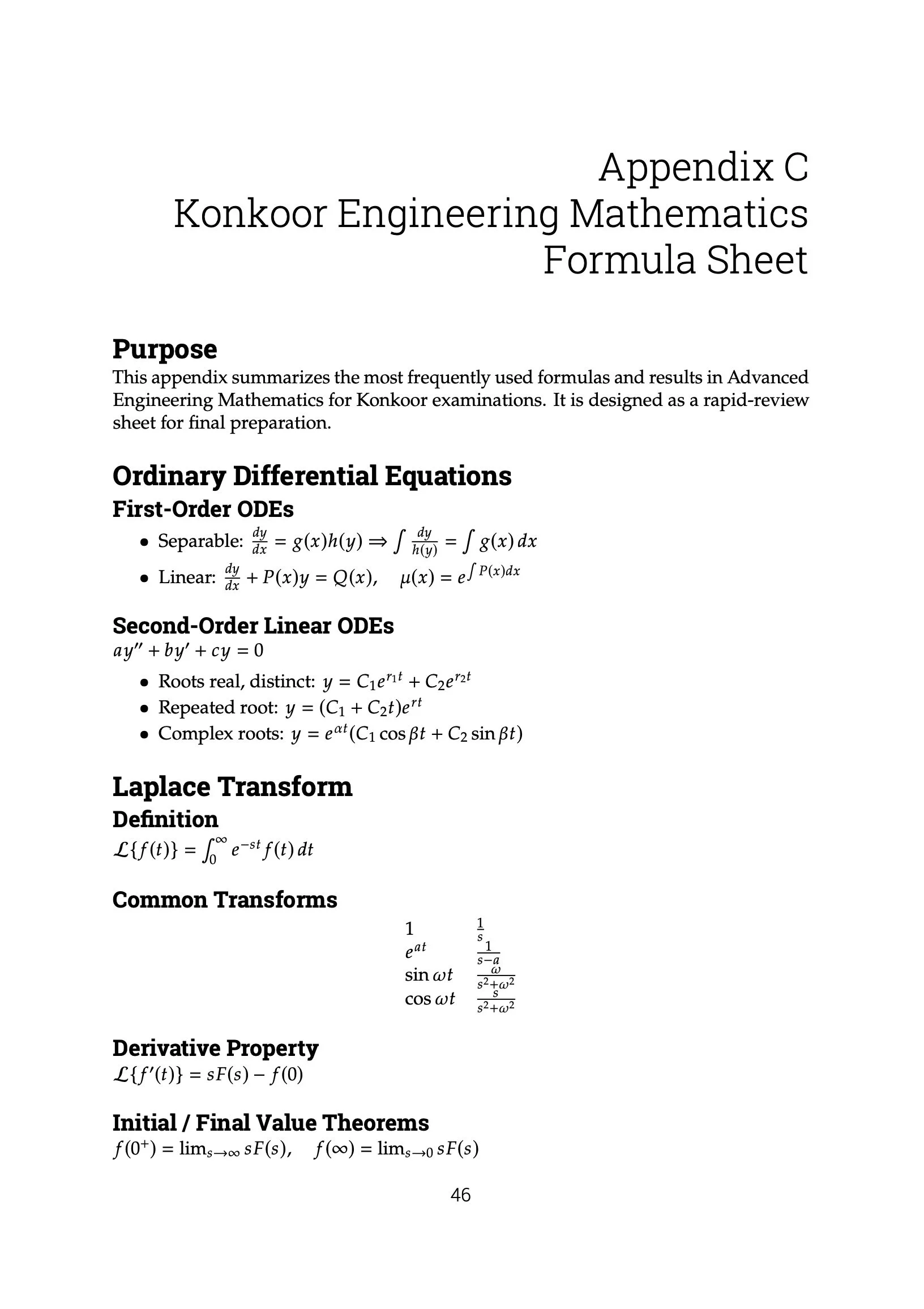
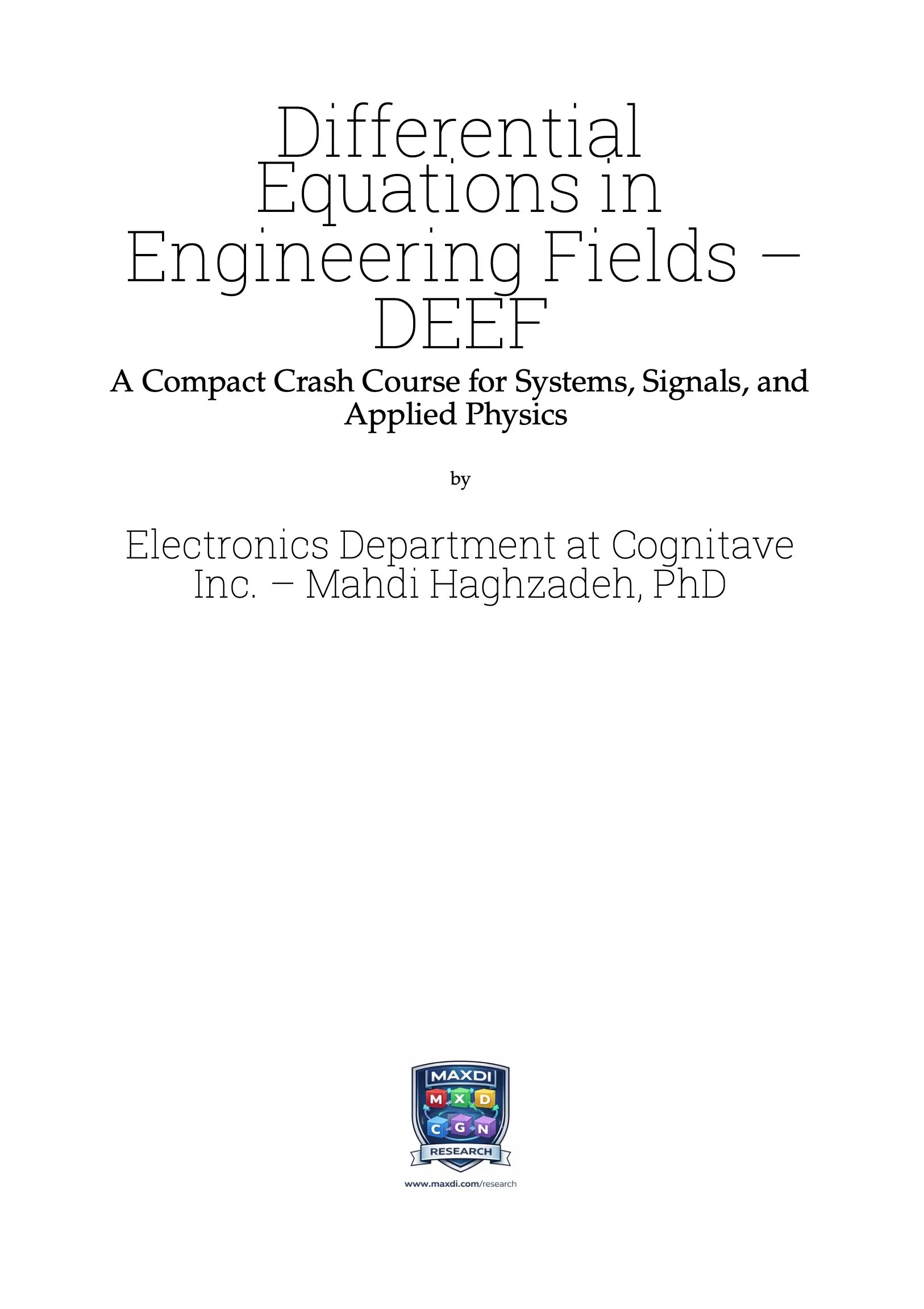
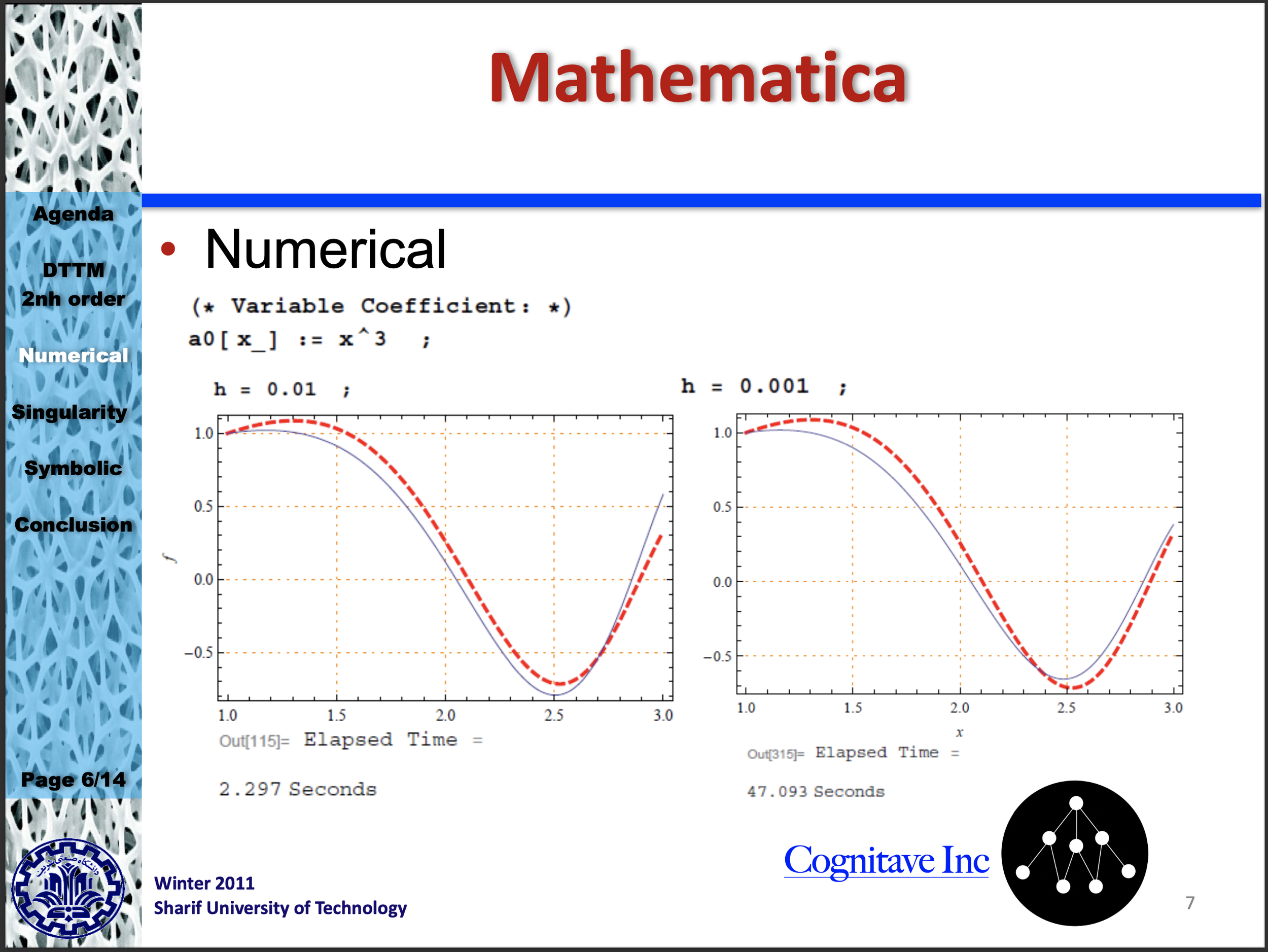
Differential Equations in Engineering Fields is a compact, intensive crash-course ebook designed to cover the core ordinary differential equations (ODE) material taught across engineering disciplines, with emphasis on how these equations are actually used in advanced engineering contexts.
This book originated from a series of accelerated courses taught by Mahdi Haghzadeh between 2008 and 2010 to undergraduate engineering students preparing for graduate-level entrance examinations. The objective of those courses was not breadth, but efficiency: to equip students with the essential differential-equation tools required to succeed in advanced engineering topics within a limited timeframe.
As a result, the ebook focuses on the standard ODE curriculum common to electrical engineering, computer engineering, computer science, and related fields, while consistently framing the material in terms of engineering systems and physical interpretation.
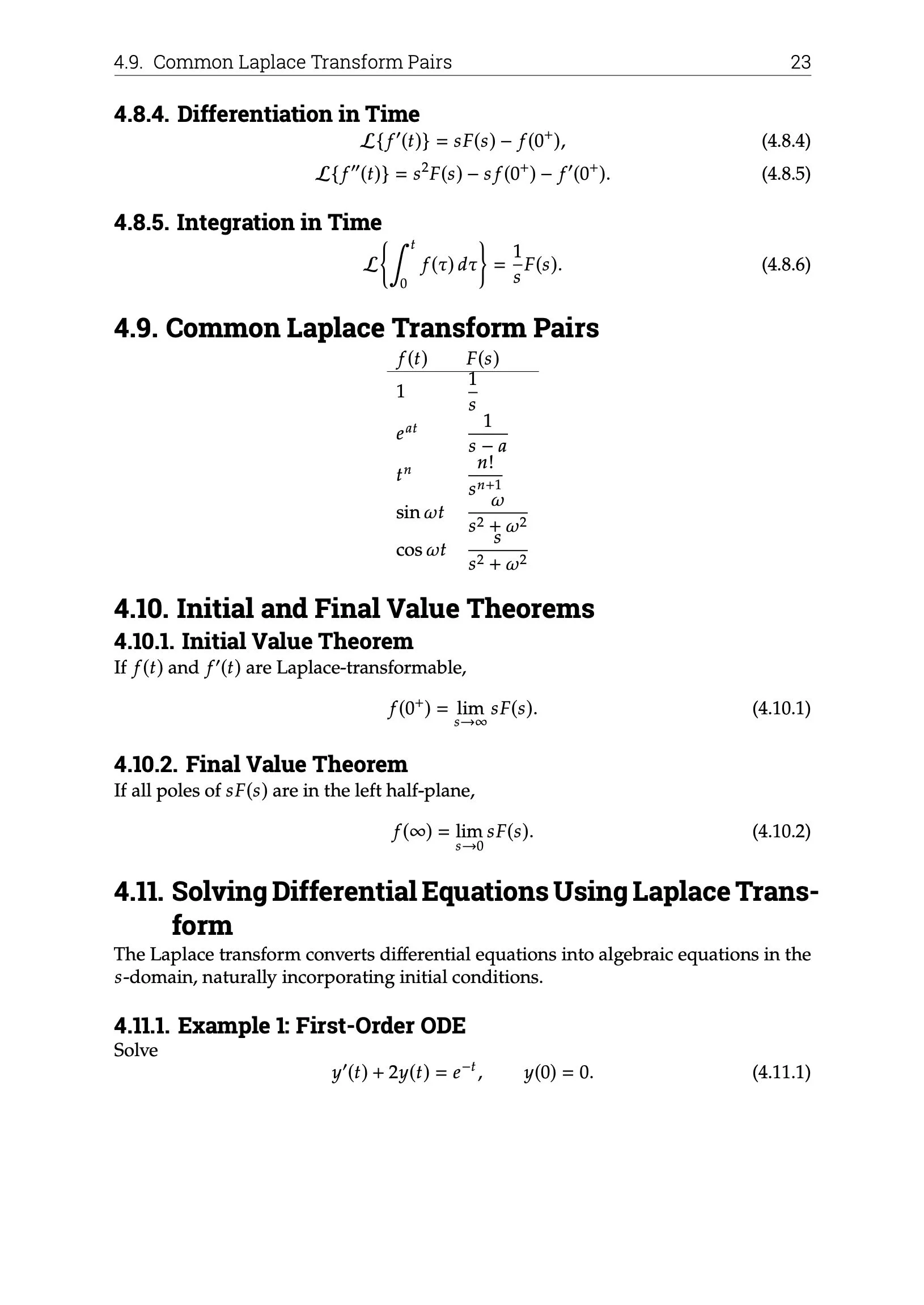
The book develops a streamlined progression through first- and higher-order ordinary differential equations, linear systems with constant coefficients, and homogeneous and non-homogeneous formulations. Responses to impulse, step, and exponential inputs are treated as central modeling cases rather than peripheral examples. Laplace-transform-based methods are introduced early and used systematically as the most effective framework for solving initial-value problems and analyzing system response.
What distinguishes this crash course is its engineering orientation. Solutions are not presented as purely mathematical results; they are interpreted in the context of real systems such as resonant circuits, RF and microwave structures, control systems, and simplified models arising in applied quantum mechanics. The focus is on understanding how differential equations encode dynamics, stability, and transient behavior.
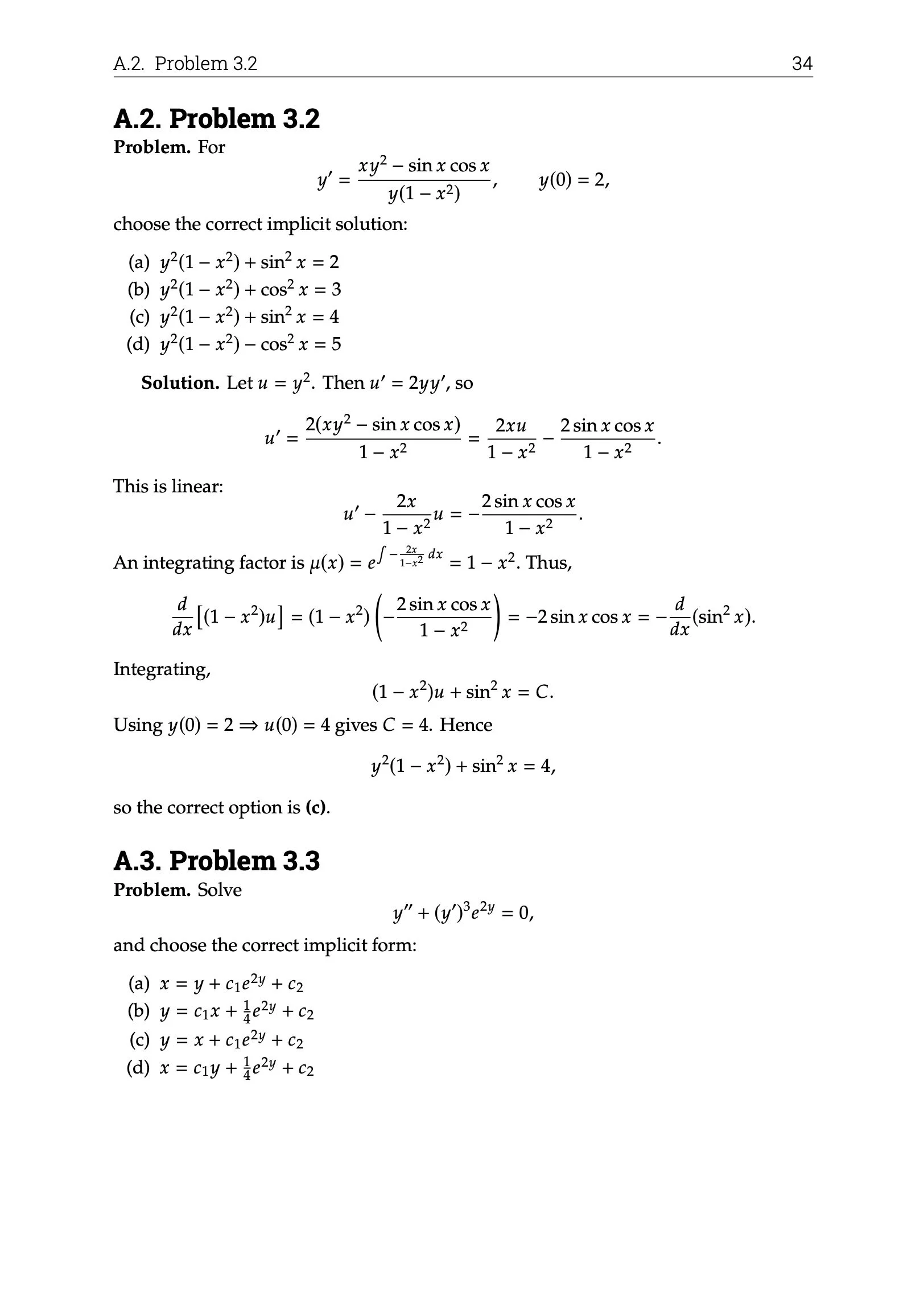
Worked examples are developed fully and concisely, reflecting the pace and structure of an intensive course. In addition, a selected set of original Konkoor problems from the 2008 examination cycle is solved in detail, illustrating how standard ODE techniques are tested in advanced engineering assessments.
This ebook is intended as a rapid yet rigorous reference for students and engineers who already possess basic calculus and linear algebra, and who need a focused review of differential equations as they appear in higher-level engineering applications.
Core Topics Covered
The material develops a coherent progression through:
first- and higher-order ordinary differential equations
linear systems with constant coefficients
homogeneous and non-homogeneous equations
impulse, step, and exponential inputs
Laplace-transform-based solution methods
initial-value problems and system response
engineering interpretation of solutions
Worked examples are fully developed, and problem sets are aligned with advanced engineering expectations.
Key Features
System-driven approach to differential equations
Transform methods integrated naturally into solution workflows
Emphasis on physical and engineering interpretation
Fully worked examples and solved problem sets
Consistent notation and mathematical typography
Designed for advanced undergraduate and graduate ECE
Format
Digital textbook (PDF)
High-resolution mathematical typesetting
Optimized for screen reading and printing
Pricing
Digital Edition (PDF):
💲 $11.99 USD
Academic and institutional licensing available upon request.
Intended Audience
Electrical and computer engineering students
Graduate-level engineering candidates
Practicing engineers working with dynamic systems
Researchers seeking a compact, rigorous ODE reference
About the Author
Mahdi Haghzadeh, PhD, is an engineer and researcher at Maxdi Research, working on mathematical systems theory, signal analysis, and advanced computational methods for engineering and physics.
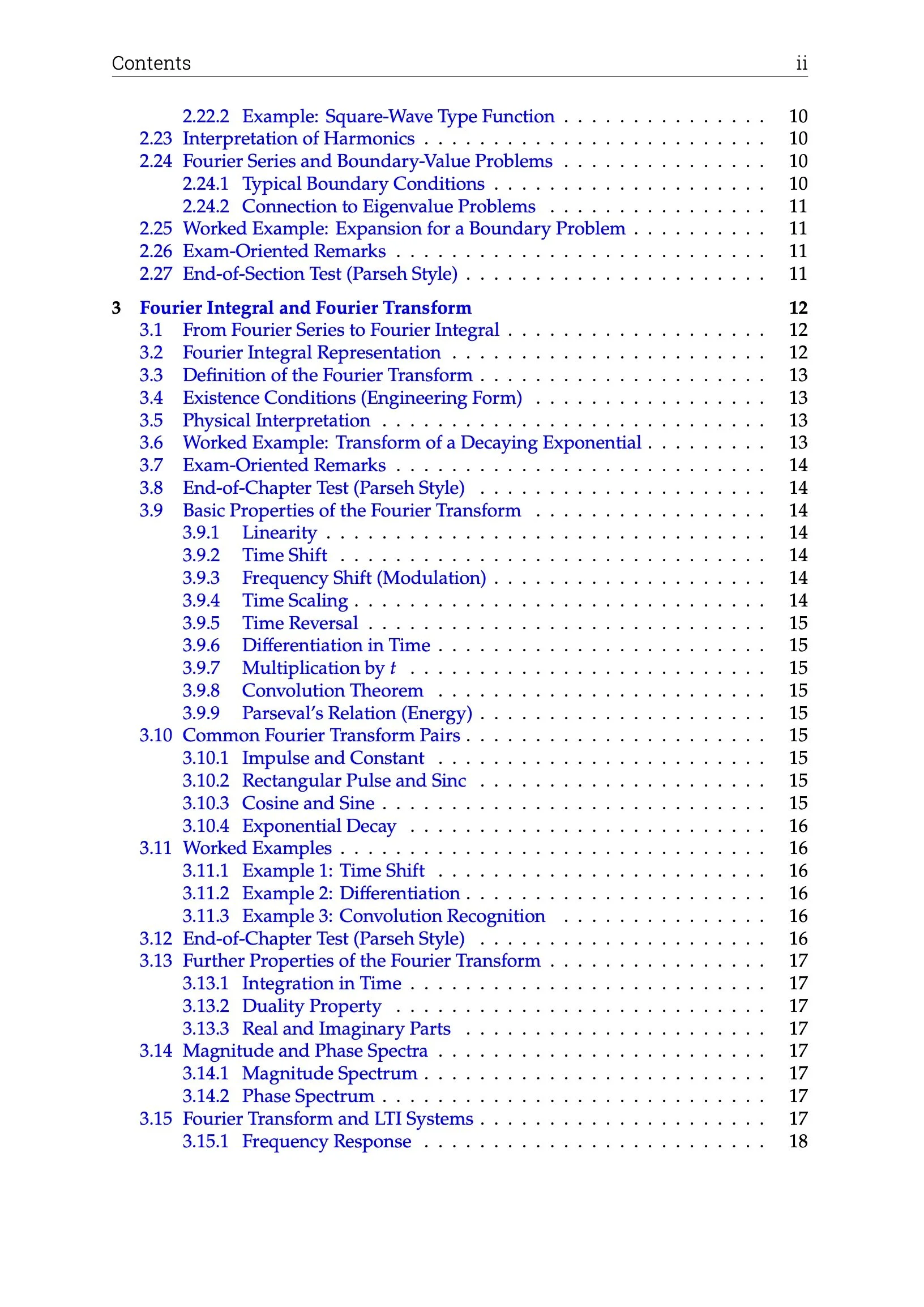
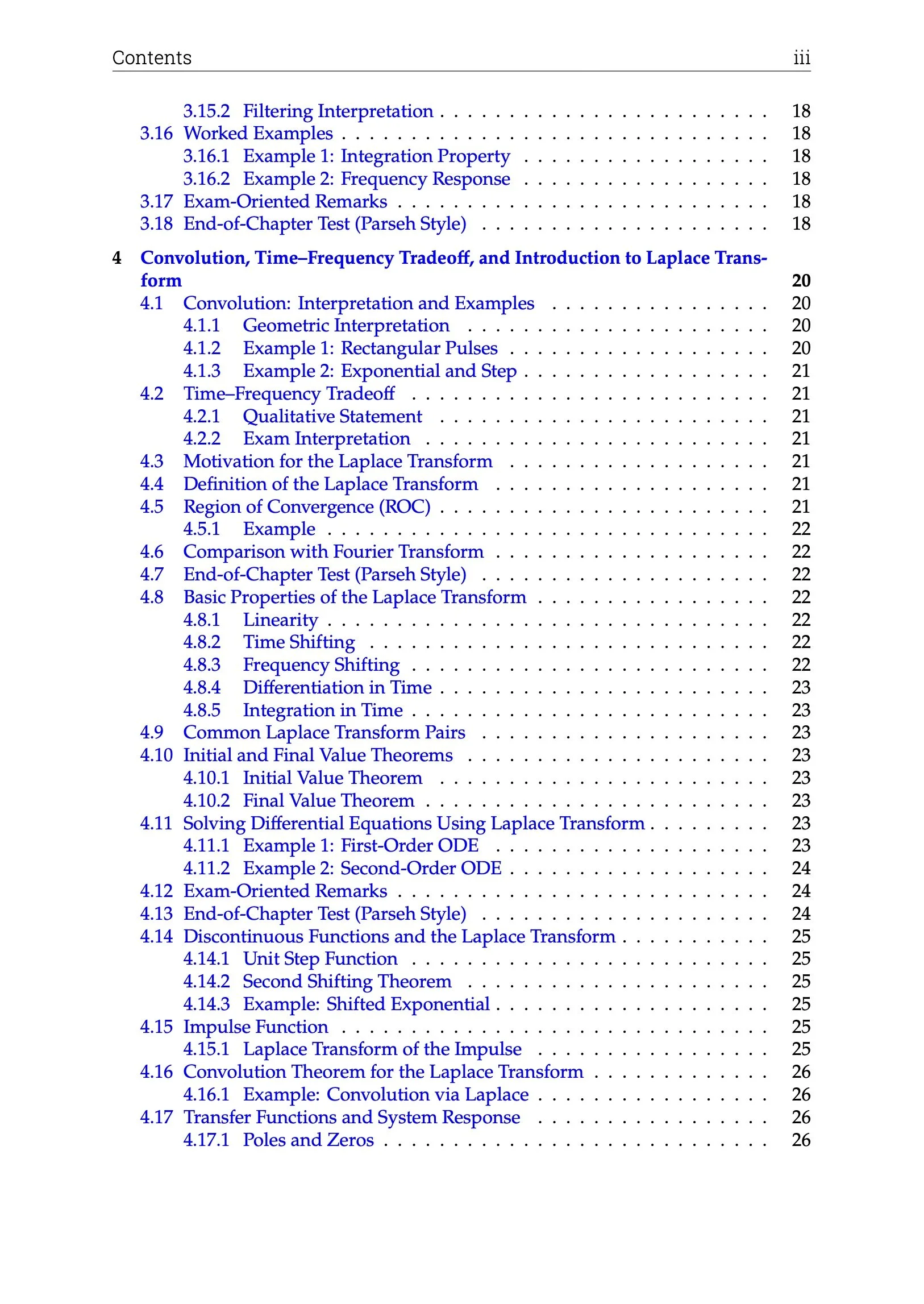
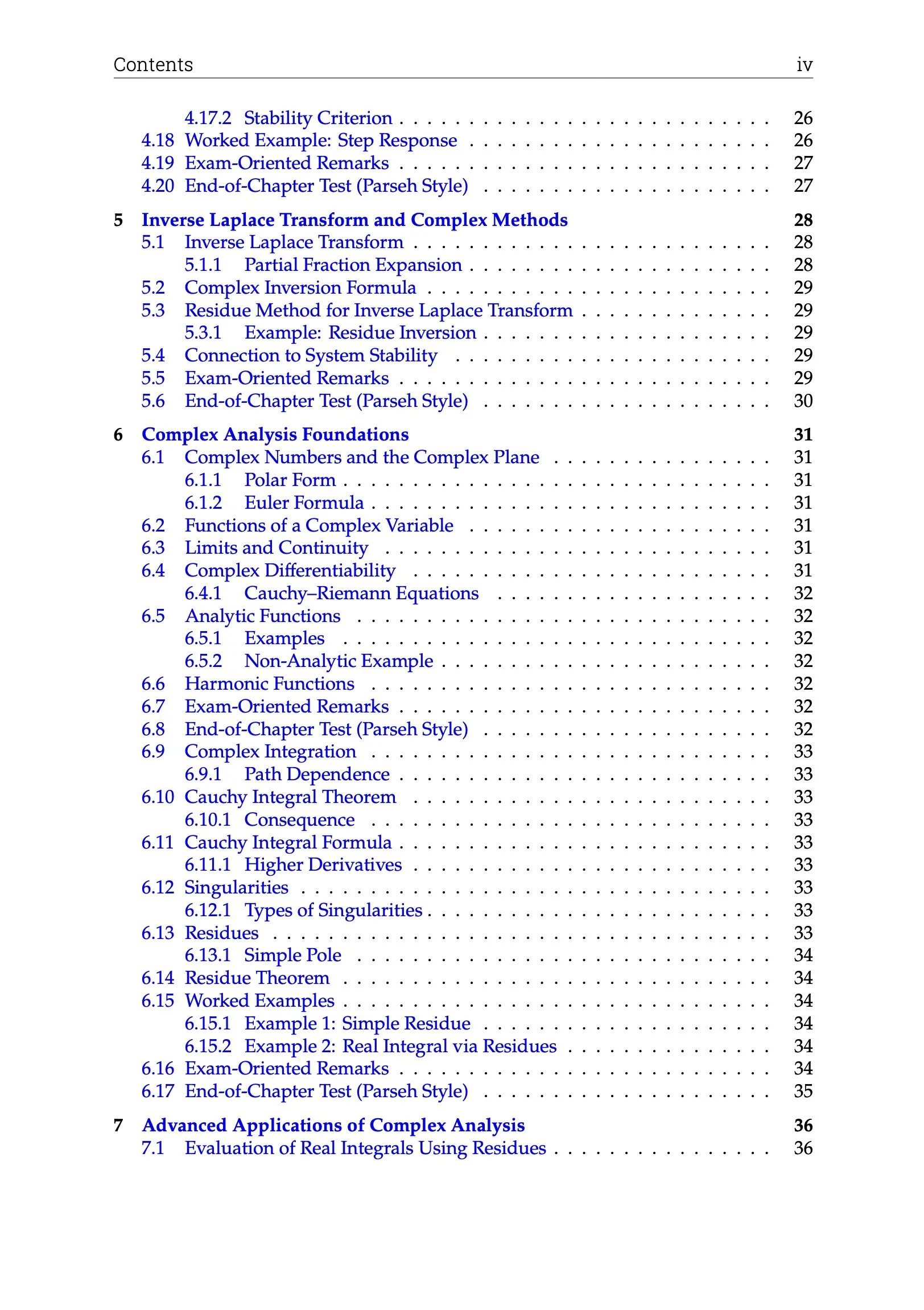
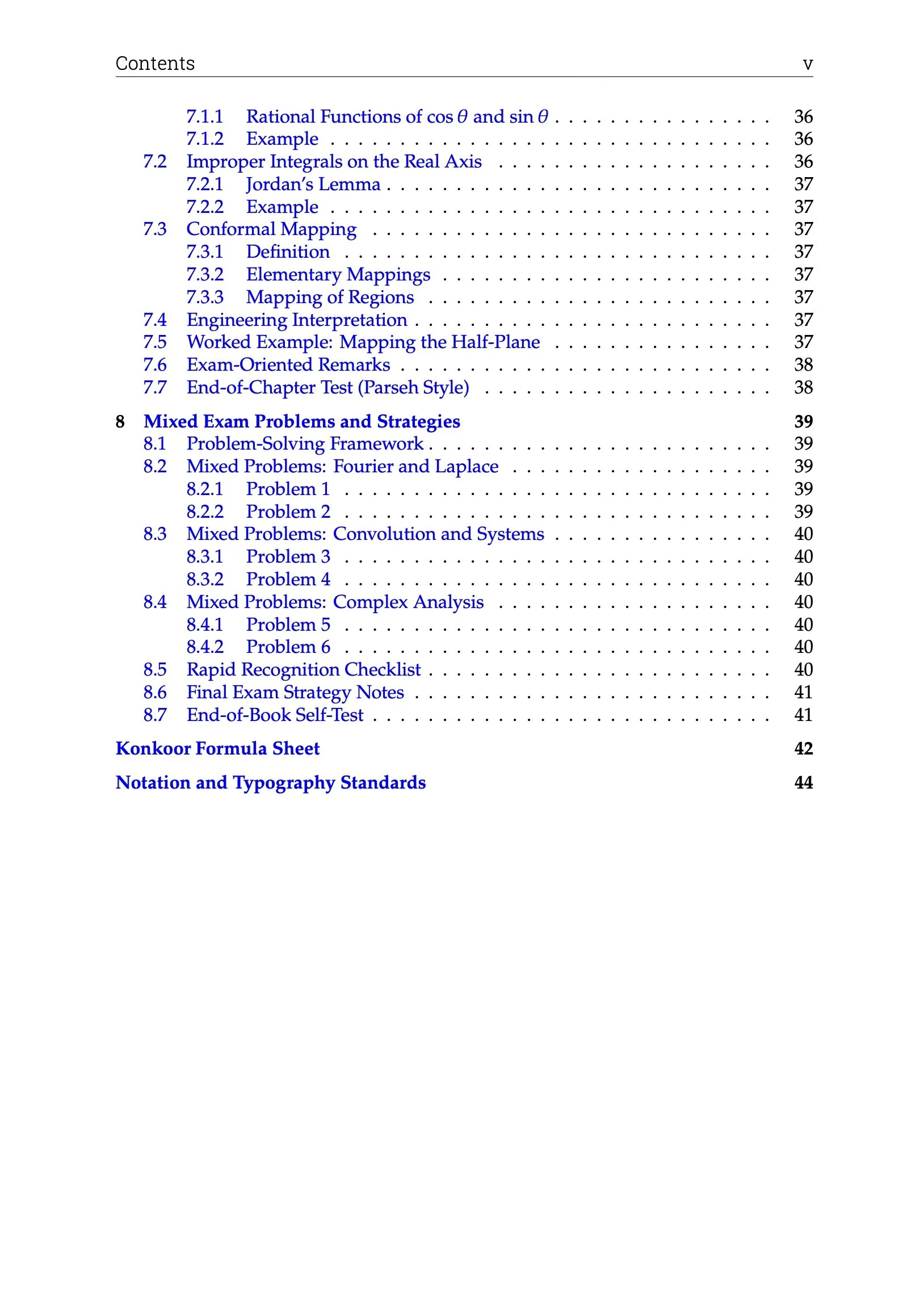
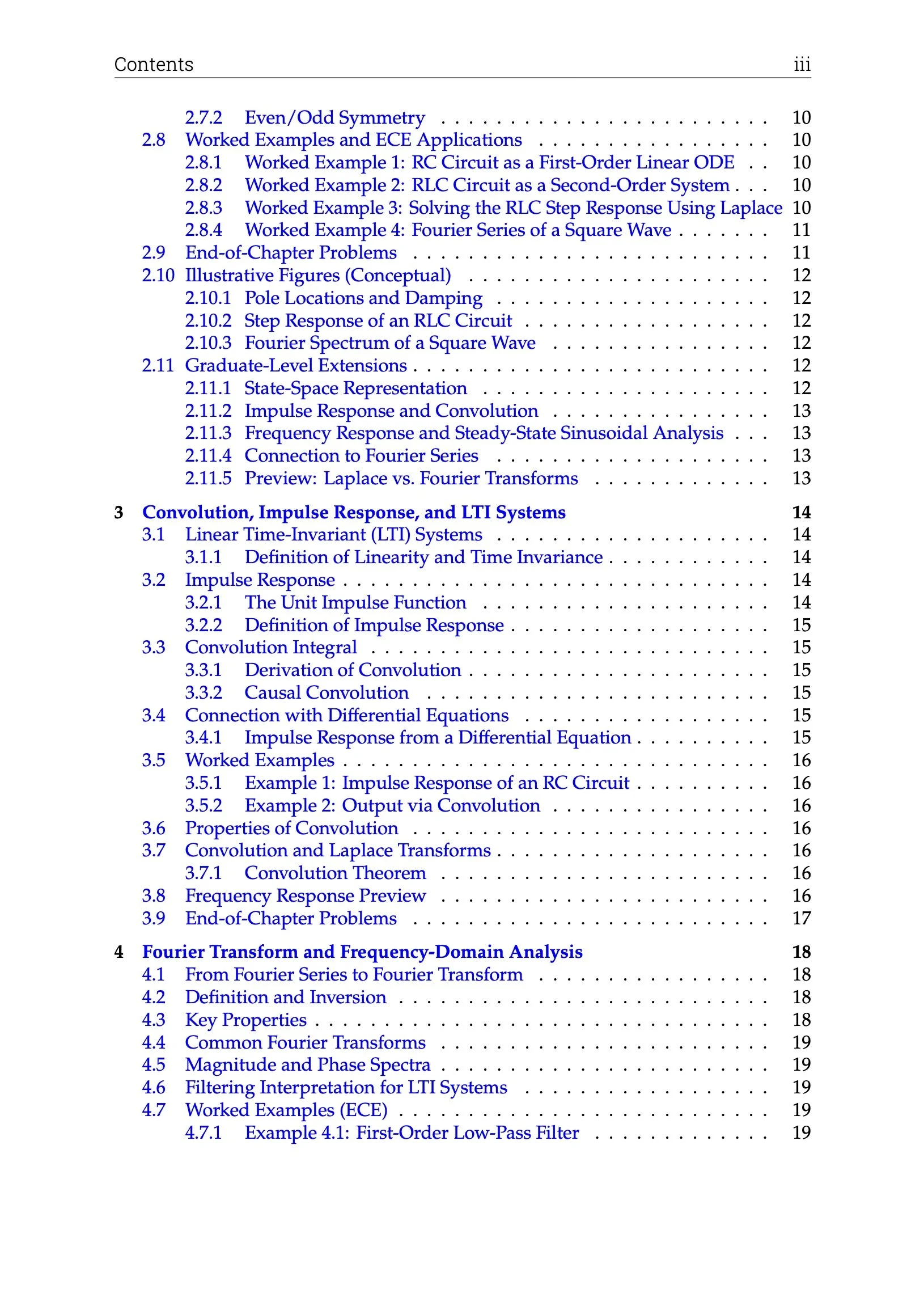
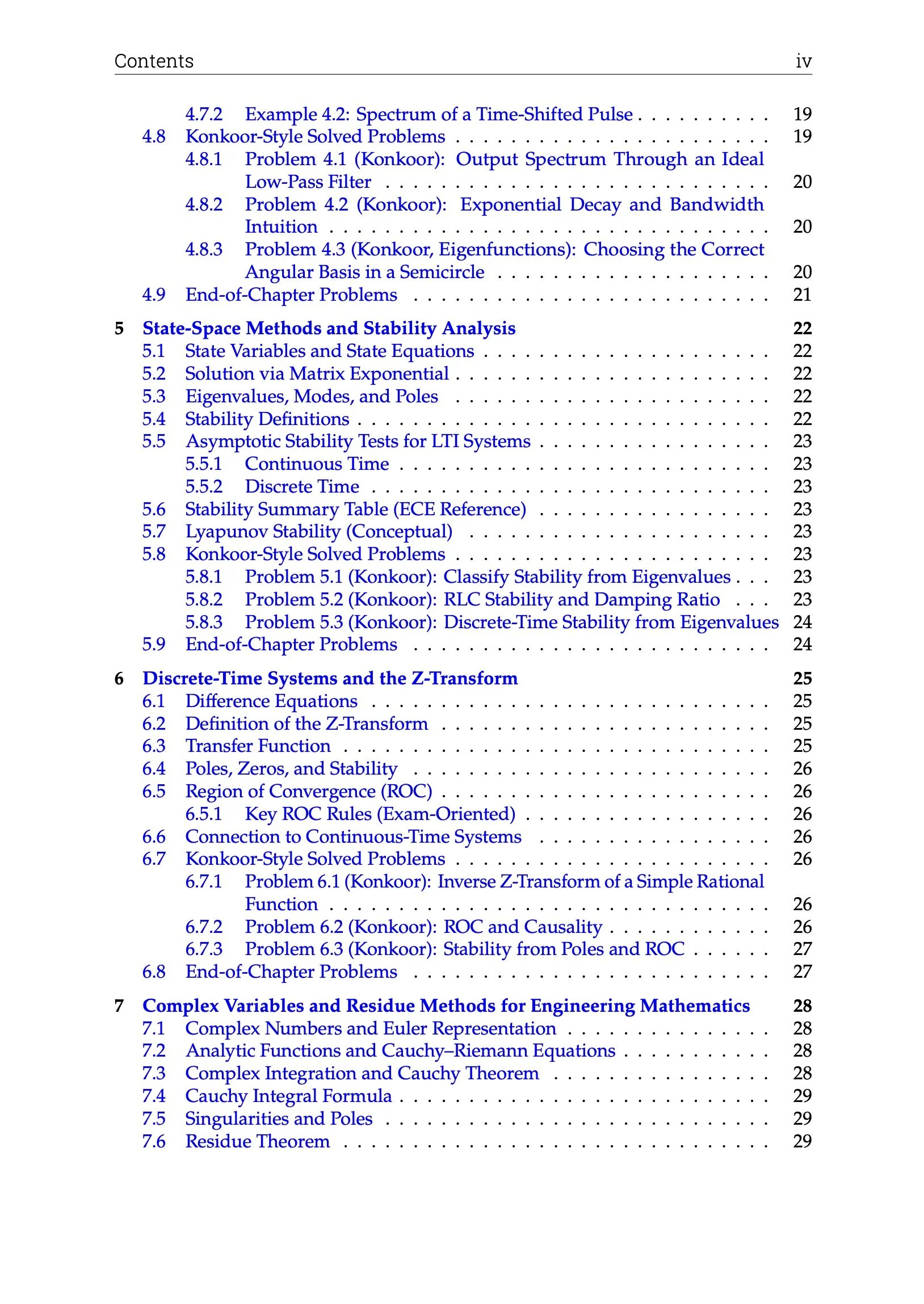
Advanced Engineering Mathematics is a compact digital ebook covering the core mathematical techniques commonly taught in advanced engineering mathematics courses.
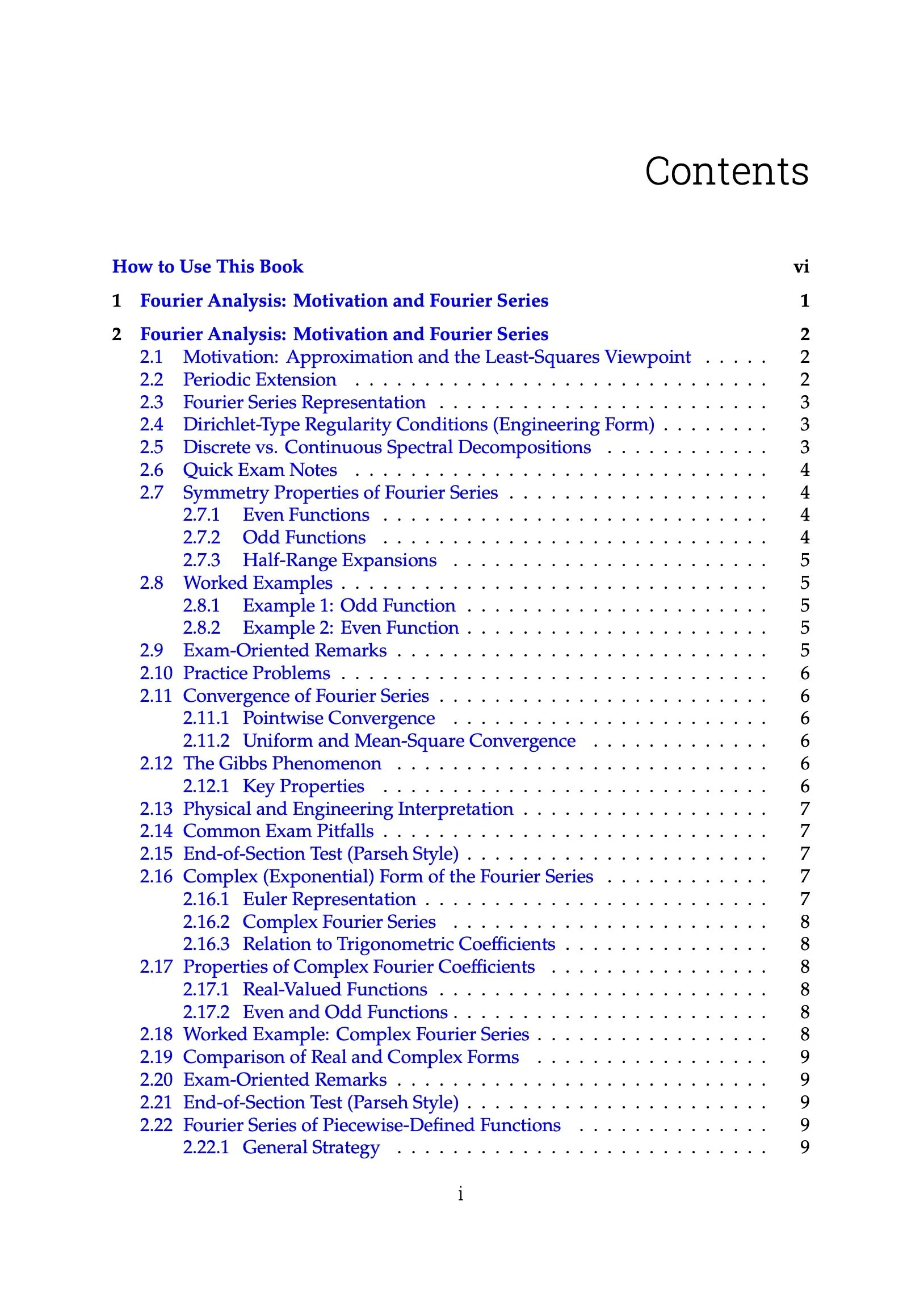
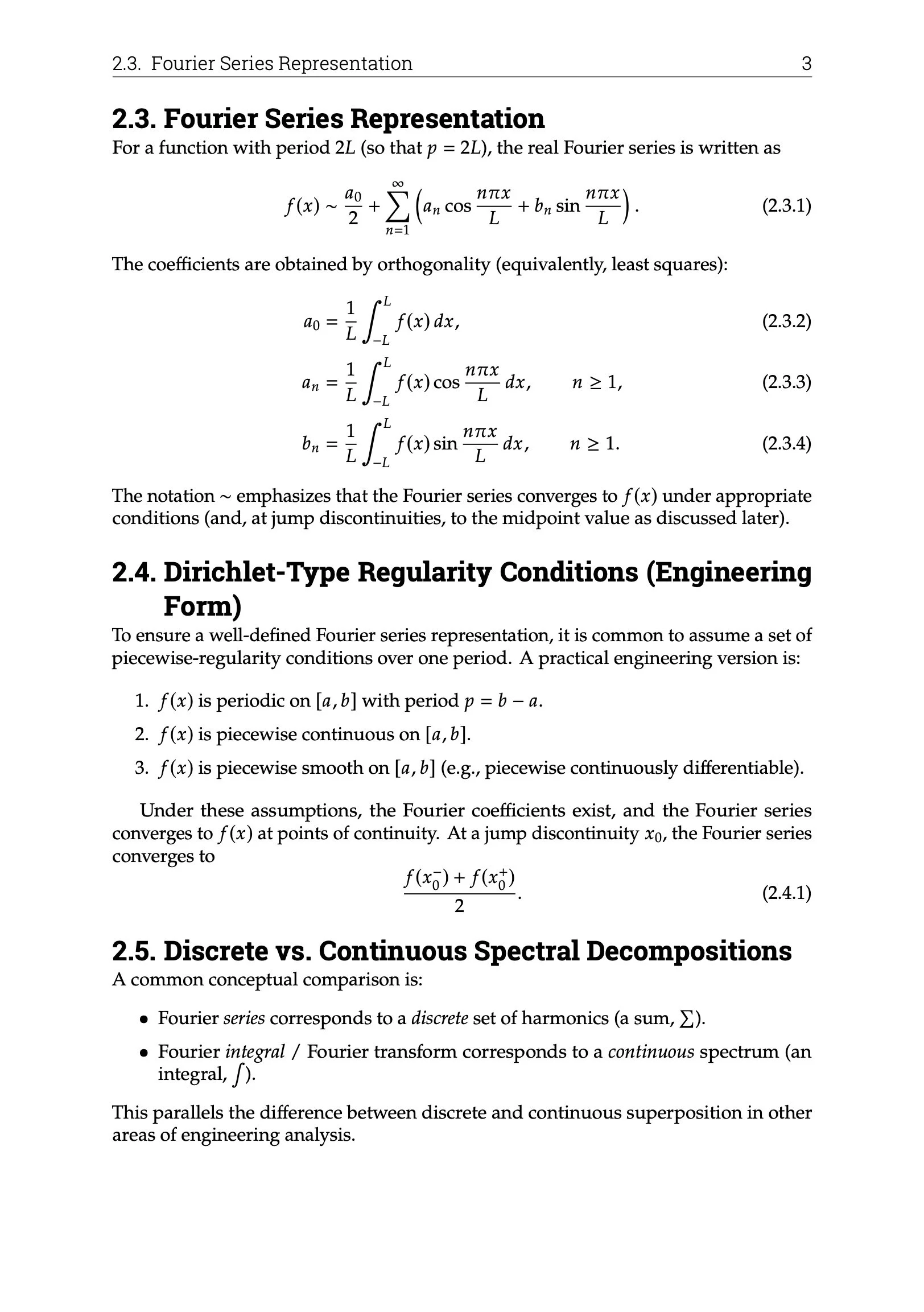
The material presents a structured treatment of Fourier series and spectral representation, followed by the Fourier transform and its use in linear time-invariant systems. Laplace transform methods are developed for solving differential equations and analyzing system behavior in the transform domain. Convolution, stability, and system response are introduced as fundamental mathematical operations and properties.
The book also includes a focused introduction to complex analysis, covering analytic functions, residue methods, contour integration, real integrals, and conformal mapping. These topics are developed as mathematical tools that support transform methods and advanced problem solving.
The final sections integrate the material through mixed advanced problems and exam-oriented strategies. Worked examples are fully developed, and problem sets are aligned with the expectations of advanced engineering mathematics coursework and examinations.
This ebook is intended for students and engineers with prior exposure to calculus and linear algebra who are seeking a concise and organized presentation of advanced engineering mathematics techniques.
What This Book Is For
Senior undergraduate and graduate ECE students
Engineers working in signal processing, control, and systems
Candidates preparing for advanced engineering entrance or qualification exams
Researchers seeking a compact but rigorous mathematical reference
Key Features
Unified coverage of Fourier, Laplace, and complex analysis methods
System-level interpretation of mathematical tools
Fully worked examples and exam-style problems with solutions
Consistent notation and typography, enforced by a custom LaTeX class
One-page A4 exam formula sheet for rapid review
MATLAB/Octave code appendix for computational reinforcement
Contents Overview
Fourier Series and Spectral Representation
Fourier Transform and LTI Systems
Laplace Transform and Differential Equation Solving
Convolution, Stability, and System Response
Complex Analysis and Residue Methods
Real Integrals and Conformal Mapping
Mixed Advanced Problems and Exam Strategies
Format
Digital textbook (PDF)
High-resolution mathematical typesetting
Optimized for screen and print
Licensing & Use
This product is licensed for individual academic and professional use.
For institutional licensing or course adoption, please contact Maxdi Research.
About the Author
Mahdi Haghzadeh, PhD, is a researcher and engineer working at the intersection of mathematics, systems theory, and advanced computation. His work spans engineering mathematics, signal analysis, and quantum analog computing.
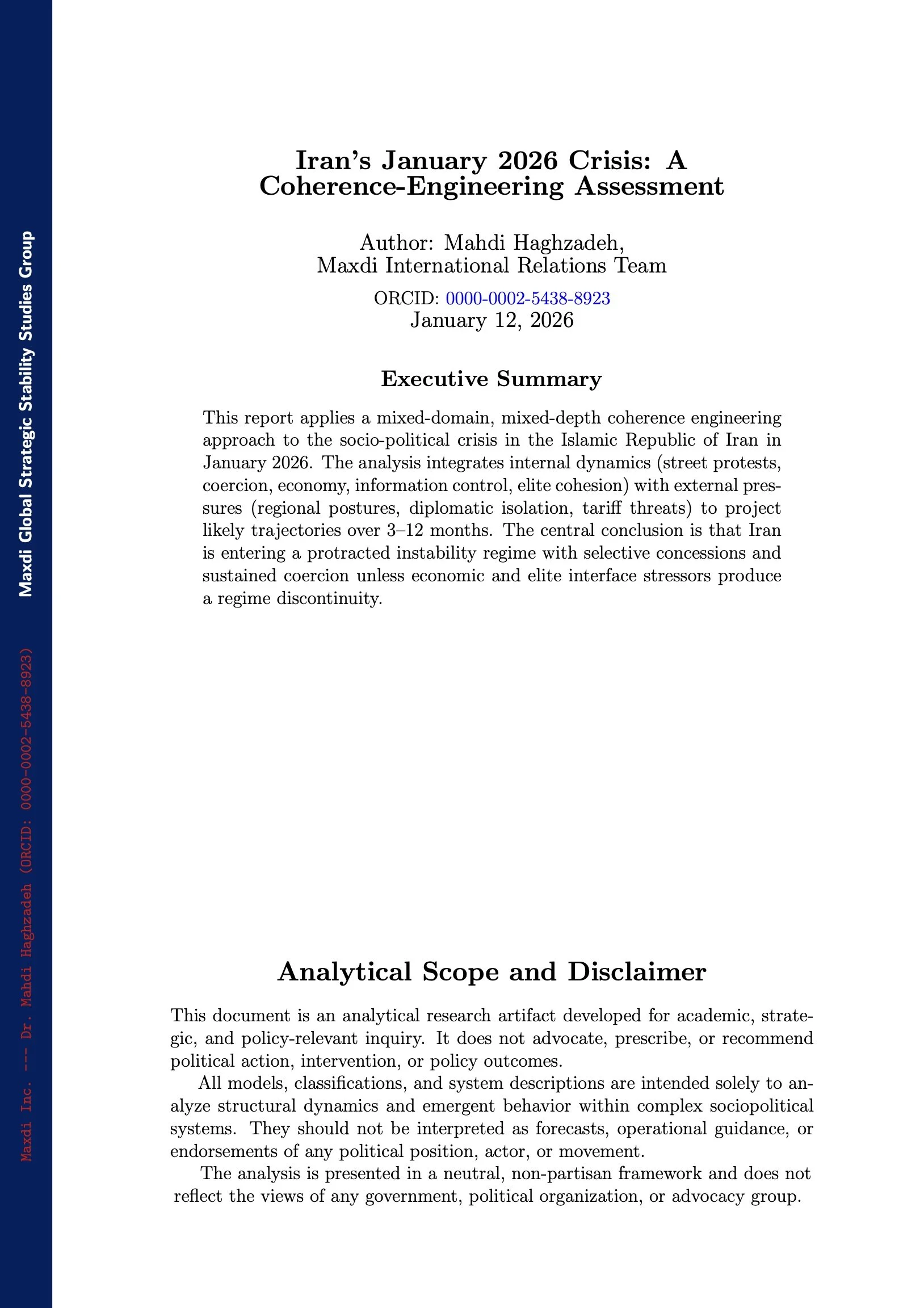
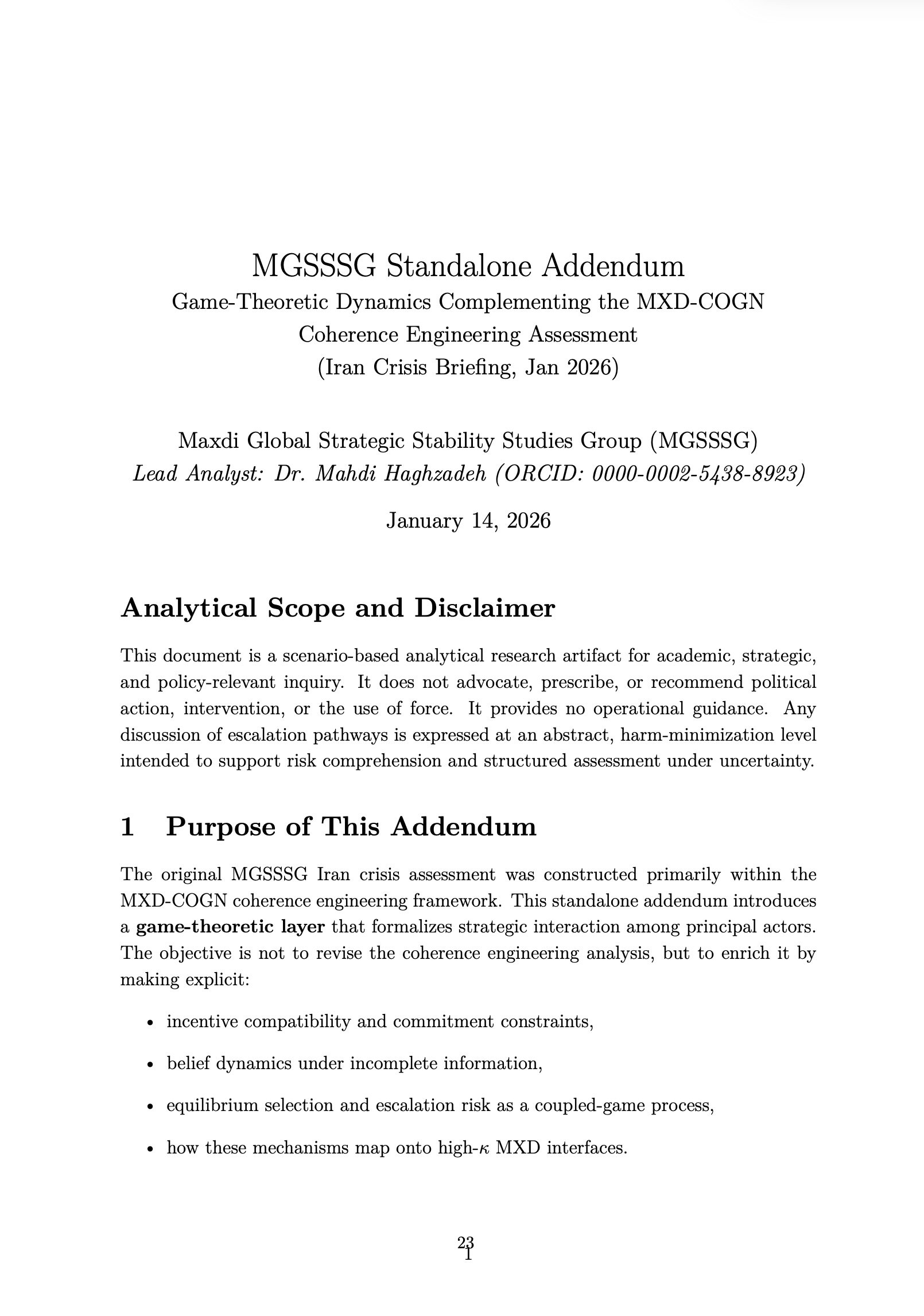
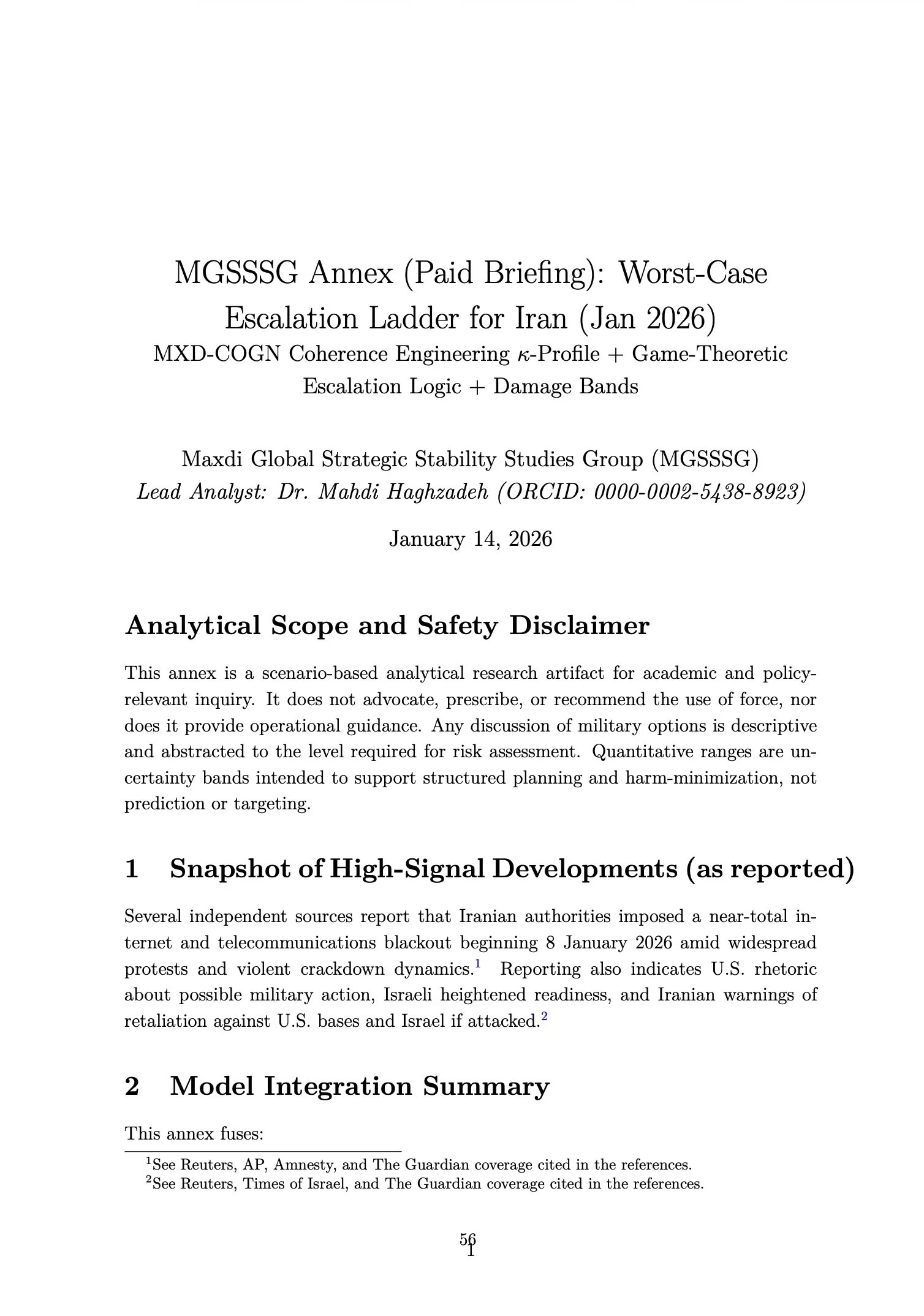
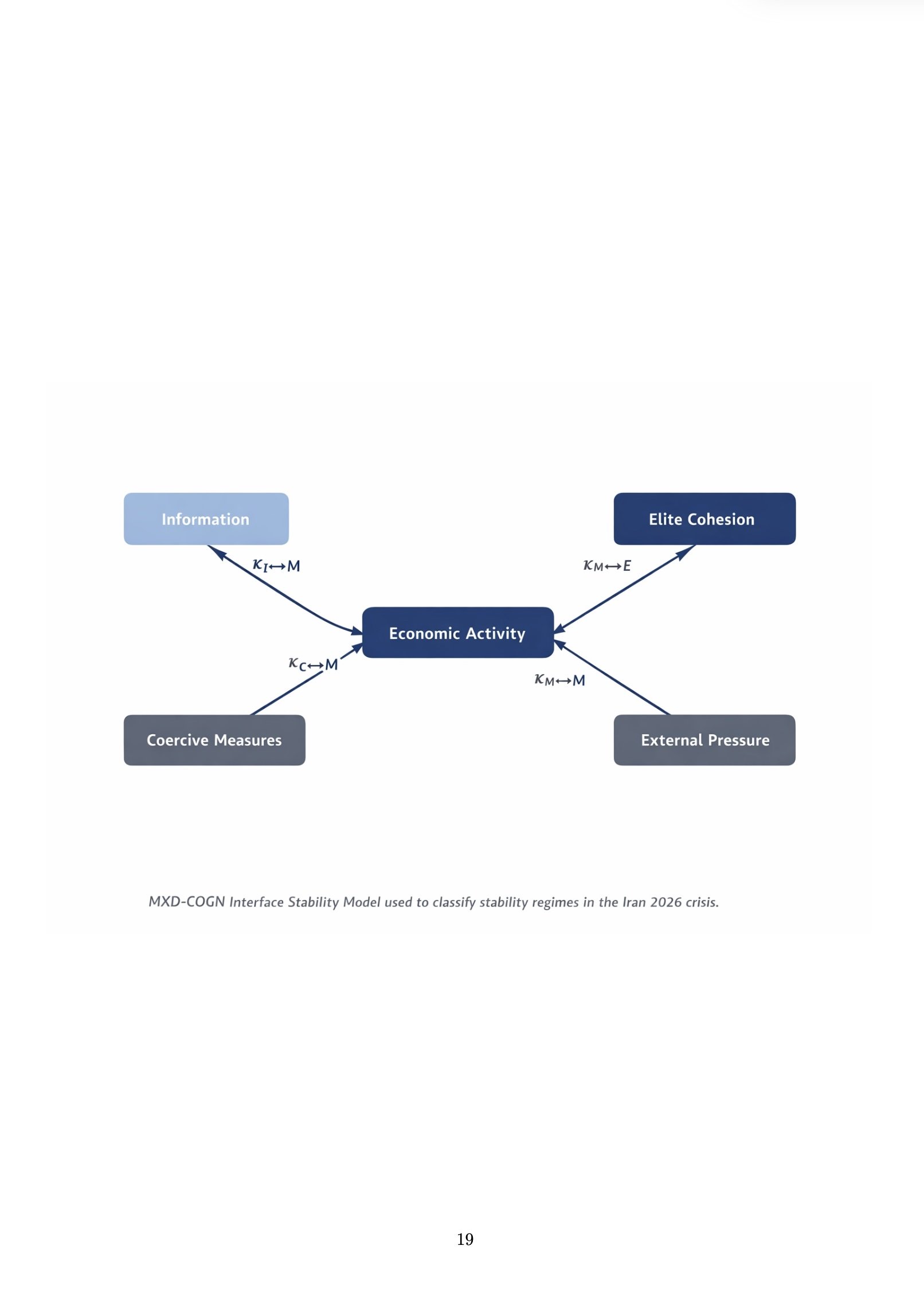
This Institutional Master Package is a comprehensive, non-prescriptive analytical dossier examining the January 2026 crisis in the Islamic Republic of Iran through the Mixed-Domain, Mixed-Depth Coherence Engineering (MXD-COGN) framework.
The package integrates internal dynamics (protests, coercion, information control, elite cohesion, economic throughput) with external pressures (sanctions, tariffs, diplomatic isolation, and regional signaling) to assess systemic stability, brittleness, and escalation risk over short- and medium-term horizons.
Unlike conventional policy briefs or forecasting reports, this work does not advocate actions or outcomes. It provides a formal structural diagnosis of regime behavior under stress, identifying regime basins of attraction, interface-level failure points, and conditions under which discontinuity becomes plausible.
Version v1.1 incorporates a major expansion with the addition of Part IV, substantially deepening the historical–structural dimension of the analysis.
What’s Included
Part I — Core Institutional Assessment
A full MXD-COGN coherence analysis of Iran’s January 2026 crisis, including:
Protest dynamics under near-total information blackout
Coercive capacity and execution coherence
Economic throughput stress and bazaar-level indicators
Elite cohesion and patronage stability
External pressure and tariff-driven uncertainty
3–6–12 month trajectory projections
Formal brittleness (κ) metrics and regime basin classification
Part II — Game-Theoretic Addendum (v1.1)
A formal strategic layer complementing MXD-COGN, modeling:
Deterrence–retaliation dynamics (U.S., Israel, Iran, regional actors)
Elite–security coordination games under existential stress
Signaling, belief formation, and commitment rigidity
Escalation equilibria and de-escalation feasibility
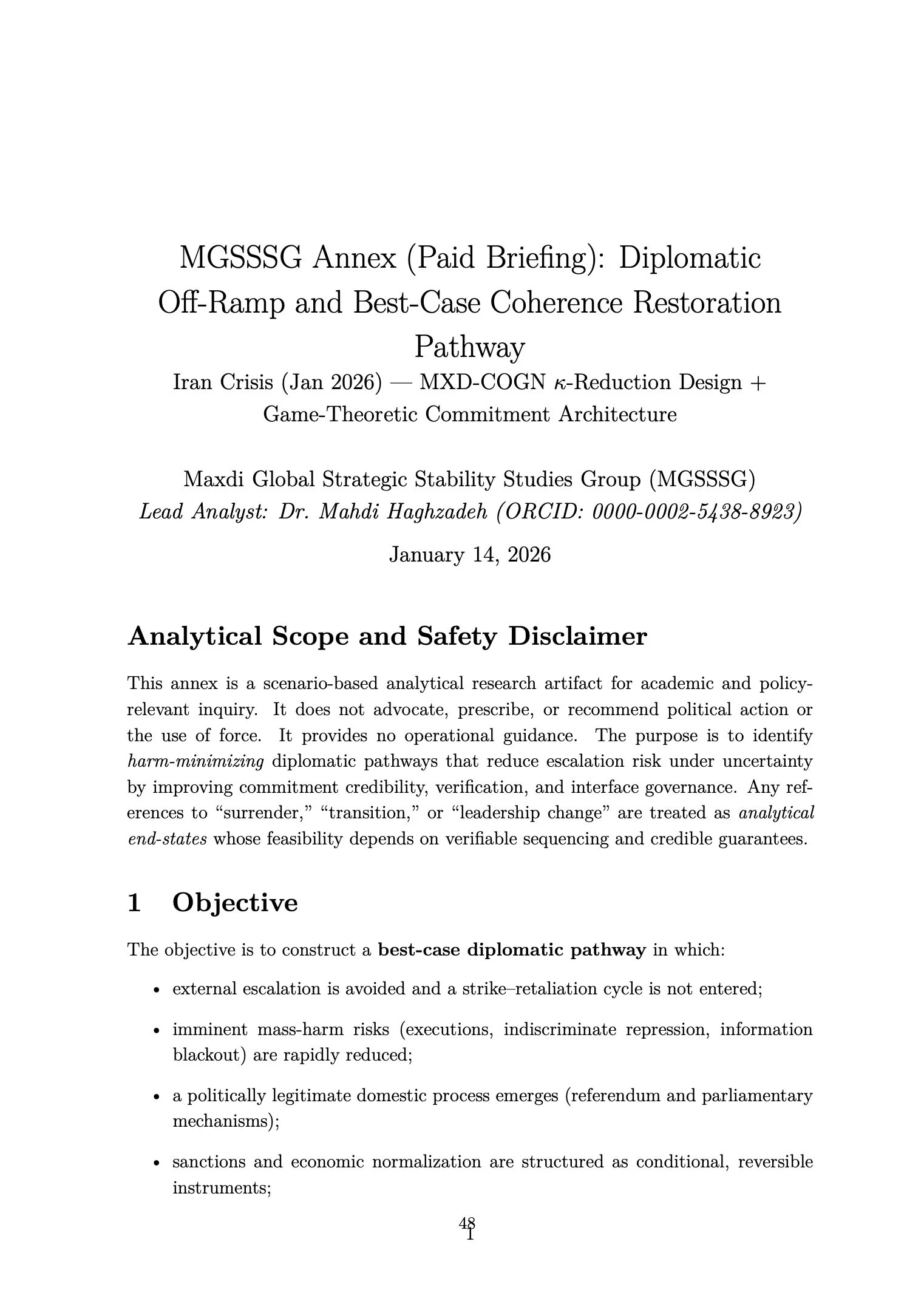
Part III — Best-Case Diplomatic Off-Ramp Annex
A harm-minimization–oriented analytical annex outlining:
Verification-based de-escalation sequencing
Conditional, reversible sanctions relief architecture
Amnesty and safe-exit logic to prevent fight-or-fracture equilibria
Institutional pathways for domestic political legitimacy
(Analytical, non-operational, non-prescriptive)
Part IV — Sanctions, Geography, Ideology, and Coherence Decay in Iran
(New in v1.1)
A standalone, long-form historical–structural assessment analyzing why sanctions and isolation have devastated civilian welfare without producing regime collapse. This section integrates:
Four decades of sanctions and boycotts as iterated external deformations
Civilian deprivation and food insecurity as emergent systemic outcomes
IRGC economic capture under scarcity and sanctions evasion
Ideological framing of deprivation (“resistance economy”) and its long-term costs
Geography, invasion memory, and siege psychology as structural constraints
Water scarcity, drought, and groundwater depletion as latent instability accelerators
The Zibakalam thesis on internal causality and institutional failure
Part IV situates Iran’s crisis within a coherence-decay regime, where elite and coercive stability is preserved at the expense of societal welfare and adaptive capacity.
Methodological Distinction
The MXD-COGN framework treats geopolitical crises as emergent properties of interacting subsystems, rather than linear cause-effect chains. This allows the analysis to:
Remain robust under censorship and limited observability
Avoid street-size or sentiment-only forecasting
Focus on interface-level brittleness where small perturbations can produce regime shifts
Distinguish apparent stability from structural fragility
Who This Is For
Government and diplomatic analysts
Think tanks and multilateral institutions
Academic researchers (political economy, sanctions, security studies)
Journalists covering Iran and regional escalation risk
Risk analysts and strategic planners
Important Notice
This document is an analytical research artifact.
It does not:
Advocate political positions
Recommend intervention or policy
Provide operational or tactical guidance
Redistribution is restricted. Interpretation should preserve the document’s analytical and non-prescriptive intent
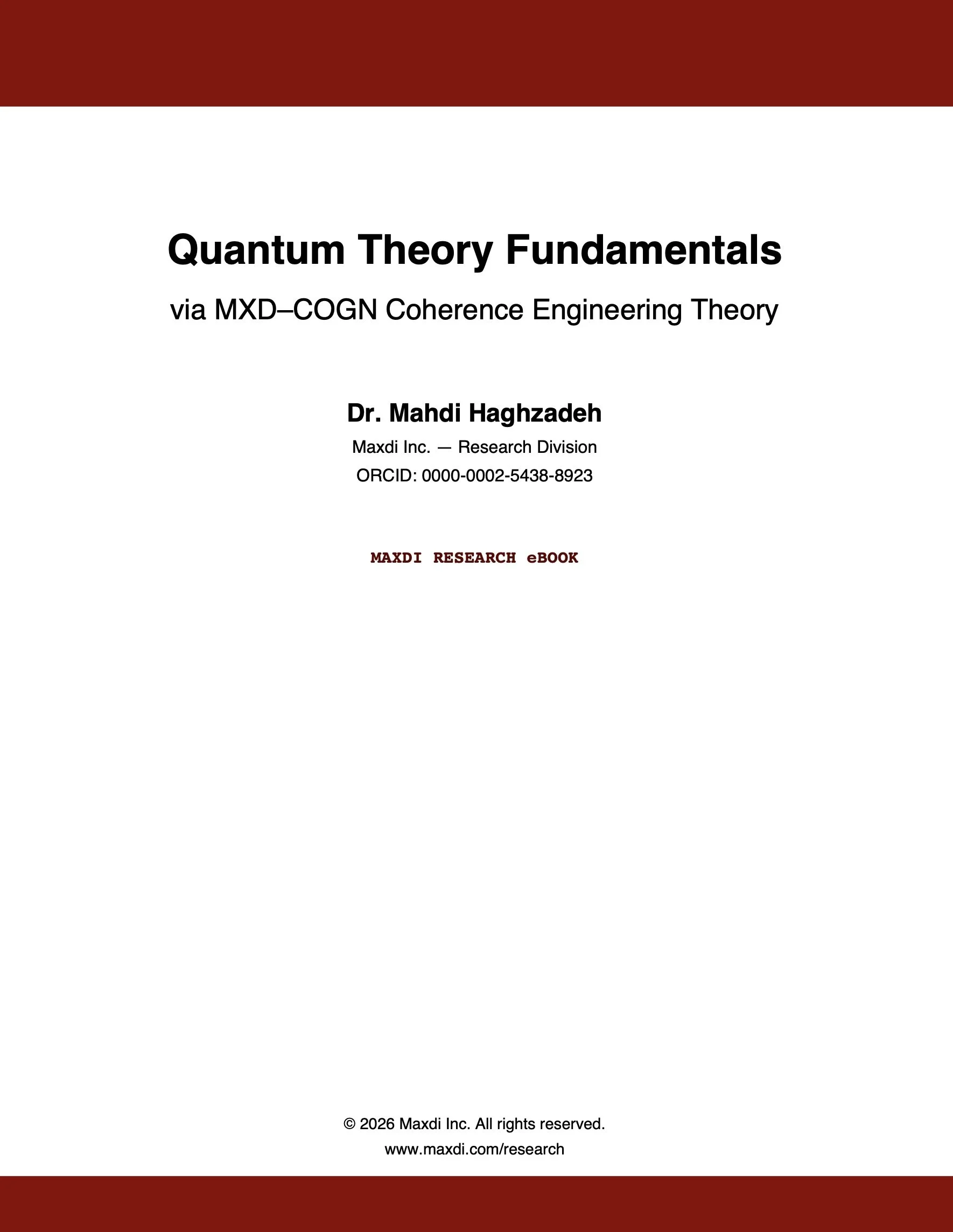
Quantum Theory Fundamentals presents a modern, coherence-engineering interpretation of quantum mechanics grounded in the MXD-COGN mixed-domain inference framework. Rather than treating quantum theory as a collection of abstract postulates, this eBook develops it as a structured inference system governed by coherence, deformation, and control constraints.
The book introduces foundational quantum concepts through the lens of MXD-COGN, unifying state evolution, measurement, interference, and reversibility within a single inference-theoretic geometry. It emphasizes operational meaning, mathematical clarity, and predictive structure, making it suitable for researchers, advanced students, and engineers working at the intersection of quantum information, control theory, and complex systems.
This volume is part of the Maxdi Research eBook series and reflects independent theoretical research conducted by Maxdi Inc.
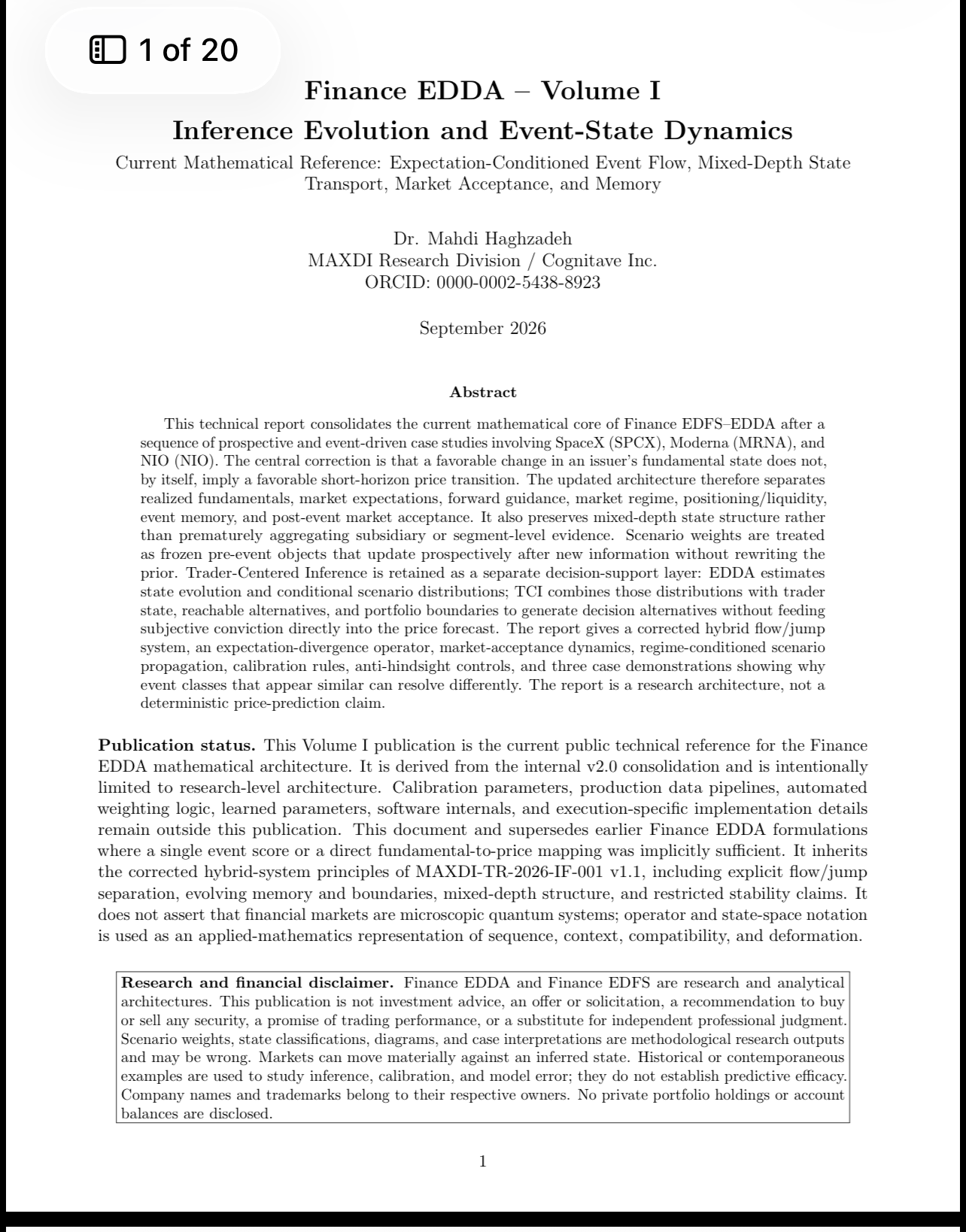
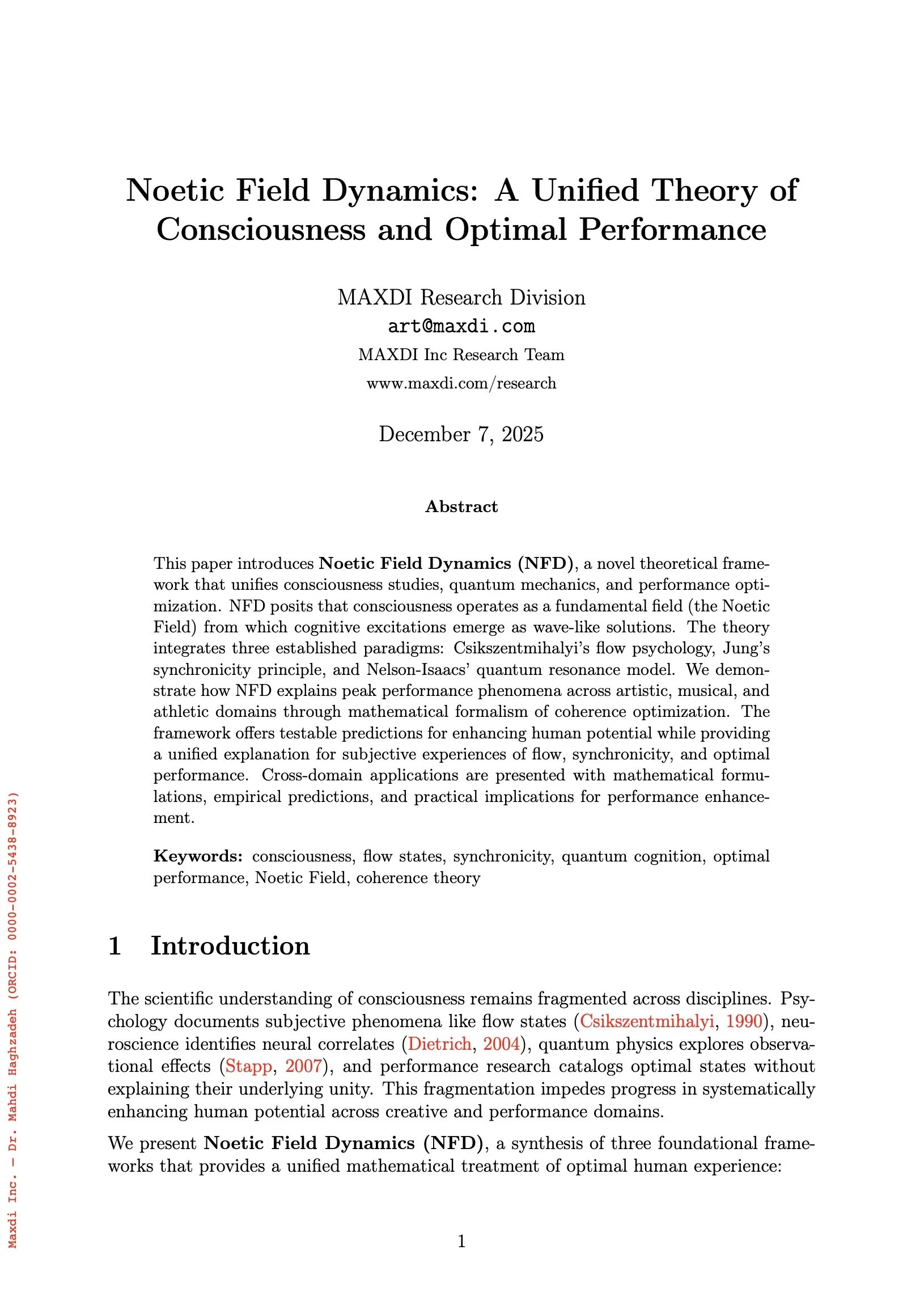
This paper introduces \textbf{Noetic Field Dynamics (NFD)}, a novel theoretical framework that unifies consciousness studies, quantum mechanics, and performance optimization. NFD posits that consciousness operates as a fundamental field (the Noetic Field) from which cognitive excitations emerge as wave-like solutions. The theory integrates three established paradigms: Csikszentmihalyi's flow psychology, Jung's synchronicity principle, and Nelson-Isaacs' quantum resonance model. We demonstrate how NFD explains peak performance phenomena across artistic, musical, and athletic domains through mathematical formalism of coherence optimization. The framework offers testable predictions for enhancing human potential while providing a unified explanation for subjective experiences of flow, synchronicity, and optimal performance. Cross-domain applications are presented with mathematical formulations, empirical predictions, and practical implications for performance enhancement.
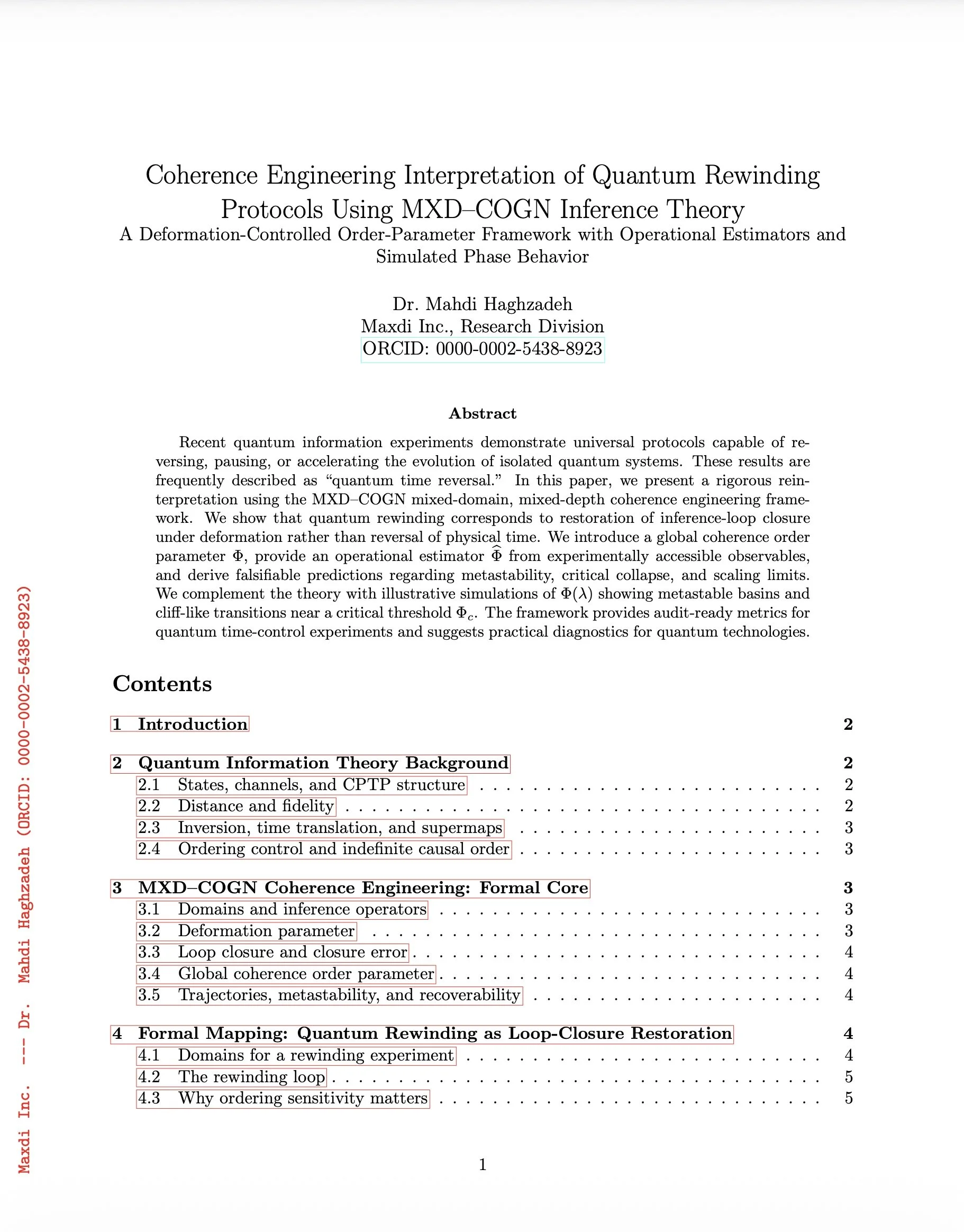
Recent quantum information experiments demonstrate universal protocols capable of reversing, pausing, or accelerating the evolution of isolated quantum systems. These results are frequently described as ``quantum time reversal.'' In this paper, we present a rigorous reinterpretation using the MXD--COGN mixed-domain, mixed-depth coherence engineering framework. We show that quantum rewinding corresponds to restoration of inference-loop closure under deformation rather than reversal of physical time. We introduce a global coherence order parameter $\Phi$, provide an operational estimator $\widehat{\Phi}$ from experimentally accessible observables, and derive falsifiable predictions regarding metastability, critical collapse, and scaling limits. We complement the theory with illustrative simulations of $\Phi(\lambda)$ showing metastable basins and cliff-like transitions near a critical threshold $\Phi_c$. The framework provides audit-ready metrics for quantum time-control experiments and suggests practical diagnostics for quantum technologies.
eBooklet - Radar for Advanced Vehicular Systems - RAVS
14.99 USD DIGITAL DOWNLOAD RAVS
a Booklet download entitle above (RAVS) in "*.pdf" format is available to download upon purchase of a token that will be sent to you e-mail inbox.
#RadarSignalProcessing #RSP #RADAR #LIDAR #Automotive #ADAS #OEM #TIER1 #SensorFusion
Mahdi Haghzadeh, PhD
Electronics Department
Cognitave Inc
Keywords: Radar Signal Processing (RSP), FMCW, Tracking, RF/MW Integrated Systems
Abstract
Radar for Advanced Vehicular Systems (RAVS) is a short technical manual on RADAR (Radio Frequency Detection and Ranging) technology used in modern ADAS (Advanced Driver Assistance Systems) and autonomous, driver-less vehicles (cars and drones) under development globally. This manual reviews main Radar sensing techniques and analysis that enable detection and tracking of targets in the front and proximity of a vehicle equipped with this sensor.
An online EE course, Advanced Radar for Autonomous Driving (ARAD), is available for in-depth development of topics and techniques on ADAS, Sensor Fusion, and advanced signal processing algorithms utilizing machine learning and AI.
Access related on-demand EE course at:
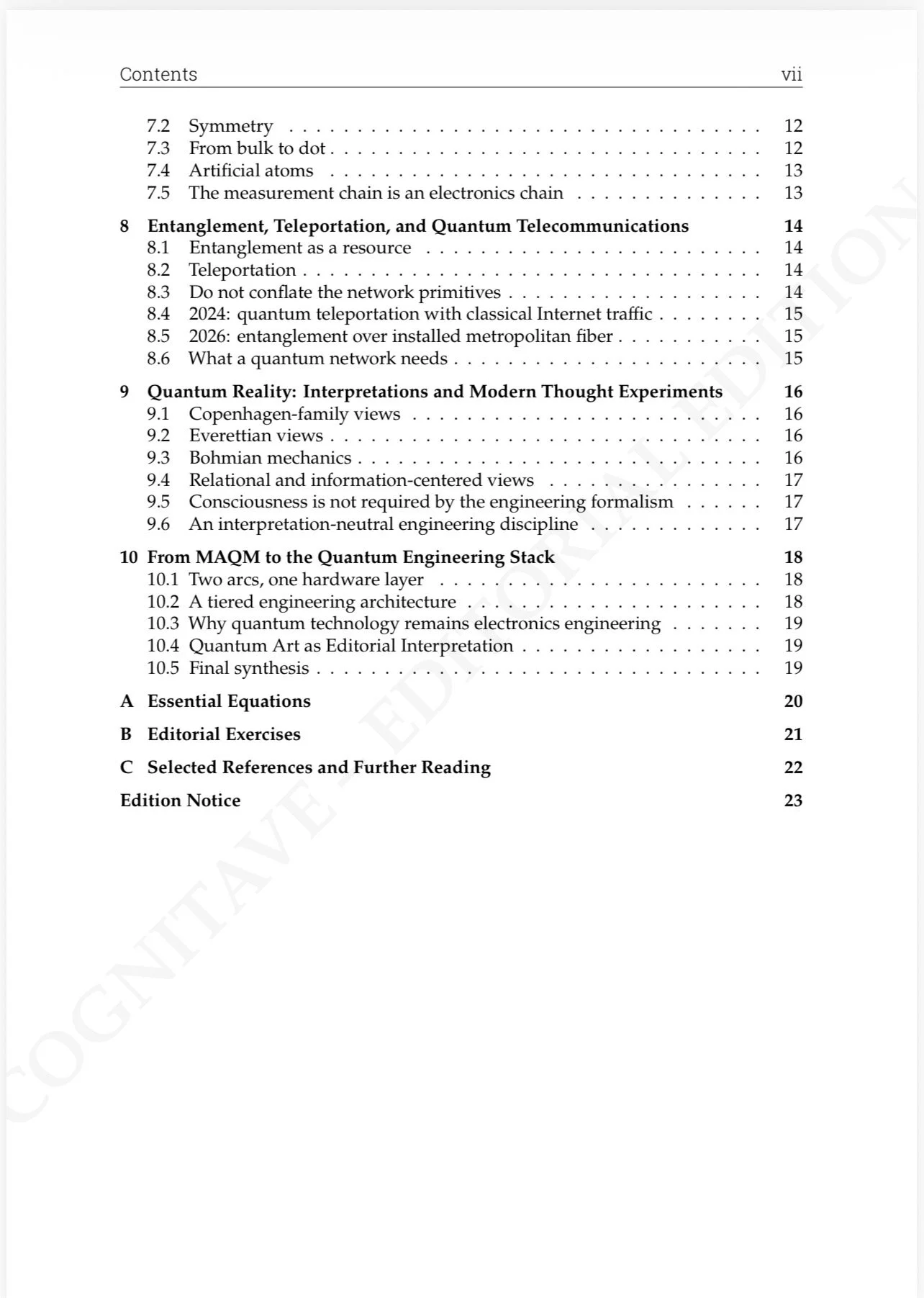
eBooklet - Modern Applied Quantum Mechanics - MAQM
44.99 USD DIGITAL DOWNLOAD MAQM
a Booklet download entitle above (MAQM) in "*.pdf" format is available to download upon purchase of a token that will be sent to you e-mail inbox.
#Electronics #QuantumMicroelectronics #QuantumRF #PhotonicCrystals #nanotechnology #photonics #QuantumPhysics #AppliedMathematics
Mahdi Haghzadeh, PhD
Electronics Department
Cognitave Inc
Keywords: Quantum Computing, Simulations and Modeling, Integrated Systems, Analysis and Applied Mathematics
Abstract
Modern Applied QM (MAQM) mathematics and numerical tools presented in this technical and business ee course are applied in consumer electronics, warfare defense and aerospace industries to solve design and engineering problems in telecommunications or for environmental threats mitigation and counter measures.
Access related on-demand EE course at:
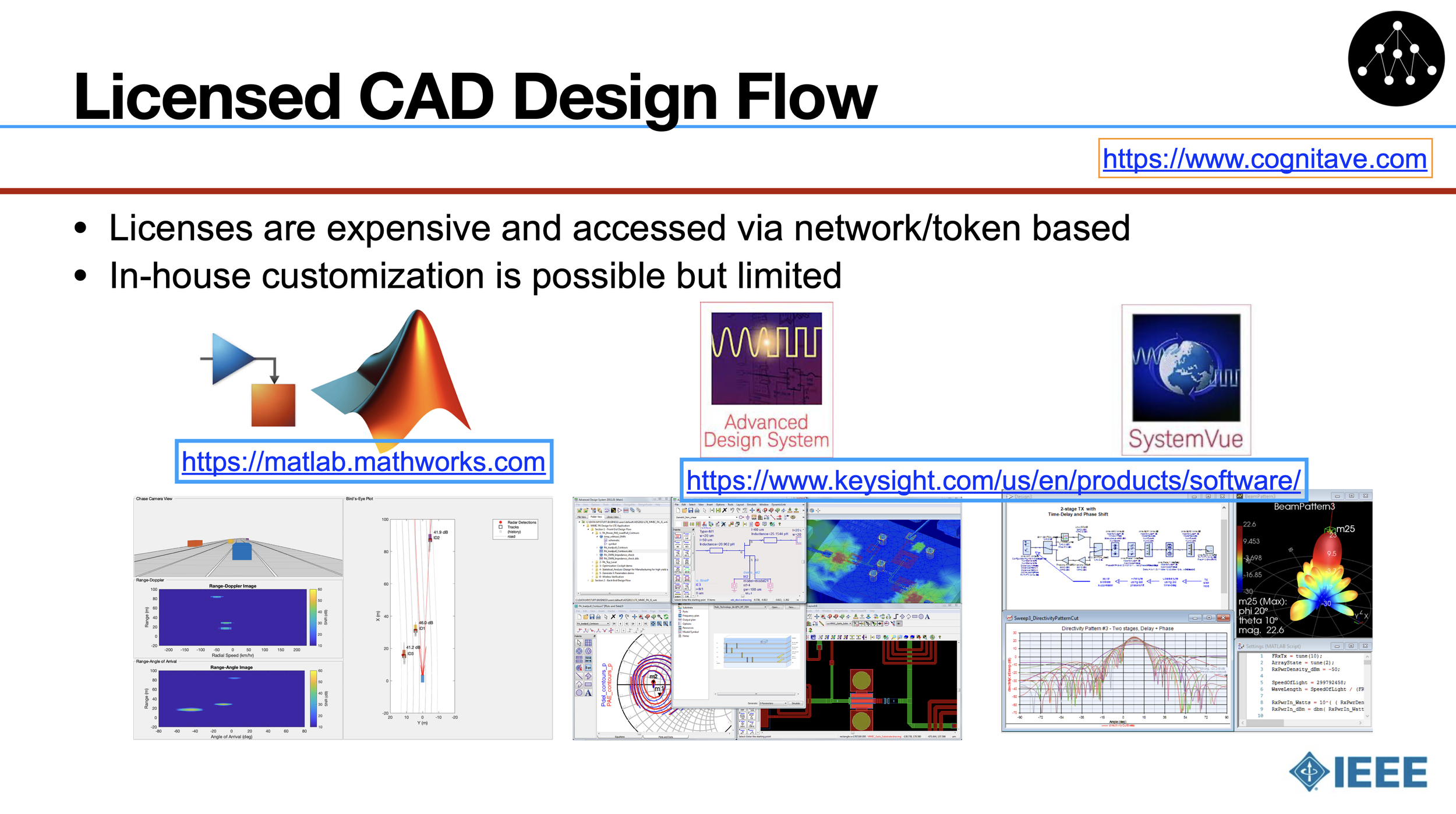
Technology Report - Microelectronics Design Automation w/ License-based & OpenSource CAD
1.99 USD DIGITAL DOWNLOAD TEX-CAD-EDA
a Technology Report presented by Cognitave Inc Department of Electronics
#EDA #MICROELECTRONICS
Mahdi Haghzadeh, PhD
Electronics Department
Cognitave Inc
Keywords: Numerical Computing, Circuit & EM Simulations, RF/MW Integrated Systems
Abstract
This Technological Report presents to microelectronics design engineering professionals in semiconductor and electronics industries latest modern design-workflow tools for simulation, modeling and fabrication.
A complete set of computer-aided micro-electronics design automation (MEDA) tools presented in this technological report that are available open source without paid-for licenses or tokens. The tools are considered industry open-source standards and used across the globe for design, modeling, manufacturing and testing of electronic and computing devices that go into medium to ultra-high complexity systems in consumer electronics, warfare defense and aerospace industries.
Access related on-demand EE course at:
eBooklet - Modern Applied Quantum Mechanics - MAQM
4.99 USD DIGITAL DOWNLOAD MAQM
a Booklet download entitle above (MAQM) in "*.pdf" format is available to download upon purchase of a token that will be sent to you e-mail inbox.
#Electronics #QuantumMicroelectronics #QuantumRF #PhotonicCrystals #nanotechnology #photonics #QuantumPhysics #AppliedMathematics
Mahdi Haghzadeh, PhD
Electronics Department
Cognitave Inc
Keywords: Quantum Computing, Simulations and Modeling, Integrated Systems, Analysis and Applied Mathematics
Abstract
{}% three ;L
{}%6-7 ;Ls
Modern Applied QM (MAQM) mathematics and numerical tools presented in this technical and business ee course are applied in consumer electronics, warfare defense and aerospace industries to solve design and engineering problems in telecommunications or for environmental threats mitigation and counter measures.
Access related on-demand EE course at:
Technology Report - Linear ODEs by DTMM for 3D Numerical Modeling in RF/MW Design and Simulation
4.99 USD DIGITAL DOWNLOAD LODE-DTMM
a Technology Report downloadable entitled (LODE-DTMM) in "*.pdf" format is available to download upon purchase of a token that will be sent to your e-mail inbox.
#NumericalProgramming #SignalProcessing #RadarSystems#Electronics #NumericalSimulations #AppliedMathematics
Mahdi Haghzadeh, PhD
Electronics Department
Cognitave Inc
Keywords: Numerical programming, numerical Simulations and Modeling, Integrated Systems, Analysis and Applied Mathematics
Abstract
Linear ODE-DTM special topic presented in Advanced Radar for Autonomous Driving (ARAD) is a technical ee-course in the field of Autonomous Driving and Sensor Fusion of signals and data in-flow from sensing and control modules OEMs deploy in autonomous and semiautonomous systems.
Access this related on-demand EE course here at:
Technology Report - Third Generation Organic and Cost Effective Solar Cells
4.99 USD DIGITAL DOWNLOAD PV-DSSC
a Technology Report downloadable entitled (DSSC-PV) in "*.pdf" format is available to download upon purchase of a token that will be sent to your e-mail inbox.
#SolarCells #Photovoltaic #Silicon #SolidStatePhysics #Electronics #RenewableEnergy #Electricity #Sustainability
Mahdi Haghzadeh, PhD
Electronics Department
Cognitave Inc
Keywords: Solar Cells, Renewable Energy, Solid State Physics, Thin Film, Organic Electronics, Dye Sensitized Solar Cells, Concentrators, Printed Electronics
Abstract
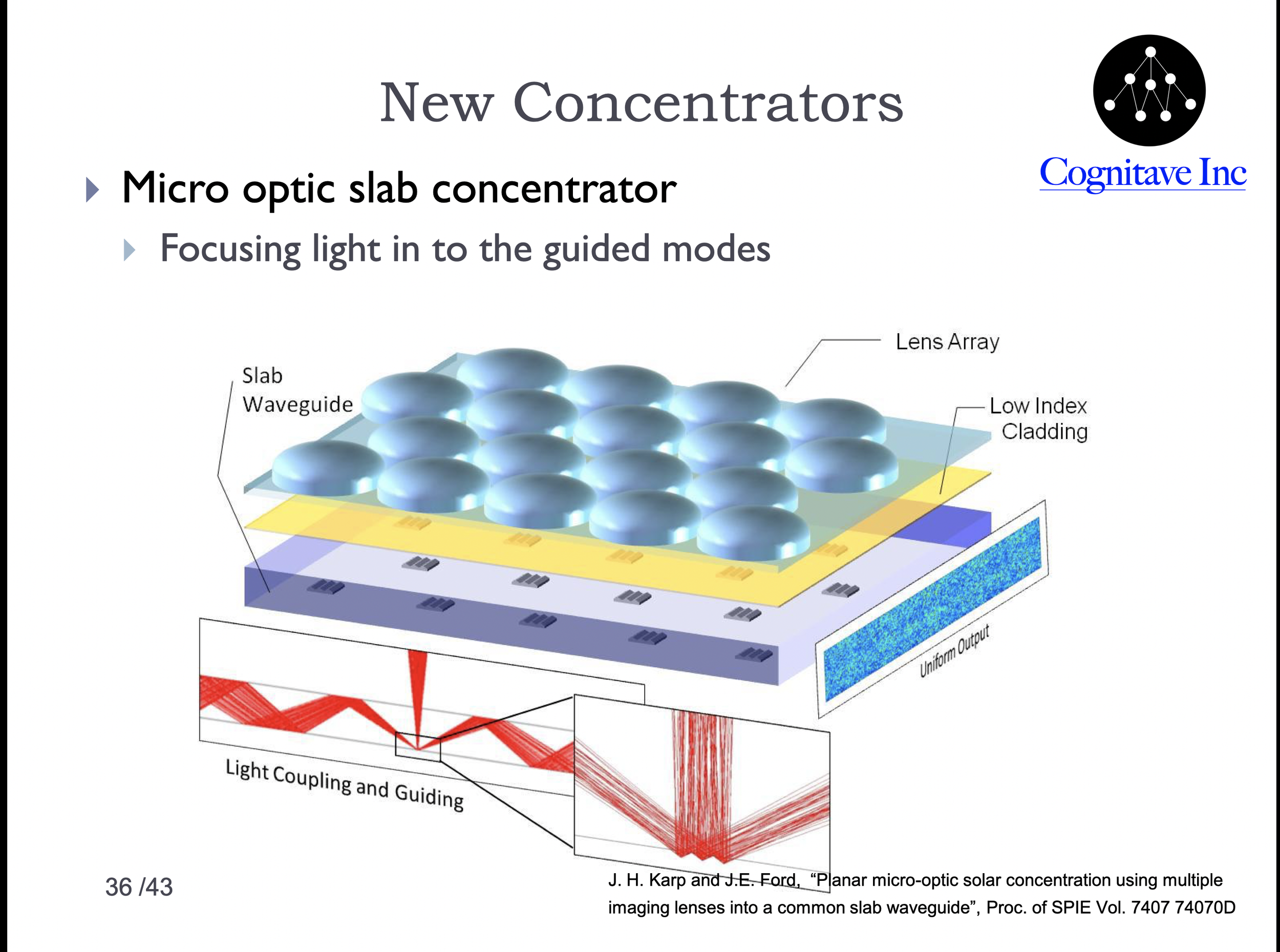
This technology report was first presented at Electrical School of Engineering at Sharif University of Technology on latest technological advancement made in development and fabrication of third generation solar cells, namely Organic Photovoltaic (PV). First generation is inorganic, single junction silicon based solar cells that reach 14—19 percent conversion efficiency for single- and multi-crystal silicon. The payback is 3.5—7 years. Second generation is based on thin film technology that yields 7—11 percent efficiency. The payback is less than a year due to inexpensive development and fabrication costs. The drawback is use of environmentally hazardous material. Third generation is organic thin film technology that can reach up to 30 percent efficiency for multi-junction cells. In this category Dye Sensitized Solar Cells are gaining popularity with a promise to deliver cost effective solar cells.
Access to Modern Technology and Engineering Tools at Cognitave Inc’s Electronics Store
Services
Access to Modern Technology and Engineering Tools at Cognitave Inc’s Electronics Store Services
Greenland occupies a uniquely sensitive position in the global strategic system: rich in critical resources, central to Arctic security architecture, yet operating under constrained sovereignty and delegated defense arrangements. Unlike crisis-driven cases, Greenland’s challenge is not instability, but how stability is preserved—or eroded—under accelerating external interest.
This institutional report applies the MXD-COGN (Mixed-Domain, Mixed-Depth Coherence Engineering) framework to model Greenland as a proto-sovereign system, where long-term outcomes are governed by interface dynamics among legitimacy, elite coordination, economic throughput, and external bargaining power.
Rather than forecasting disruption, the report identifies equilibrium families that define Greenland’s plausible strategic futures, ranging from managed strategic dependency to structured sovereignty rebalancing. It evaluates how resource extraction, infrastructure bottlenecks, climate governance, and Arctic security norms interact to shape autonomy trajectories over the coming decade.
Key features include:
Greenland-specific MXD-COGN domain modeling
External bargaining and sovereignty-constraint analysis
Resource extraction and infrastructure throughput assessment
Full scenario engineering framework (4 scenarios)
Arctic system comparative positioning
Strategic indicators dashboard for ongoing monitoring
This report is designed for institutional investors, policymakers, defense and energy analysts, and strategic plannersseeking disciplined, non-speculative analysis of Arctic stability and long-horizon geopolitical risk.
MXD-COGN: A Theory of Mixed-Domain, Mixed-Depth Cognition is the foundational reference for coherence engineering and deformation-controlled inference in complex systems. This work is not a conventional academic textbook, nor is it a software manual. It is a formal, graph-native theory of how inference executes, deforms, stabilizes, and fails across heterogeneous domains and depths of abstraction.
At its core, MXD-COGN introduces a mathematical language for treating inference as a first-class dynamical object. Systems are modeled as executable graphs governed by order parameters, deformation fields, and coherence constraints rather than isolated equations or static optimization targets. This perspective enables rigorous reasoning about stability, metastability, collapse, and early warning in systems that evolve over time, adapt to stress, and span physical, computational, and organizational layers.
The theory is intentionally domain-agnostic. It applies equally to RF and microwave systems, cyber-physical control architectures, artificial intelligence, socio-technical organizations, and large-scale engineered infrastructures. By unifying these domains under a shared inference geometry, MXD-COGN provides a stable foundation for analyzing systems that cannot be adequately described by classical control, linear stability, or isolated simulation alone.
Cogn-Tex™: A Theoretical Processing Design Kit
MXD-COGN functions as what Maxdi Inc. designates Cogn-Tex™—a theoretical processing design kit for inference and coherence. In the same way that a semiconductor PDK defines design rules, constraints, and interfaces for physical fabrication, Cogn-Tex™ defines the mathematical structures, invariants, and execution semantics required to reason about inference under deformation.
Cogn-Tex™ enables engineers, researchers, and institutions to encode systems into formal inference graphs, evaluate coherence margins, reason about deformation envelopes, and predict failure modes before collapse occurs. While the theory itself is fully specified in this text, its value compounds when paired with internal tools, simulation engines, or large language models capable of operating within the MXD-COGN framework.
This deliberate openness is not a loss of intellectual property; it is the foundation of it. By publishing the canonical theory, Maxdi Inc. establishes the reference standard upon which certified tools, execution engines, and institutional practices can be built.
Scope and Intent
MXD-COGN is written for advanced practitioners: researchers, system architects, and organizations confronting the limits of traditional modeling and control. It is not designed as an introductory survey or a tutorial series. Instead, it provides a closed, internally consistent theoretical framework intended to be cited, extended, and operationalized through companion platforms and certified implementations.
The book concludes at the level of theory. Questions of execution platforms, software engines, certification workflows, and deployment practices are intentionally treated as out-of-scope here and are addressed through separate products and services offered by Maxdi Inc.
In publishing MXD-COGN, Maxdi Inc. releases the mathematical foundation of coherence engineering while retaining the ability to deliver value through execution, certification, and institutional enablement. This text is the reference point from which all MXD-COGN-compliant systems derive legitimacy.
Pricing and Access
MXD-COGN is offered under an institutional access model, reflecting its role as a foundational theory and processing design kit (Cogn-Tex™) rather than a conventional retail textbook.
Institutional License (Primary Offering)
Institutions—including universities, research laboratories, defense organizations, and corporate R&D groups—may license MXD-COGN for internal research, teaching, and architectural development.
Institutional Access Fee:
USD $2,500 per year
Includes:
Full digital access to MXD-COGN: A Theory of Mixed-Domain, Mixed-Depth Cognition
Internal institutional use for research and instruction
Eligibility for MXD-COGN–aligned tooling, certification, and execution platforms
This model ensures that MXD-COGN remains a stable, authoritative reference while enabling institutions to build compliant systems and curricula on top of the theory.
Individual Researchers and Enterprise Access
Individual researchers, independent scholars, and commercial enterprises seeking direct access or broader usage rights should contact Maxdi Inc. to discuss appropriate licensing and enablement options.
📧 Contact: tex@cognitave.com
Enterprise engagements may include:
Extended usage rights
Integration with execution engines and design tools
Certification pathways and technical onboarding
Pricing for these engagements is determined based on scope, scale, and intended application.
Venezuela 2026 is a paid institutional research report published by the Maxdi Global Strategic Stability Studies Group (MGSSSG). The report applies the MXD-COGN coherence-engineering framework, integrated with a formal game-theoretic overlay, to analyze Venezuela’s instability environment following leadership discontinuity and intensified external intervention dynamics.
Rather than offering narrative forecasts or policy prescriptions, the assessment models Venezuela as a high-sensitivity (high-κ) system, where outcomes are governed by interactions across elite coordination, coercive execution, oil-based macroeconomic throughput, legitimacy formation, and external policy coupling. The report identifies structural instability basins, interface brittleness, and equilibrium families that define Venezuela’s near- and medium-term trajectories.
Core analytical focus areas include oil sector control and revenue governance, sanctions and licensing dynamics, elite–security coordination risk, opposition signaling constraints, civilian welfare implications, and regional spillover pathways. Scenario engineering is conducted as a function of interface sensitivity and belief dynamics, not leadership symbolism or event-driven speculation.
This report is intended for institutional analysts, policy professionals, investors, and research organizations requiring disciplined, non-prescriptive structural analysis under conditions of contested information and political volatility.
Format: Institutional PDF
Length: ~50 pages
Classification: Restricted institutional analysis (non-prescriptive)
Differential Equations in Engineering Fields is a compact, intensive crash-course ebook designed to cover the core ordinary differential equations (ODE) material taught across engineering disciplines, with emphasis on how these equations are actually used in advanced engineering contexts.
This book originated from a series of accelerated courses taught by Mahdi Haghzadeh between 2008 and 2010 to undergraduate engineering students preparing for graduate-level entrance examinations. The objective of those courses was not breadth, but efficiency: to equip students with the essential differential-equation tools required to succeed in advanced engineering topics within a limited timeframe.
As a result, the ebook focuses on the standard ODE curriculum common to electrical engineering, computer engineering, computer science, and related fields, while consistently framing the material in terms of engineering systems and physical interpretation.
The book develops a streamlined progression through first- and higher-order ordinary differential equations, linear systems with constant coefficients, and homogeneous and non-homogeneous formulations. Responses to impulse, step, and exponential inputs are treated as central modeling cases rather than peripheral examples. Laplace-transform-based methods are introduced early and used systematically as the most effective framework for solving initial-value problems and analyzing system response.
What distinguishes this crash course is its engineering orientation. Solutions are not presented as purely mathematical results; they are interpreted in the context of real systems such as resonant circuits, RF and microwave structures, control systems, and simplified models arising in applied quantum mechanics. The focus is on understanding how differential equations encode dynamics, stability, and transient behavior.
Worked examples are developed fully and concisely, reflecting the pace and structure of an intensive course. In addition, a selected set of original Konkoor problems from the 2008 examination cycle is solved in detail, illustrating how standard ODE techniques are tested in advanced engineering assessments.
This ebook is intended as a rapid yet rigorous reference for students and engineers who already possess basic calculus and linear algebra, and who need a focused review of differential equations as they appear in higher-level engineering applications.
Core Topics Covered
The material develops a coherent progression through:
first- and higher-order ordinary differential equations
linear systems with constant coefficients
homogeneous and non-homogeneous equations
impulse, step, and exponential inputs
Laplace-transform-based solution methods
initial-value problems and system response
engineering interpretation of solutions
Worked examples are fully developed, and problem sets are aligned with advanced engineering expectations.
Key Features
System-driven approach to differential equations
Transform methods integrated naturally into solution workflows
Emphasis on physical and engineering interpretation
Fully worked examples and solved problem sets
Consistent notation and mathematical typography
Designed for advanced undergraduate and graduate ECE
Format
Digital textbook (PDF)
High-resolution mathematical typesetting
Optimized for screen reading and printing
Pricing
Digital Edition (PDF):
💲 $11.99 USD
Academic and institutional licensing available upon request.
Intended Audience
Electrical and computer engineering students
Graduate-level engineering candidates
Practicing engineers working with dynamic systems
Researchers seeking a compact, rigorous ODE reference
About the Author
Mahdi Haghzadeh, PhD, is an engineer and researcher at Maxdi Research, working on mathematical systems theory, signal analysis, and advanced computational methods for engineering and physics.
Advanced Engineering Mathematics is a compact digital ebook covering the core mathematical techniques commonly taught in advanced engineering mathematics courses.
The material presents a structured treatment of Fourier series and spectral representation, followed by the Fourier transform and its use in linear time-invariant systems. Laplace transform methods are developed for solving differential equations and analyzing system behavior in the transform domain. Convolution, stability, and system response are introduced as fundamental mathematical operations and properties.
The book also includes a focused introduction to complex analysis, covering analytic functions, residue methods, contour integration, real integrals, and conformal mapping. These topics are developed as mathematical tools that support transform methods and advanced problem solving.
The final sections integrate the material through mixed advanced problems and exam-oriented strategies. Worked examples are fully developed, and problem sets are aligned with the expectations of advanced engineering mathematics coursework and examinations.
This ebook is intended for students and engineers with prior exposure to calculus and linear algebra who are seeking a concise and organized presentation of advanced engineering mathematics techniques.
What This Book Is For
Senior undergraduate and graduate ECE students
Engineers working in signal processing, control, and systems
Candidates preparing for advanced engineering entrance or qualification exams
Researchers seeking a compact but rigorous mathematical reference
Key Features
Unified coverage of Fourier, Laplace, and complex analysis methods
System-level interpretation of mathematical tools
Fully worked examples and exam-style problems with solutions
Consistent notation and typography, enforced by a custom LaTeX class
One-page A4 exam formula sheet for rapid review
MATLAB/Octave code appendix for computational reinforcement
Contents Overview
Fourier Series and Spectral Representation
Fourier Transform and LTI Systems
Laplace Transform and Differential Equation Solving
Convolution, Stability, and System Response
Complex Analysis and Residue Methods
Real Integrals and Conformal Mapping
Mixed Advanced Problems and Exam Strategies
Format
Digital textbook (PDF)
High-resolution mathematical typesetting
Optimized for screen and print
Licensing & Use
This product is licensed for individual academic and professional use.
For institutional licensing or course adoption, please contact Maxdi Research.
About the Author
Mahdi Haghzadeh, PhD, is a researcher and engineer working at the intersection of mathematics, systems theory, and advanced computation. His work spans engineering mathematics, signal analysis, and quantum analog computing.
This Institutional Master Package is a comprehensive, non-prescriptive analytical dossier examining the January 2026 crisis in the Islamic Republic of Iran through the Mixed-Domain, Mixed-Depth Coherence Engineering (MXD-COGN) framework.
The package integrates internal dynamics (protests, coercion, information control, elite cohesion, economic throughput) with external pressures (sanctions, tariffs, diplomatic isolation, and regional signaling) to assess systemic stability, brittleness, and escalation risk over short- and medium-term horizons.
Unlike conventional policy briefs or forecasting reports, this work does not advocate actions or outcomes. It provides a formal structural diagnosis of regime behavior under stress, identifying regime basins of attraction, interface-level failure points, and conditions under which discontinuity becomes plausible.
Version v1.1 incorporates a major expansion with the addition of Part IV, substantially deepening the historical–structural dimension of the analysis.
What’s Included
Part I — Core Institutional Assessment
A full MXD-COGN coherence analysis of Iran’s January 2026 crisis, including:
Protest dynamics under near-total information blackout
Coercive capacity and execution coherence
Economic throughput stress and bazaar-level indicators
Elite cohesion and patronage stability
External pressure and tariff-driven uncertainty
3–6–12 month trajectory projections
Formal brittleness (κ) metrics and regime basin classification
Part II — Game-Theoretic Addendum (v1.1)
A formal strategic layer complementing MXD-COGN, modeling:
Deterrence–retaliation dynamics (U.S., Israel, Iran, regional actors)
Elite–security coordination games under existential stress
Signaling, belief formation, and commitment rigidity
Escalation equilibria and de-escalation feasibility
Part III — Best-Case Diplomatic Off-Ramp Annex
A harm-minimization–oriented analytical annex outlining:
Verification-based de-escalation sequencing
Conditional, reversible sanctions relief architecture
Amnesty and safe-exit logic to prevent fight-or-fracture equilibria
Institutional pathways for domestic political legitimacy
(Analytical, non-operational, non-prescriptive)
Part IV — Sanctions, Geography, Ideology, and Coherence Decay in Iran
(New in v1.1)
A standalone, long-form historical–structural assessment analyzing why sanctions and isolation have devastated civilian welfare without producing regime collapse. This section integrates:
Four decades of sanctions and boycotts as iterated external deformations
Civilian deprivation and food insecurity as emergent systemic outcomes
IRGC economic capture under scarcity and sanctions evasion
Ideological framing of deprivation (“resistance economy”) and its long-term costs
Geography, invasion memory, and siege psychology as structural constraints
Water scarcity, drought, and groundwater depletion as latent instability accelerators
The Zibakalam thesis on internal causality and institutional failure
Part IV situates Iran’s crisis within a coherence-decay regime, where elite and coercive stability is preserved at the expense of societal welfare and adaptive capacity.
Methodological Distinction
The MXD-COGN framework treats geopolitical crises as emergent properties of interacting subsystems, rather than linear cause-effect chains. This allows the analysis to:
Remain robust under censorship and limited observability
Avoid street-size or sentiment-only forecasting
Focus on interface-level brittleness where small perturbations can produce regime shifts
Distinguish apparent stability from structural fragility
Who This Is For
Government and diplomatic analysts
Think tanks and multilateral institutions
Academic researchers (political economy, sanctions, security studies)
Journalists covering Iran and regional escalation risk
Risk analysts and strategic planners
Important Notice
This document is an analytical research artifact.
It does not:
Advocate political positions
Recommend intervention or policy
Provide operational or tactical guidance
Redistribution is restricted. Interpretation should preserve the document’s analytical and non-prescriptive intent
Quantum Theory Fundamentals presents a modern, coherence-engineering interpretation of quantum mechanics grounded in the MXD-COGN mixed-domain inference framework. Rather than treating quantum theory as a collection of abstract postulates, this eBook develops it as a structured inference system governed by coherence, deformation, and control constraints.
The book introduces foundational quantum concepts through the lens of MXD-COGN, unifying state evolution, measurement, interference, and reversibility within a single inference-theoretic geometry. It emphasizes operational meaning, mathematical clarity, and predictive structure, making it suitable for researchers, advanced students, and engineers working at the intersection of quantum information, control theory, and complex systems.
This volume is part of the Maxdi Research eBook series and reflects independent theoretical research conducted by Maxdi Inc.
This paper introduces \textbf{Noetic Field Dynamics (NFD)}, a novel theoretical framework that unifies consciousness studies, quantum mechanics, and performance optimization. NFD posits that consciousness operates as a fundamental field (the Noetic Field) from which cognitive excitations emerge as wave-like solutions. The theory integrates three established paradigms: Csikszentmihalyi's flow psychology, Jung's synchronicity principle, and Nelson-Isaacs' quantum resonance model. We demonstrate how NFD explains peak performance phenomena across artistic, musical, and athletic domains through mathematical formalism of coherence optimization. The framework offers testable predictions for enhancing human potential while providing a unified explanation for subjective experiences of flow, synchronicity, and optimal performance. Cross-domain applications are presented with mathematical formulations, empirical predictions, and practical implications for performance enhancement.
Recent quantum information experiments demonstrate universal protocols capable of reversing, pausing, or accelerating the evolution of isolated quantum systems. These results are frequently described as ``quantum time reversal.'' In this paper, we present a rigorous reinterpretation using the MXD--COGN mixed-domain, mixed-depth coherence engineering framework. We show that quantum rewinding corresponds to restoration of inference-loop closure under deformation rather than reversal of physical time. We introduce a global coherence order parameter $\Phi$, provide an operational estimator $\widehat{\Phi}$ from experimentally accessible observables, and derive falsifiable predictions regarding metastability, critical collapse, and scaling limits. We complement the theory with illustrative simulations of $\Phi(\lambda)$ showing metastable basins and cliff-like transitions near a critical threshold $\Phi_c$. The framework provides audit-ready metrics for quantum time-control experiments and suggests practical diagnostics for quantum technologies.
eBooklet - Radar for Advanced Vehicular Systems - RAVS
14.99 USD DIGITAL DOWNLOAD RAVS
a Booklet download entitle above (RAVS) in "*.pdf" format is available to download upon purchase of a token that will be sent to you e-mail inbox.
#RadarSignalProcessing #RSP #RADAR #LIDAR #Automotive #ADAS #OEM #TIER1 #SensorFusion
Mahdi Haghzadeh, PhD
Electronics Department
Cognitave Inc
Keywords: Radar Signal Processing (RSP), FMCW, Tracking, RF/MW Integrated Systems
Abstract
Radar for Advanced Vehicular Systems (RAVS) is a short technical manual on RADAR (Radio Frequency Detection and Ranging) technology used in modern ADAS (Advanced Driver Assistance Systems) and autonomous, driver-less vehicles (cars and drones) under development globally. This manual reviews main Radar sensing techniques and analysis that enable detection and tracking of targets in the front and proximity of a vehicle equipped with this sensor.
An online EE course, Advanced Radar for Autonomous Driving (ARAD), is available for in-depth development of topics and techniques on ADAS, Sensor Fusion, and advanced signal processing algorithms utilizing machine learning and AI.
Access related on-demand EE course at:
eBooklet - Modern Applied Quantum Mechanics - MAQM
44.99 USD DIGITAL DOWNLOAD MAQM
a Booklet download entitle above (MAQM) in "*.pdf" format is available to download upon purchase of a token that will be sent to you e-mail inbox.
#Electronics #QuantumMicroelectronics #QuantumRF #PhotonicCrystals #nanotechnology #photonics #QuantumPhysics #AppliedMathematics
Mahdi Haghzadeh, PhD
Electronics Department
Cognitave Inc
Keywords: Quantum Computing, Simulations and Modeling, Integrated Systems, Analysis and Applied Mathematics
Abstract
Modern Applied QM (MAQM) mathematics and numerical tools presented in this technical and business ee course are applied in consumer electronics, warfare defense and aerospace industries to solve design and engineering problems in telecommunications or for environmental threats mitigation and counter measures.
Access related on-demand EE course at:
Technology Report - Microelectronics Design Automation w/ License-based & OpenSource CAD
1.99 USD DIGITAL DOWNLOAD TEX-CAD-EDA
a Technology Report presented by Cognitave Inc Department of Electronics
#EDA #MICROELECTRONICS
Mahdi Haghzadeh, PhD
Electronics Department
Cognitave Inc
Keywords: Numerical Computing, Circuit & EM Simulations, RF/MW Integrated Systems
Abstract
This Technological Report presents to microelectronics design engineering professionals in semiconductor and electronics industries latest modern design-workflow tools for simulation, modeling and fabrication.
A complete set of computer-aided micro-electronics design automation (MEDA) tools presented in this technological report that are available open source without paid-for licenses or tokens. The tools are considered industry open-source standards and used across the globe for design, modeling, manufacturing and testing of electronic and computing devices that go into medium to ultra-high complexity systems in consumer electronics, warfare defense and aerospace industries.
Access related on-demand EE course at:
eBooklet - Modern Applied Quantum Mechanics - MAQM
4.99 USD DIGITAL DOWNLOAD MAQM
a Booklet download entitle above (MAQM) in "*.pdf" format is available to download upon purchase of a token that will be sent to you e-mail inbox.
#Electronics #QuantumMicroelectronics #QuantumRF #PhotonicCrystals #nanotechnology #photonics #QuantumPhysics #AppliedMathematics
Mahdi Haghzadeh, PhD
Electronics Department
Cognitave Inc
Keywords: Quantum Computing, Simulations and Modeling, Integrated Systems, Analysis and Applied Mathematics
Abstract
{}% three ;L
{}%6-7 ;Ls
Modern Applied QM (MAQM) mathematics and numerical tools presented in this technical and business ee course are applied in consumer electronics, warfare defense and aerospace industries to solve design and engineering problems in telecommunications or for environmental threats mitigation and counter measures.
Access related on-demand EE course at:
Technology Report - Linear ODEs by DTMM for 3D Numerical Modeling in RF/MW Design and Simulation
4.99 USD DIGITAL DOWNLOAD LODE-DTMM
a Technology Report downloadable entitled (LODE-DTMM) in "*.pdf" format is available to download upon purchase of a token that will be sent to your e-mail inbox.
#NumericalProgramming #SignalProcessing #RadarSystems#Electronics #NumericalSimulations #AppliedMathematics
Mahdi Haghzadeh, PhD
Electronics Department
Cognitave Inc
Keywords: Numerical programming, numerical Simulations and Modeling, Integrated Systems, Analysis and Applied Mathematics
Abstract
Linear ODE-DTM special topic presented in Advanced Radar for Autonomous Driving (ARAD) is a technical ee-course in the field of Autonomous Driving and Sensor Fusion of signals and data in-flow from sensing and control modules OEMs deploy in autonomous and semiautonomous systems.
Access this related on-demand EE course here at:
Technology Report - Third Generation Organic and Cost Effective Solar Cells
4.99 USD DIGITAL DOWNLOAD PV-DSSC
a Technology Report downloadable entitled (DSSC-PV) in "*.pdf" format is available to download upon purchase of a token that will be sent to your e-mail inbox.
#SolarCells #Photovoltaic #Silicon #SolidStatePhysics #Electronics #RenewableEnergy #Electricity #Sustainability
Mahdi Haghzadeh, PhD
Electronics Department
Cognitave Inc
Keywords: Solar Cells, Renewable Energy, Solid State Physics, Thin Film, Organic Electronics, Dye Sensitized Solar Cells, Concentrators, Printed Electronics
Abstract
This technology report was first presented at Electrical School of Engineering at Sharif University of Technology on latest technological advancement made in development and fabrication of third generation solar cells, namely Organic Photovoltaic (PV). First generation is inorganic, single junction silicon based solar cells that reach 14—19 percent conversion efficiency for single- and multi-crystal silicon. The payback is 3.5—7 years. Second generation is based on thin film technology that yields 7—11 percent efficiency. The payback is less than a year due to inexpensive development and fabrication costs. The drawback is use of environmentally hazardous material. Third generation is organic thin film technology that can reach up to 30 percent efficiency for multi-junction cells. In this category Dye Sensitized Solar Cells are gaining popularity with a promise to deliver cost effective solar cells.
Micro-Electronics Design Automation using Open-Source, free of charge EDA tools - Part2.
Presented at IEEE BOSTON 2024 by Electronics Department at Cognitave Inc.
CHERNOBYL: Institutional Failure, Coherence Collapse, and Strategic Consequences is a comprehensive institutional debriefing applying MXD-COGN coherence analysis to one of the most consequential socio-technical failures of the modern era.
Rather than retelling events, this report examines how and why institutional recoverability was lost across physical, cognitive, procedural, and political layers. Chernobyl is treated not as an isolated technical accident, but as a coherence collapse in which observability degraded, action sets narrowed, escalation pathways failed, and institutional feedback was suppressed.
Using graph-native inference models, curvature-mapped timelines, and multi-domain failure taxonomies, the report reconstructs how locally rational decisions coexisted with global instability—and why recovery became impossible once critical boundaries were crossed.
What this report delivers
A graph-native MXD-COGN system model of Chernobyl
A timeline mapped to coherence curvature and recoverability windows
A multi-domain failure taxonomy (physical, cognitive, institutional, political)
An institutional lessons matrix with corrective controls
A long-horizon aftermath analysis (containment, remediation, metastability)
An appendix analyzing Chernobyl as a systemic stressor in Soviet state stability (non-monocausal)
Intended audience
Institutional risk and safety analysts
Strategic planners and regulators
Researchers studying systemic failure and resilience
Professionals in nuclear, energy, and high-reliability domains
Scope and limitations
This report is:
Non-prescriptive
Non-operational
Analytical in nature
It is designed for institutional understanding, not technical operation or policy advocacy.
Format: PDF
Length: ~50–60 pages
Methodology: MXD-COGN (Mixed-Domain, Mixed-Depth Coherence Analysis)
Use: Institutional, academic, and analytical