MODERN APPLIED QUANTUM MECHANICS (MAQM) — ESSENTIAL LECTURES
Expanded Quantum Reality & Engineering Edition
Mahdi Haghzadeh, PhD | Cognitave Inc.
MAQM Essential Lectures is not simply an abridged version of the original Modern Applied Quantum Mechanics textbook. It is an editorial reinterpretation of MAQM’s mathematical core, viewed simultaneously through engineering, quantum foundations, and the philosophy of physical reality.
The original MAQM develops an applied-physics progression from Hilbert spaces, eigenvalue problems, Hermitian operators, and Dirac notation through Schrödinger dynamics, measurement, quantum waves, special potentials, transfer matrices, tunneling, resonant structures, and multidimensional semiconductor confinement. Essential Lectures retains that technical spine but turns the reader’s angle of view: the same mathematics is used to ask what a quantum state means, why measurement context matters, what Bell experiments exclude, how interference and alternative histories differ from classical possibilities, how decoherence changes accessible observations, and how these ideas become physical devices and quantum communications infrastructure.
A distinctive three-tier reading system separates Physical Intuition, MAQM Mathematics, and Foundations & Interpretation. This allows the book to move from an equation to its experimental meaning and then to its philosophical implications without confusing those levels of description.
The expanded edition introduces EPR and Bell/CHSH correlations, contextuality, delayed-choice and quantum-eraser reasoning, Schrödinger’s cat, Wigner’s friend, decoherence, Copenhagen-family interpretations, Everettian relative states, Bohmian mechanics, entanglement, teleportation, QKD, and quantum networking. These editorial expansions are clearly distinguished from the source-derived MAQM material.
The cover establishes another unusual dimension of the edition: art as an interpretive companion to quantum theory, never as scientific evidence. The photograph was taken inside the Calderwood Courtyard of the Harvard Art Museums in Cambridge, Massachusetts. Suspended through the multi-level courtyard is Carlos Amorales’s Triangle Constellation (2015), a commissioned mobile of graduated chrome-plated steel triangles, painted steel, and rope. The Harvard Art Museums describe the work as occupying the five-level courtyard beneath the Renzo Piano Building Workshop glass roof and as creating a visual idea of sound while tying together the museum’s interior spaces.
For MAQM, Triangle Constellation becomes a carefully bounded visual metaphor for relation, balance, multiplicity, projection, nonseparability, and changing viewpoint. The artwork is not presented as a representation of quantum mechanics and no quantum intention is attributed to the artist. Instead, its relational structure provides a visual counterpoint to a book concerned with states, basis projections, interference, entanglement, measurement, and the distinction between constituent properties and global structure.
This produces two parallel trajectories:
Quantum Algebra → Waves → Tunneling → Confinement → Quantum Devices
Quantum State → Measurement → EPR/Bell → Entanglement → Quantum Reality → Quantum Networks
Their intersection is quantum engineering: the point where questions about the mathematical structure of reality become requirements for semiconductor structures, photonic interfaces, control electronics, detectors, communication channels, and complete mixed quantum-classical systems.
MAQM Essential Lectures therefore occupies an uncommon position between textbook, engineering reader, foundations survey, and visual-philosophical essay. It is designed for readers who want more than a popular account of quantum “mysteries,” but who also want to see beyond formal derivation to understand why the mathematics has changed both our conception of physical reality and the technologies engineers can build.
Cover reference:
Harvard Art Museums, Calderwood Courtyard; Carlos Amorales, Triangle Constellation, 2015.
Source article: https://harvardartmuseums.org/article/over-our-heads
Collection record: https://harvardartmuseums.org/collections/object/352128
MODERN APPLIED QUANTUM MECHANICS (MAQM) — ESSENTIAL LECTURES
Expanded Quantum Reality & Engineering Edition
Mahdi Haghzadeh, PhD | Cognitave Inc.
MAQM Essential Lectures is not simply an abridged version of the original Modern Applied Quantum Mechanics textbook. It is an editorial reinterpretation of MAQM’s mathematical core, viewed simultaneously through engineering, quantum foundations, and the philosophy of physical reality.
The original MAQM develops an applied-physics progression from Hilbert spaces, eigenvalue problems, Hermitian operators, and Dirac notation through Schrödinger dynamics, measurement, quantum waves, special potentials, transfer matrices, tunneling, resonant structures, and multidimensional semiconductor confinement. Essential Lectures retains that technical spine but turns the reader’s angle of view: the same mathematics is used to ask what a quantum state means, why measurement context matters, what Bell experiments exclude, how interference and alternative histories differ from classical possibilities, how decoherence changes accessible observations, and how these ideas become physical devices and quantum communications infrastructure.
A distinctive three-tier reading system separates Physical Intuition, MAQM Mathematics, and Foundations & Interpretation. This allows the book to move from an equation to its experimental meaning and then to its philosophical implications without confusing those levels of description.
The expanded edition introduces EPR and Bell/CHSH correlations, contextuality, delayed-choice and quantum-eraser reasoning, Schrödinger’s cat, Wigner’s friend, decoherence, Copenhagen-family interpretations, Everettian relative states, Bohmian mechanics, entanglement, teleportation, QKD, and quantum networking. These editorial expansions are clearly distinguished from the source-derived MAQM material.
The cover establishes another unusual dimension of the edition: art as an interpretive companion to quantum theory, never as scientific evidence. The photograph was taken inside the Calderwood Courtyard of the Harvard Art Museums in Cambridge, Massachusetts. Suspended through the multi-level courtyard is Carlos Amorales’s Triangle Constellation (2015), a commissioned mobile of graduated chrome-plated steel triangles, painted steel, and rope. The Harvard Art Museums describe the work as occupying the five-level courtyard beneath the Renzo Piano Building Workshop glass roof and as creating a visual idea of sound while tying together the museum’s interior spaces.
For MAQM, Triangle Constellation becomes a carefully bounded visual metaphor for relation, balance, multiplicity, projection, nonseparability, and changing viewpoint. The artwork is not presented as a representation of quantum mechanics and no quantum intention is attributed to the artist. Instead, its relational structure provides a visual counterpoint to a book concerned with states, basis projections, interference, entanglement, measurement, and the distinction between constituent properties and global structure.
This produces two parallel trajectories:
Quantum Algebra → Waves → Tunneling → Confinement → Quantum Devices
Quantum State → Measurement → EPR/Bell → Entanglement → Quantum Reality → Quantum Networks
Their intersection is quantum engineering: the point where questions about the mathematical structure of reality become requirements for semiconductor structures, photonic interfaces, control electronics, detectors, communication channels, and complete mixed quantum-classical systems.
MAQM Essential Lectures therefore occupies an uncommon position between textbook, engineering reader, foundations survey, and visual-philosophical essay. It is designed for readers who want more than a popular account of quantum “mysteries,” but who also want to see beyond formal derivation to understand why the mathematics has changed both our conception of physical reality and the technologies engineers can build.
Cover reference:
Harvard Art Museums, Calderwood Courtyard; Carlos Amorales, Triangle Constellation, 2015.
Source article: https://harvardartmuseums.org/article/over-our-heads
Collection record: https://harvardartmuseums.org/collections/object/352128

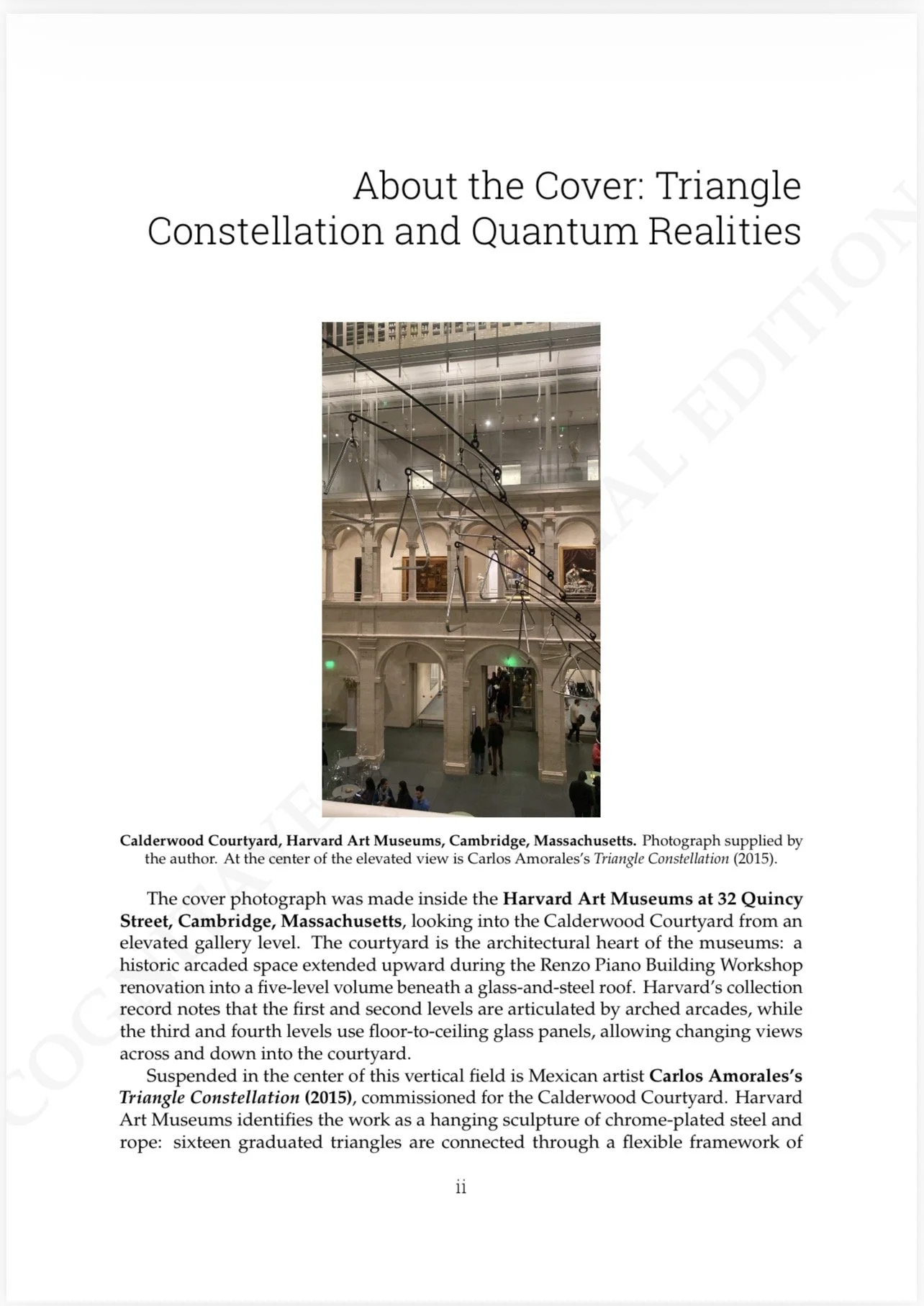 Image 1 of 5
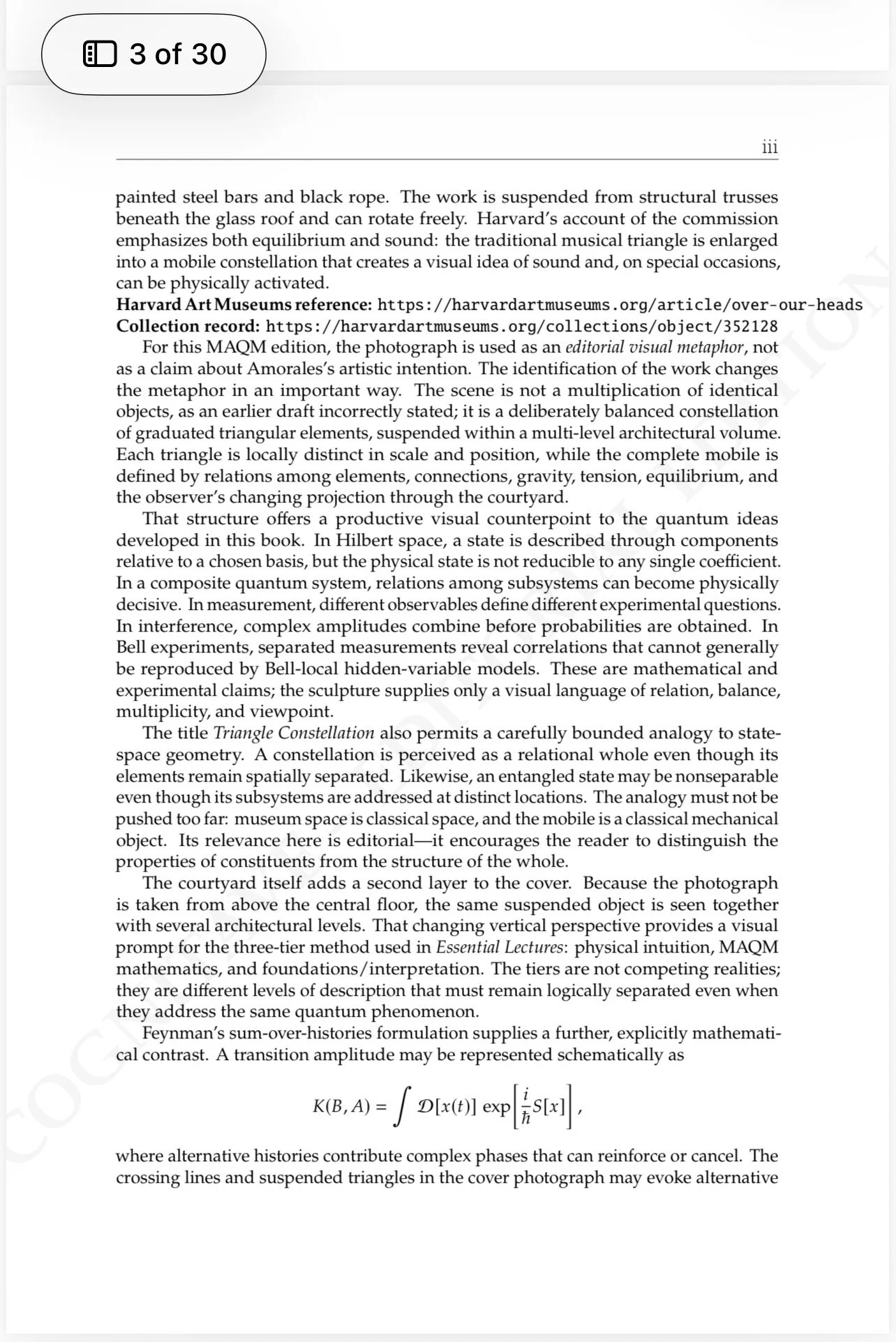 Image 2 of 5
 Image 3 of 5
 Image 4 of 5
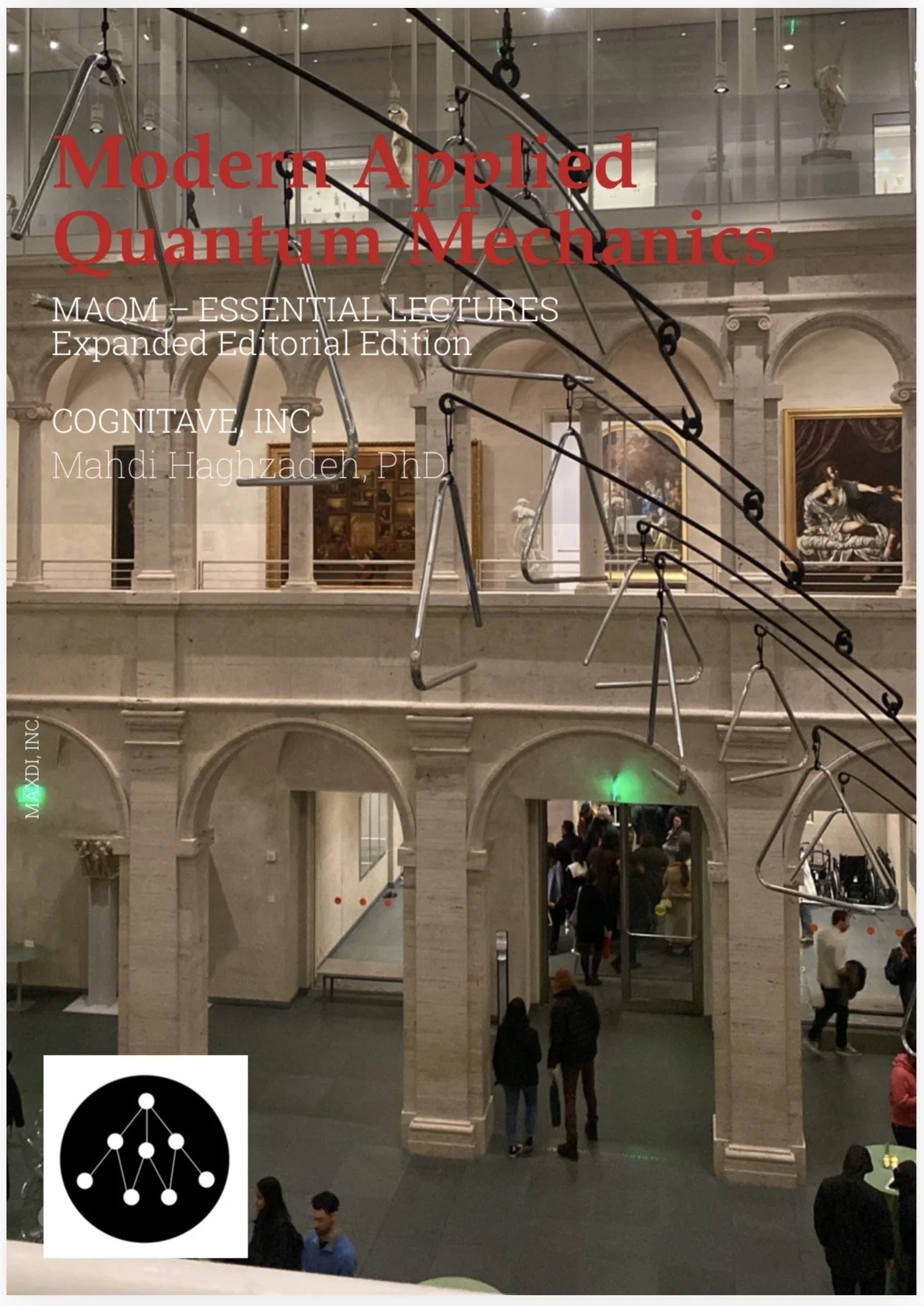 Image 5 of 5