This Institutional Master Package is a comprehensive, non-prescriptive analytical dossier examining the January 2026 crisis in the Islamic Republic of Iran through the Mixed-Domain, Mixed-Depth Coherence Engineering (MXD-COGN) framework.
The package integrates internal dynamics (protests, coercion, information control, elite cohesion, economic throughput) with external pressures (sanctions, tariffs, diplomatic isolation, and regional signaling) to assess systemic stability, brittleness, and escalation risk over short- and medium-term horizons.
Unlike conventional policy briefs or forecasting reports, this work does not advocate actions or outcomes. It provides a formal structural diagnosis of regime behavior under stress, identifying regime basins of attraction, interface-level failure points, and conditions under which discontinuity becomes plausible.
Version v1.1 incorporates a major expansion with the addition of Part IV, substantially deepening the historical–structural dimension of the analysis.
What’s Included
Part I — Core Institutional Assessment
A full MXD-COGN coherence analysis of Iran’s January 2026 crisis, including:
Protest dynamics under near-total information blackout
Coercive capacity and execution coherence
Economic throughput stress and bazaar-level indicators
Elite cohesion and patronage stability
External pressure and tariff-driven uncertainty
3–6–12 month trajectory projections
Formal brittleness (κ) metrics and regime basin classification
Part II — Game-Theoretic Addendum (v1.1)
A formal strategic layer complementing MXD-COGN, modeling:
Deterrence–retaliation dynamics (U.S., Israel, Iran, regional actors)
Elite–security coordination games under existential stress
Signaling, belief formation, and commitment rigidity
Escalation equilibria and de-escalation feasibility
Part III — Best-Case Diplomatic Off-Ramp Annex
A harm-minimization–oriented analytical annex outlining:
Verification-based de-escalation sequencing
Conditional, reversible sanctions relief architecture
Amnesty and safe-exit logic to prevent fight-or-fracture equilibria
Institutional pathways for domestic political legitimacy
(Analytical, non-operational, non-prescriptive)
Part IV — Sanctions, Geography, Ideology, and Coherence Decay in Iran
(New in v1.1)
A standalone, long-form historical–structural assessment analyzing why sanctions and isolation have devastated civilian welfare without producing regime collapse. This section integrates:
Four decades of sanctions and boycotts as iterated external deformations
Civilian deprivation and food insecurity as emergent systemic outcomes
IRGC economic capture under scarcity and sanctions evasion
Ideological framing of deprivation (“resistance economy”) and its long-term costs
Geography, invasion memory, and siege psychology as structural constraints
Water scarcity, drought, and groundwater depletion as latent instability accelerators
The Zibakalam thesis on internal causality and institutional failure
Part IV situates Iran’s crisis within a coherence-decay regime, where elite and coercive stability is preserved at the expense of societal welfare and adaptive capacity.
Methodological Distinction
The MXD-COGN framework treats geopolitical crises as emergent properties of interacting subsystems, rather than linear cause-effect chains. This allows the analysis to:
Remain robust under censorship and limited observability
Avoid street-size or sentiment-only forecasting
Focus on interface-level brittleness where small perturbations can produce regime shifts
Distinguish apparent stability from structural fragility
Who This Is For
Government and diplomatic analysts
Think tanks and multilateral institutions
Academic researchers (political economy, sanctions, security studies)
Journalists covering Iran and regional escalation risk
Risk analysts and strategic planners
Important Notice
This document is an analytical research artifact.
It does not:
Advocate political positions
Recommend intervention or policy
Provide operational or tactical guidance
Redistribution is restricted. Interpretation should preserve the document’s analytical and non-prescriptive intent
This Institutional Master Package is a comprehensive, non-prescriptive analytical dossier examining the January 2026 crisis in the Islamic Republic of Iran through the Mixed-Domain, Mixed-Depth Coherence Engineering (MXD-COGN) framework.
The package integrates internal dynamics (protests, coercion, information control, elite cohesion, economic throughput) with external pressures (sanctions, tariffs, diplomatic isolation, and regional signaling) to assess systemic stability, brittleness, and escalation risk over short- and medium-term horizons.
Unlike conventional policy briefs or forecasting reports, this work does not advocate actions or outcomes. It provides a formal structural diagnosis of regime behavior under stress, identifying regime basins of attraction, interface-level failure points, and conditions under which discontinuity becomes plausible.
Version v1.1 incorporates a major expansion with the addition of Part IV, substantially deepening the historical–structural dimension of the analysis.
What’s Included
Part I — Core Institutional Assessment
A full MXD-COGN coherence analysis of Iran’s January 2026 crisis, including:
Protest dynamics under near-total information blackout
Coercive capacity and execution coherence
Economic throughput stress and bazaar-level indicators
Elite cohesion and patronage stability
External pressure and tariff-driven uncertainty
3–6–12 month trajectory projections
Formal brittleness (κ) metrics and regime basin classification
Part II — Game-Theoretic Addendum (v1.1)
A formal strategic layer complementing MXD-COGN, modeling:
Deterrence–retaliation dynamics (U.S., Israel, Iran, regional actors)
Elite–security coordination games under existential stress
Signaling, belief formation, and commitment rigidity
Escalation equilibria and de-escalation feasibility
Part III — Best-Case Diplomatic Off-Ramp Annex
A harm-minimization–oriented analytical annex outlining:
Verification-based de-escalation sequencing
Conditional, reversible sanctions relief architecture
Amnesty and safe-exit logic to prevent fight-or-fracture equilibria
Institutional pathways for domestic political legitimacy
(Analytical, non-operational, non-prescriptive)
Part IV — Sanctions, Geography, Ideology, and Coherence Decay in Iran
(New in v1.1)
A standalone, long-form historical–structural assessment analyzing why sanctions and isolation have devastated civilian welfare without producing regime collapse. This section integrates:
Four decades of sanctions and boycotts as iterated external deformations
Civilian deprivation and food insecurity as emergent systemic outcomes
IRGC economic capture under scarcity and sanctions evasion
Ideological framing of deprivation (“resistance economy”) and its long-term costs
Geography, invasion memory, and siege psychology as structural constraints
Water scarcity, drought, and groundwater depletion as latent instability accelerators
The Zibakalam thesis on internal causality and institutional failure
Part IV situates Iran’s crisis within a coherence-decay regime, where elite and coercive stability is preserved at the expense of societal welfare and adaptive capacity.
Methodological Distinction
The MXD-COGN framework treats geopolitical crises as emergent properties of interacting subsystems, rather than linear cause-effect chains. This allows the analysis to:
Remain robust under censorship and limited observability
Avoid street-size or sentiment-only forecasting
Focus on interface-level brittleness where small perturbations can produce regime shifts
Distinguish apparent stability from structural fragility
Who This Is For
Government and diplomatic analysts
Think tanks and multilateral institutions
Academic researchers (political economy, sanctions, security studies)
Journalists covering Iran and regional escalation risk
Risk analysts and strategic planners
Important Notice
This document is an analytical research artifact.
It does not:
Advocate political positions
Recommend intervention or policy
Provide operational or tactical guidance
Redistribution is restricted. Interpretation should preserve the document’s analytical and non-prescriptive intent

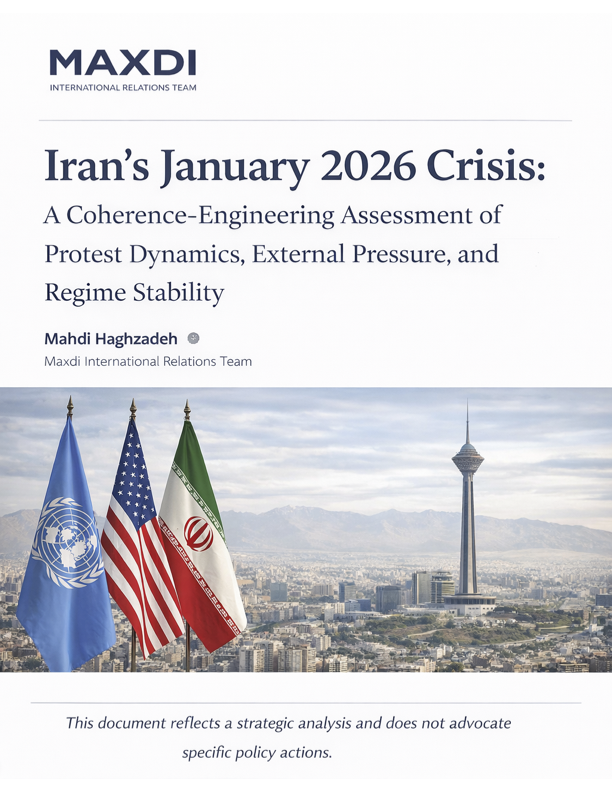 Image 1 of 8
 Image 2 of 8
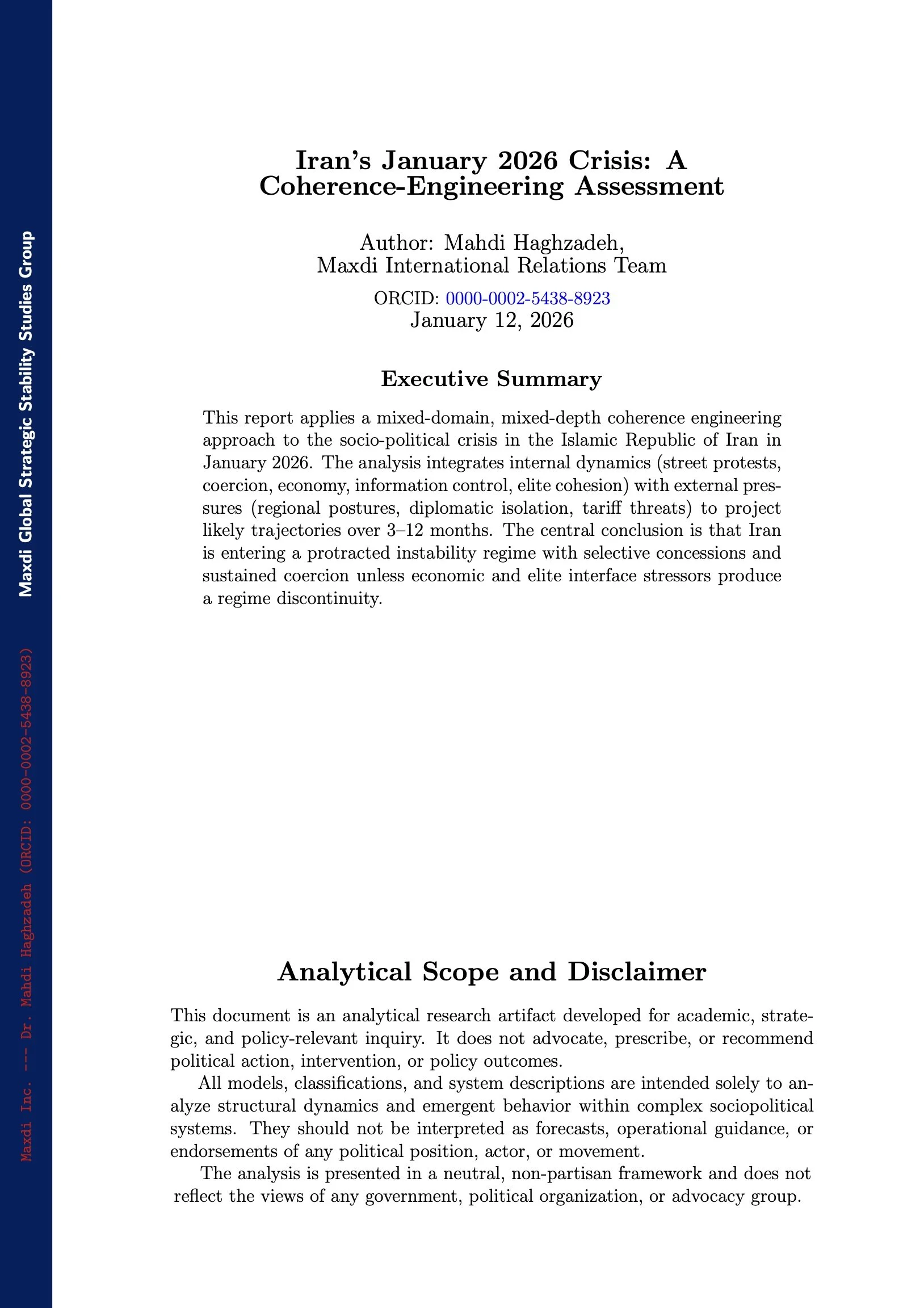 Image 3 of 8
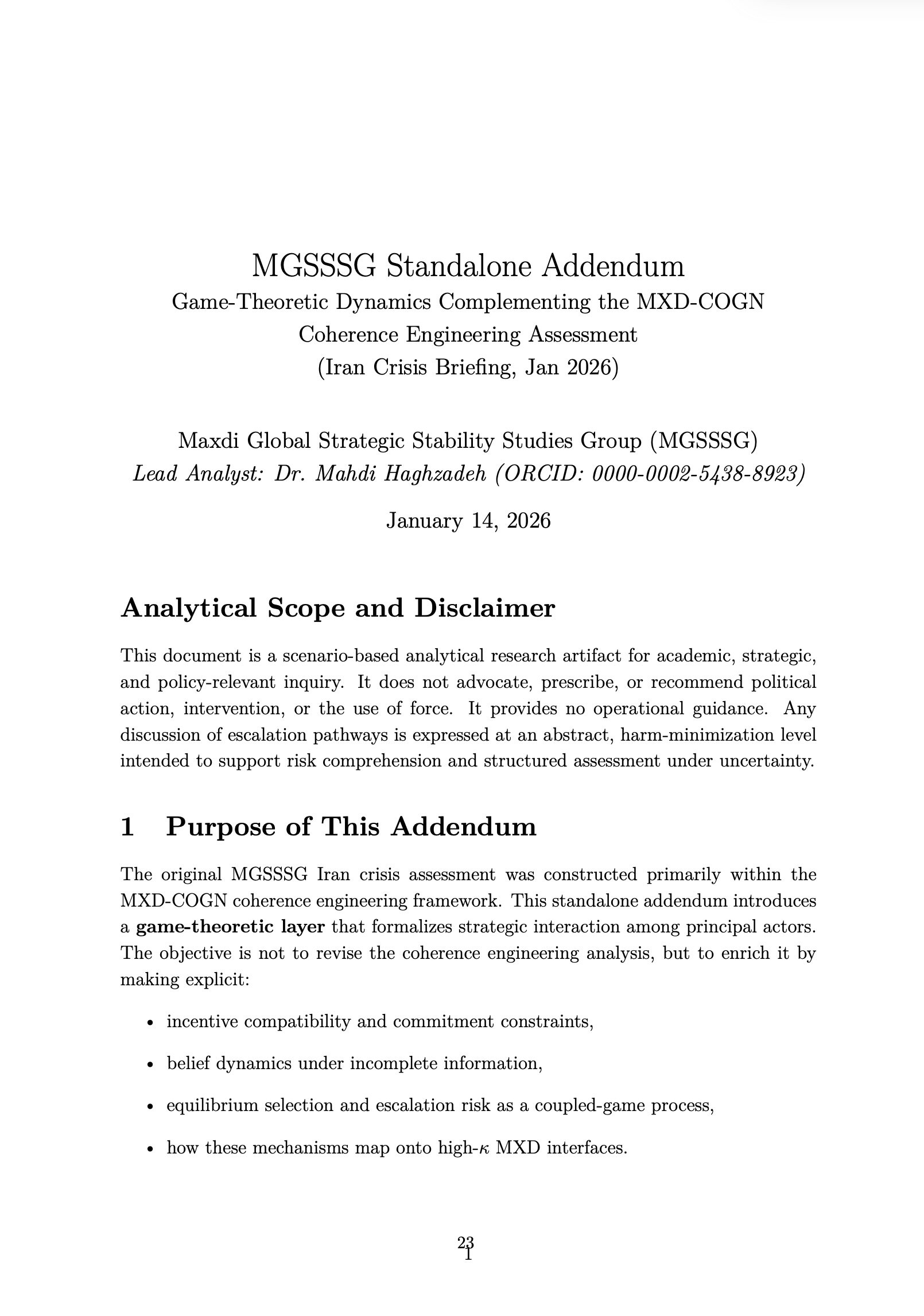 Image 4 of 8
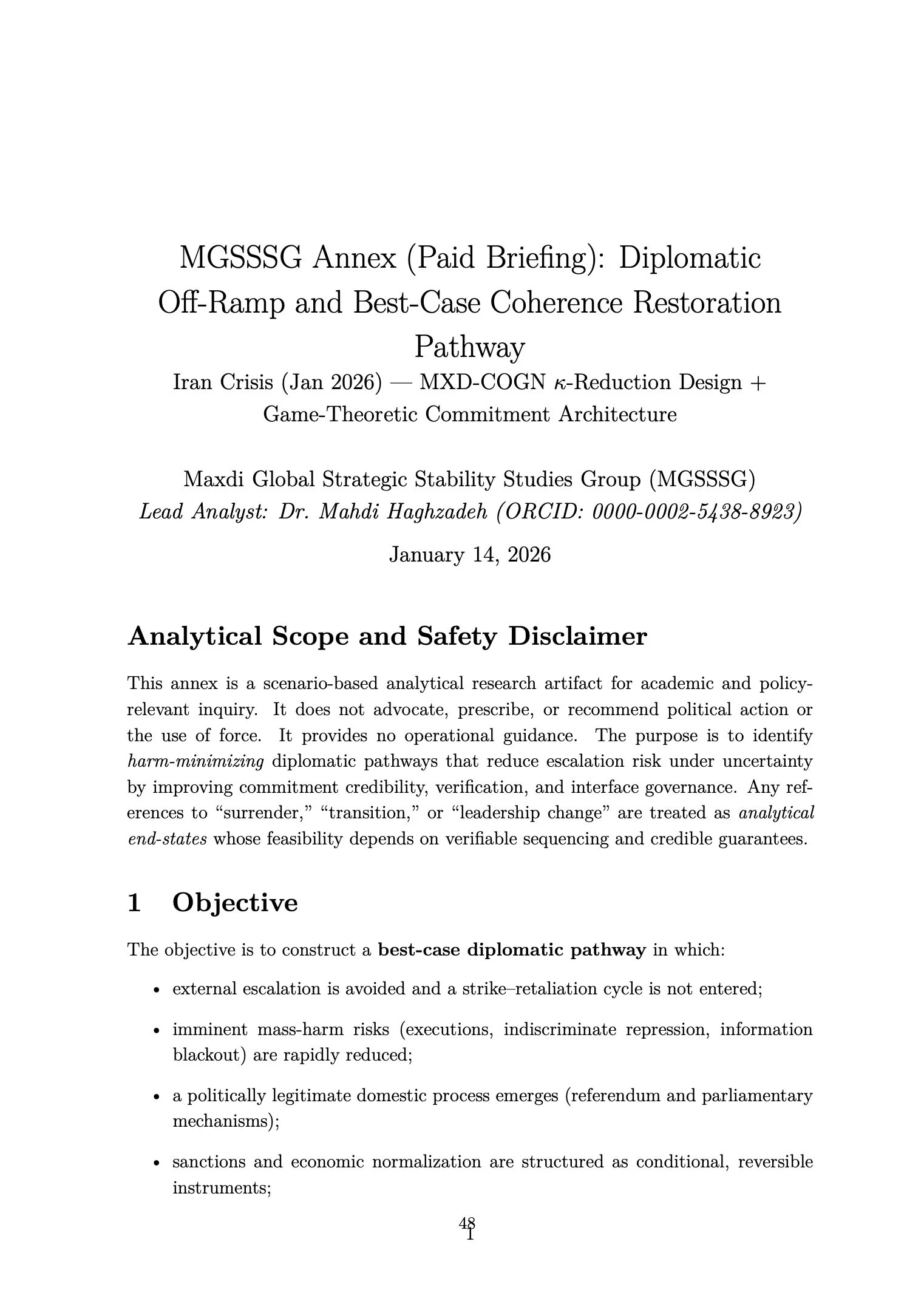 Image 5 of 8
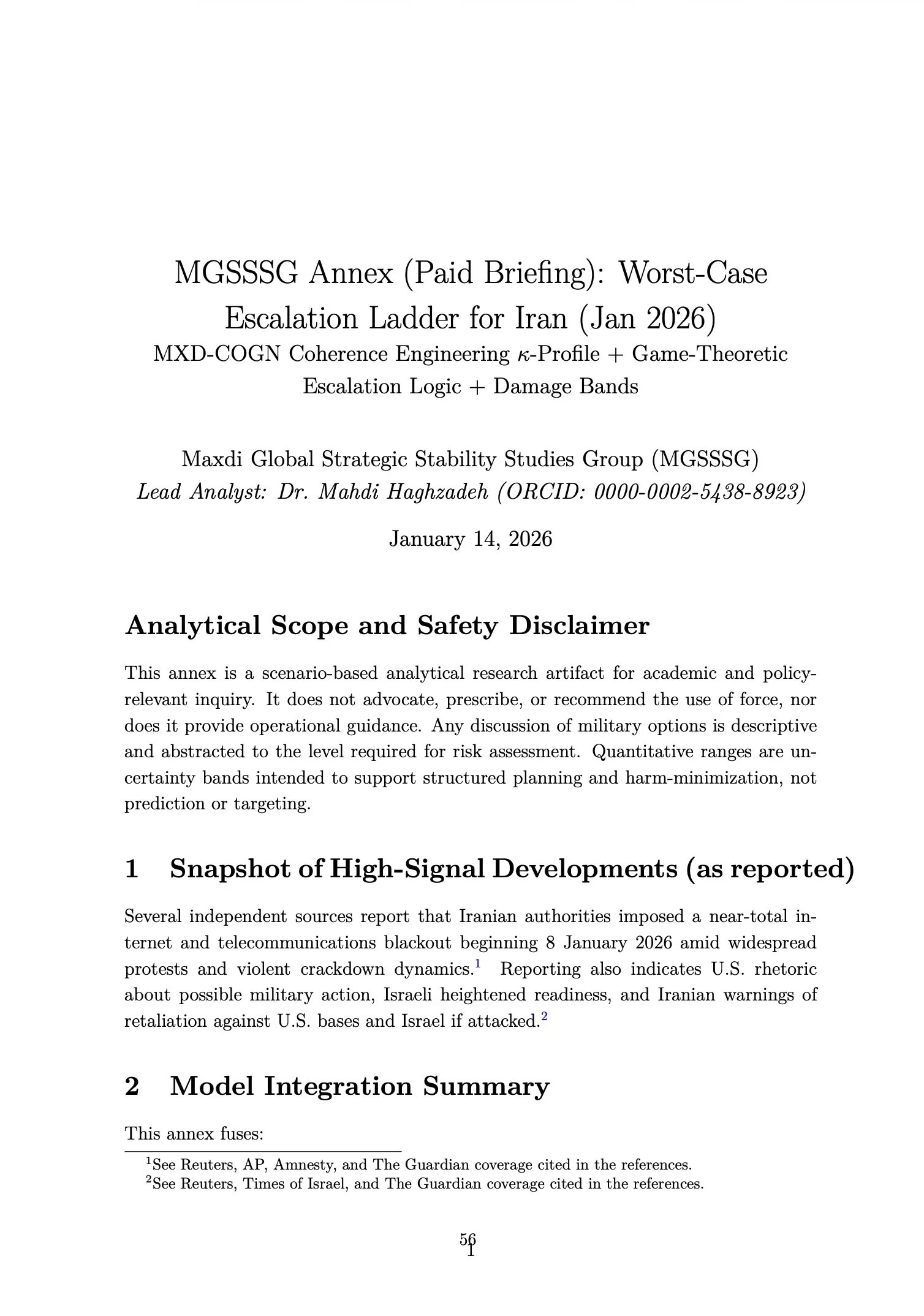 Image 6 of 8
 Image 7 of 8
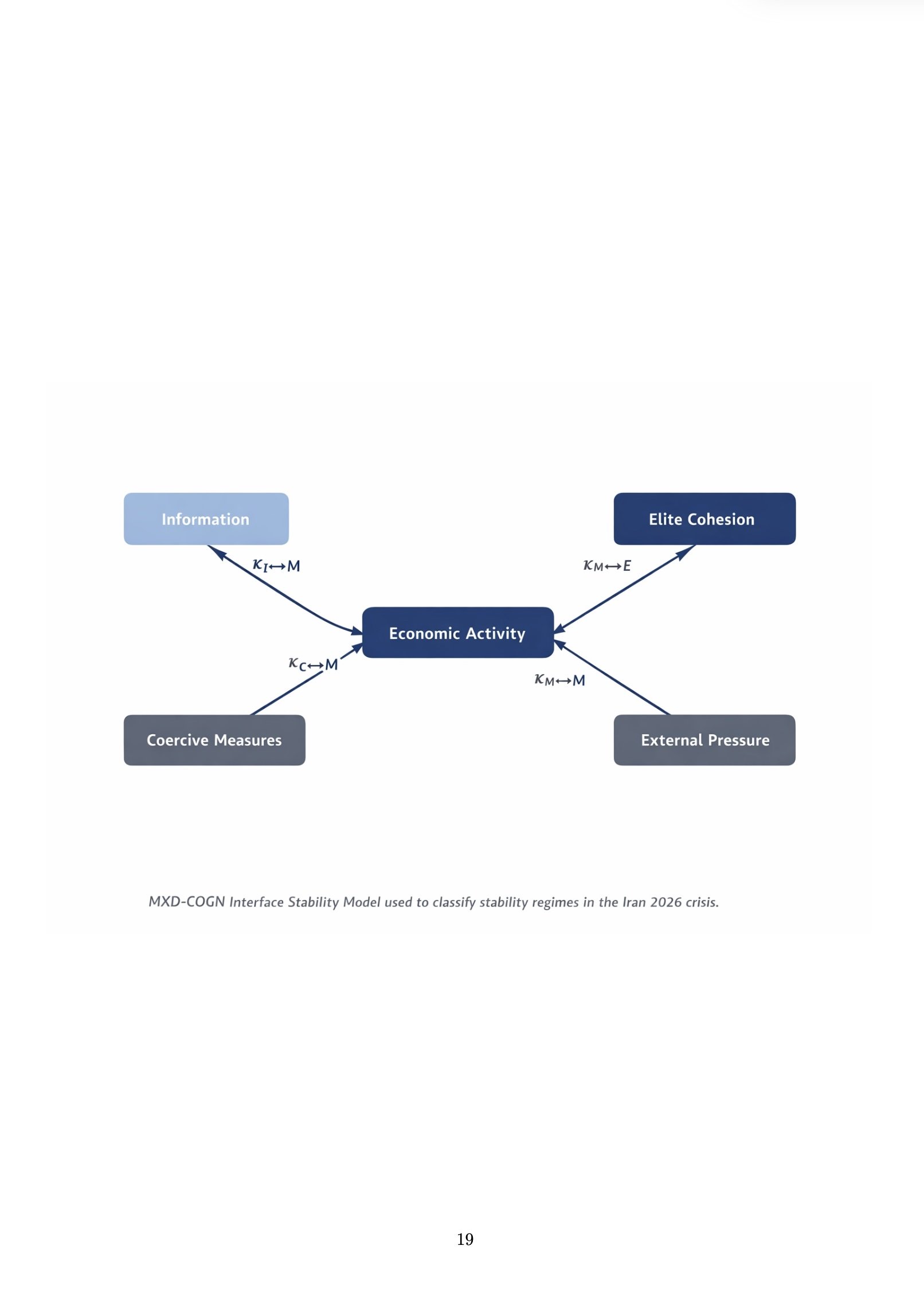 Image 8 of 8