Greenland occupies a uniquely sensitive position in the global strategic system: rich in critical resources, central to Arctic security architecture, yet operating under constrained sovereignty and delegated defense arrangements. Unlike crisis-driven cases, Greenland’s challenge is not instability, but how stability is preserved—or eroded—under accelerating external interest.
This institutional report applies the MXD-COGN (Mixed-Domain, Mixed-Depth Coherence Engineering) framework to model Greenland as a proto-sovereign system, where long-term outcomes are governed by interface dynamics among legitimacy, elite coordination, economic throughput, and external bargaining power.
Rather than forecasting disruption, the report identifies equilibrium families that define Greenland’s plausible strategic futures, ranging from managed strategic dependency to structured sovereignty rebalancing. It evaluates how resource extraction, infrastructure bottlenecks, climate governance, and Arctic security norms interact to shape autonomy trajectories over the coming decade.
Key features include:
Greenland-specific MXD-COGN domain modeling
External bargaining and sovereignty-constraint analysis
Resource extraction and infrastructure throughput assessment
Full scenario engineering framework (4 scenarios)
Arctic system comparative positioning
Strategic indicators dashboard for ongoing monitoring
This report is designed for institutional investors, policymakers, defense and energy analysts, and strategic plannersseeking disciplined, non-speculative analysis of Arctic stability and long-horizon geopolitical risk.
Greenland occupies a uniquely sensitive position in the global strategic system: rich in critical resources, central to Arctic security architecture, yet operating under constrained sovereignty and delegated defense arrangements. Unlike crisis-driven cases, Greenland’s challenge is not instability, but how stability is preserved—or eroded—under accelerating external interest.
This institutional report applies the MXD-COGN (Mixed-Domain, Mixed-Depth Coherence Engineering) framework to model Greenland as a proto-sovereign system, where long-term outcomes are governed by interface dynamics among legitimacy, elite coordination, economic throughput, and external bargaining power.
Rather than forecasting disruption, the report identifies equilibrium families that define Greenland’s plausible strategic futures, ranging from managed strategic dependency to structured sovereignty rebalancing. It evaluates how resource extraction, infrastructure bottlenecks, climate governance, and Arctic security norms interact to shape autonomy trajectories over the coming decade.
Key features include:
Greenland-specific MXD-COGN domain modeling
External bargaining and sovereignty-constraint analysis
Resource extraction and infrastructure throughput assessment
Full scenario engineering framework (4 scenarios)
Arctic system comparative positioning
Strategic indicators dashboard for ongoing monitoring
This report is designed for institutional investors, policymakers, defense and energy analysts, and strategic plannersseeking disciplined, non-speculative analysis of Arctic stability and long-horizon geopolitical risk.

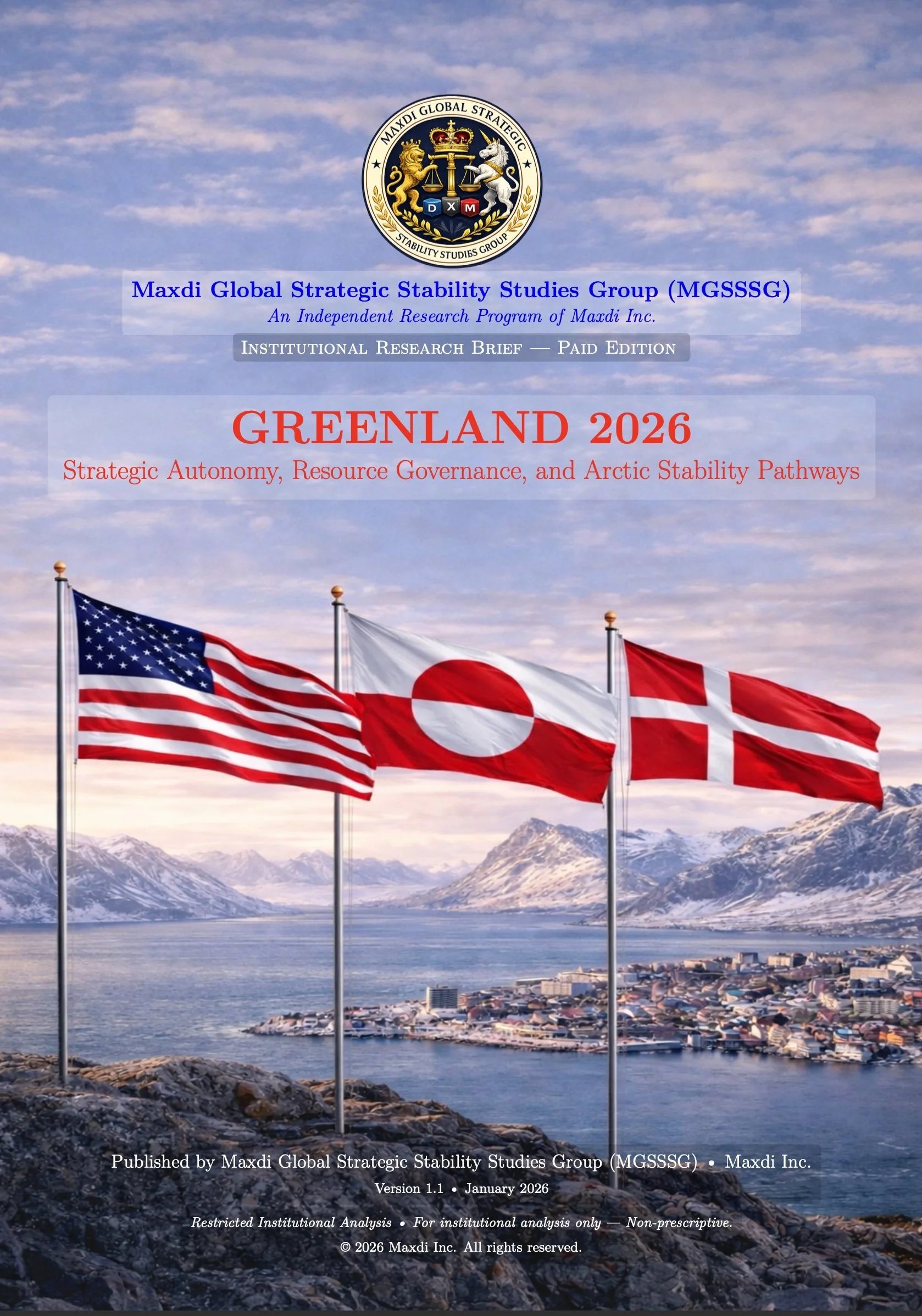 Image 1 of 6
 Image 2 of 6
 Image 3 of 6
 Image 4 of 6
 Image 5 of 6
 Image 6 of 6