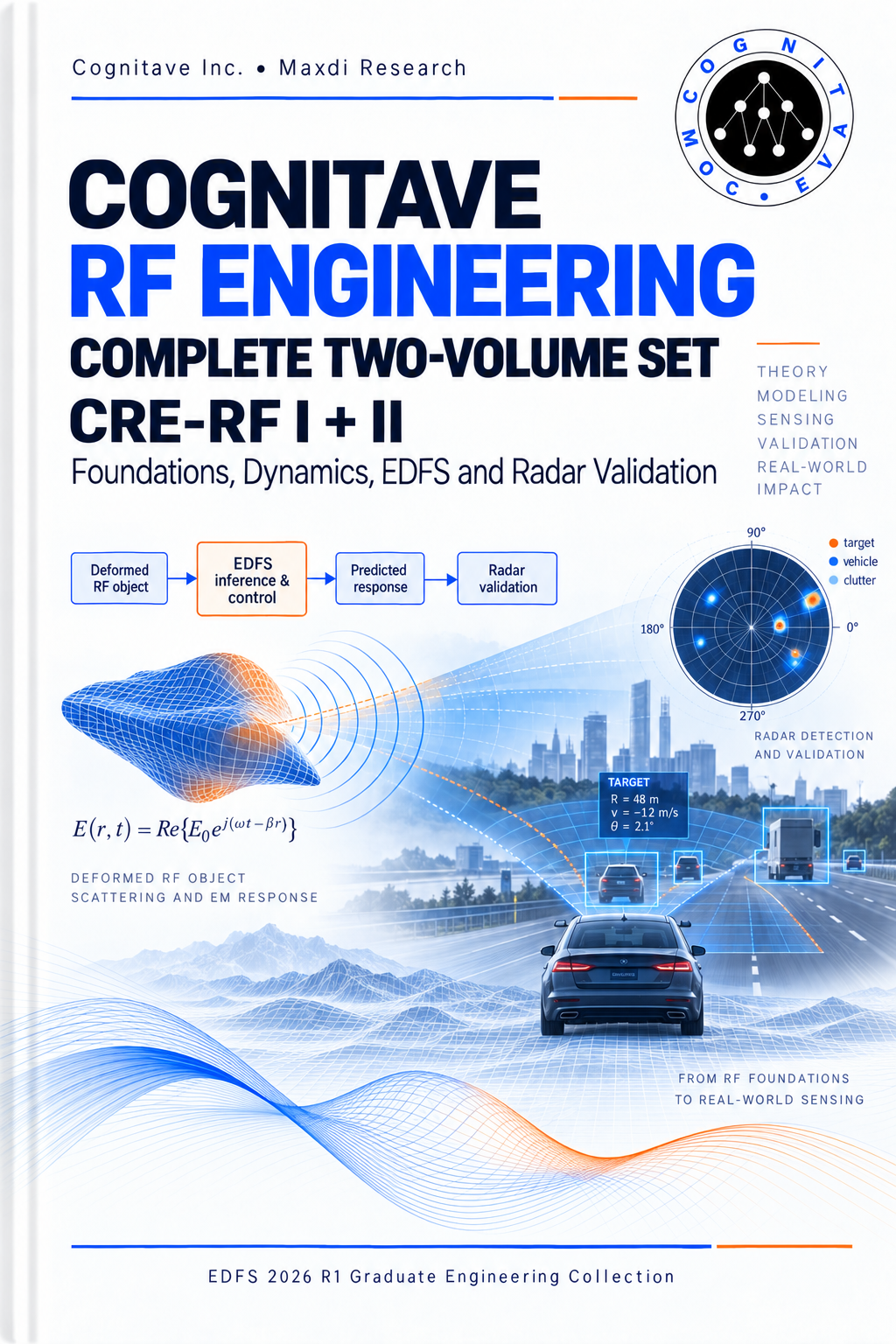
 Image 1 of 2
 Image 2 of 2
Professional Single-User License
List Price: $2,995
Optional Launch Price: $2,495
Existing EDFS RF 2026 R1 Professional Upgrade: $1,500
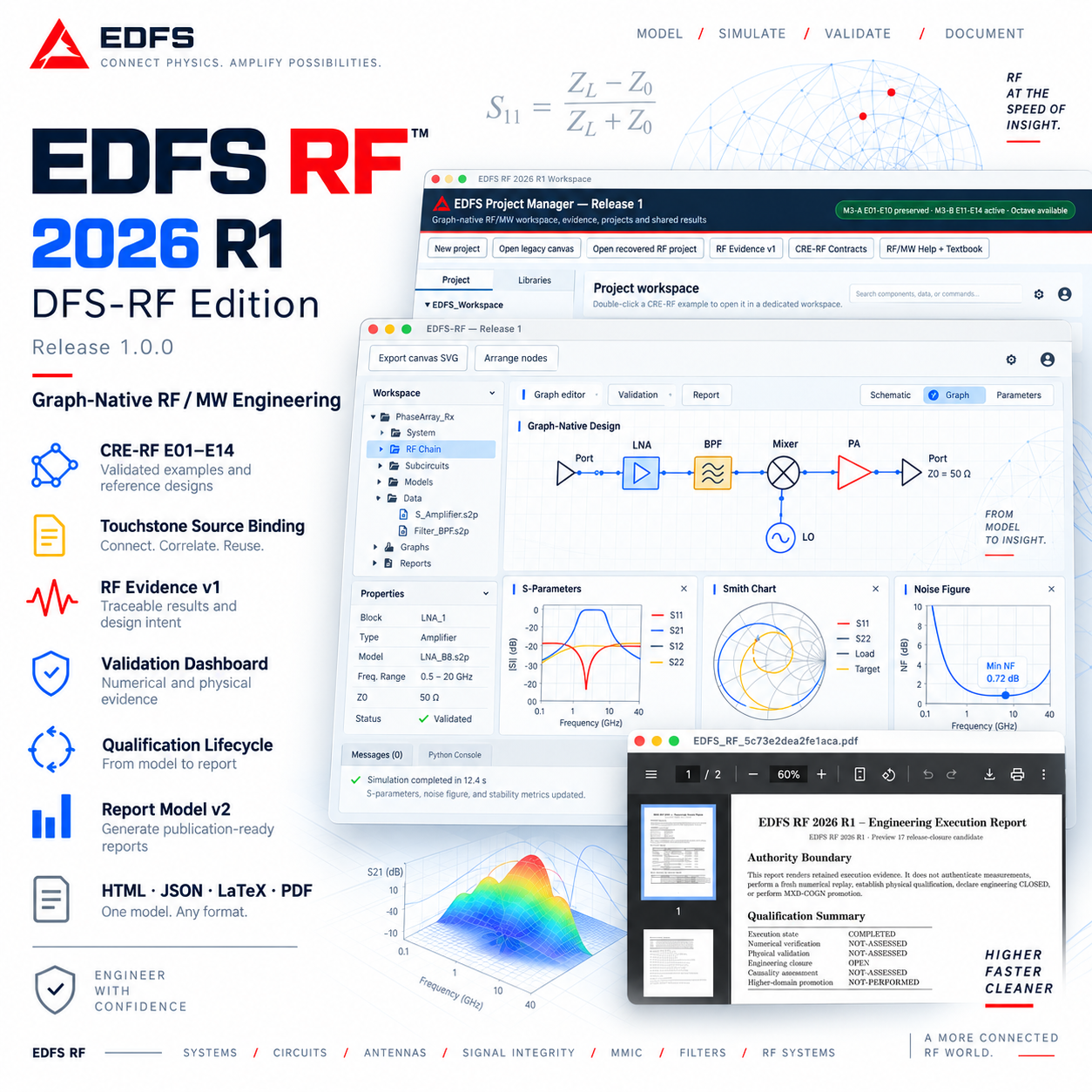
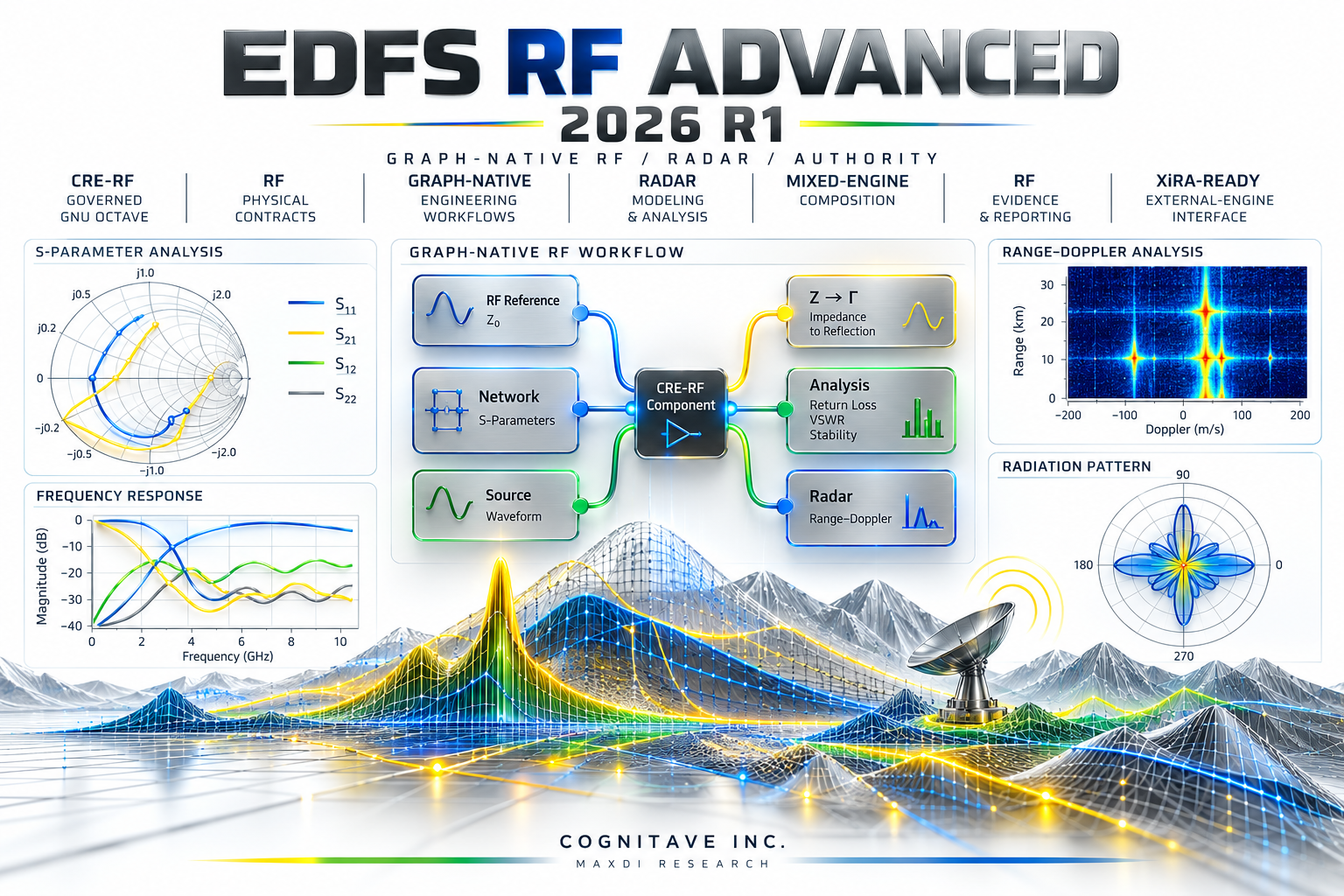
EDFS RF Advanced 2026 R1 is the advanced RF/microwave tier of Electronics Design Flow Studio, combining the complete EDFS Core + EDFS RF environment with governed computational authority, RF physical contracts, radar execution, mixed-engine graph composition, engineering evidence, provenance, replay, and reproducible technical reporting.
RF Advanced is designed for engineering workflows where obtaining a numerical result is only one part of the problem.
The environment explicitly distinguishes:
Execution → Numerical Verification → Physical Validation → Engineering Closure → Promotion
A successful numerical run is therefore never silently treated as physical validation or a closed engineering conclusion.
RF Advanced implements persistent, hash-governed GNU Octave numerical authority where declared by CRE-RF.
The current implementation preserves the CRE-RF E01-E14 validation lineage and supports 34 staged CRE-RF operations.
The environment also verifies the identity and integrity of the original CRE-RF-I GNU Octave companion.
If a workflow declares GNU Octave as its numerical authority and that authority is unavailable, modified, or invalid, EDFS fails explicitly.
No silent Octave-to-Python mathematical fallback is permitted.
Python remains available for orchestration and approved QA/reference functions where applicable.
EDFS RF Advanced extends the Graph Schema v2 environment with authority-preserving execution.
The architecture combines:
Graph-v2 Projects + Engineering Canvas + Typed Fibers + RF Evidence + Report Model v2
with per-node computational authority and engine dispatch.
Current engine families include:
CRE_RF_OCTAVE
CRE-RF numerical workflows
CRE_RF_RADAR_OCTAVE
Dedicated radar computational authority
XIRA_OCTAVE
Controlled external-engine boundary for protected XiRA workflows
RF Advanced independently tracks:
product tier,
DFS level,
engine family,
computational authority,
runtime readiness,
physical authority,
evidence,
and qualification state.
This prevents an engineering block from being declared valid merely because another computational engine can produce a numerically similar result.
RF Advanced inherits the complete EDFS Core and EDFS RF project environment, including:
Graph Schema v2
scalable RF engineering canvas
new projects and user-authored arbitrary RF graphs
typed engineering nodes
typed ports and fibers
retained engineering results
RF Evidence
project persistence
replay
stale-state handling
Data Display
structured engineering outputs
technical reporting
This creates a persistent engineering project rather than a collection of unrelated simulation files and scripts.
RF Advanced introduces explicit physical-contract information into the graph.
Supported engineering concepts include:
RF reference impedance
reference planes
physical RF ports
typed data fibers
network and distributed states
mode basis
normalization
material state
constitutive state
boundary state
provenance
Physical ports and engineering contracts remain distinguishable from generic computational data connections.
This provides a stronger basis for connecting numerical execution to the physical assumptions under which an RF result is meaningful.
Radar is treated as a distinct computational authority rather than as an alias for conventional RF network analysis.
EDFS RF Advanced includes a dedicated:
CRE_RF_RADAR_OCTAVE
engine family together with integration of the:
EDFS Radar Benchmark v1.2
reference implementation.
The current radar line includes reference workflows for:
FMCW radar processing
range-Doppler analysis
MUSIC-based processing
governed radar evidence
radar result integration into the EDFS project structure
Radar output is not automatically promoted into higher inference domains. Promotion into MXD-COGN, XiRA, or another higher-level inference process must be explicitly declared.
RF Advanced supports per-node mixed-engine planning and dispatch.
Different nodes within an engineering graph can therefore retain distinct computational authorities and runtime requirements.
The environment separates:
Which engine can execute a calculation
from:
Which engine is authoritative for that engineering claim.
This distinction is central to the RF Advanced architecture.
It provides a foundation for engineering workflows combining CRE-RF, radar processing, imported physical evidence, external solvers, and protected computational engines without silently changing the authority of the model.
EDFS RF Advanced provides a governed interface for protected XiRA workflows.
The current RF Advanced product includes:
a dedicated XIRA_OCTAVE engine family
external-engine-required authority state
explicit XiRA runtime health and availability behavior
failure when the required protected engine is unavailable
interface targets for XIRA_JOB
XIRA_RESULT_BUNDLE
RF Evidence mapping
Report Model v2 integration
status and health integration
Protected XiRA mathematics and protected XiRA source are not bundled with the standard EDFS RF Advanced installer.
RF Advanced should therefore be described as:
“XiRA-ready external-engine architecture; protected XiRA workflows are enabled separately under their own source, licensing, and qualification gates.”
RF Advanced retains the relationship between computation and the engineering evidence generated from it.
The environment supports:
retained graph results
RF Evidence
engine identity
source identity
source hashes
execution status
validation status
project replay
provenance
Data Display
Report Model v2
engineering report generation
LaTeX/PDF reporting
The objective is not simply to produce a result.
It is to retain sufficient information to establish:
what ran, which authority produced it, under which project state, using which source, and what level of engineering claim that result supports.
Native target validation included a user-authored RF graph containing:
RF Reference Impedance → Complex Load Vector → Z-to-Γ CRE-RF Operator → Return Loss
The graph executed through GNU Octave and produced retained project results together with a generated engineering report.
An independent opposite-backend numerical assessment was performed against the same graph and parameter state.
9 comparisons passed with 0 failures at absolute and relative tolerances of 10⁻¹⁰.
This represents scoped numerical verification and is not presented as physical validation.
The RF Advanced NP7 engineering program has passed the principal release gates:
NP7 Part 1 — PASS
Predecessor preservation and authority integration
NP7 Part 2 — PASS
CRE-RF authority, companion mounting and E01-E14 execution
NP7 Part 3 — PASS
Physical contracts and radar authority
NP7 Part 4 — PASS
Mixed-engine composition, edition enforcement and HTTP endpoints
Combined NP7 HTTP RC1 — PASS
HTTP Source Baseline — FROZEN
Native macOS x86_64 Application — PASS
DMG Installation — PASS
Finder Launch from /Applications — PASS
Project Manager — PASS
DFS-RF Graph Authoring — PASS
GNU Octave Execution — PASS
Data Display — PASS
LaTeX/PDF Reporting — PASS
The accepted RF Advanced native candidate successfully exercised:
Project Manager → DFS-RF Editor → CRE-RF Graph Authoring → GNU Octave Execution → Data Display → Engineering Reporting
The accepted native platform for this release is:
Current reference environment:
macOS Intel x86_64
Python 3.12 host/runtime environment
GNU Octave 10.3 for workflows declaring Octave authority
local storage for projects, evidence and generated reports
EDFS RF Advanced native DMG
Apple Silicon, Windows and Linux are not qualified native targets for this release unless separately stated in a subsequent release notice.
The Professional Single-User License includes:
complete EDFS Core capability stack
complete EDFS RF capability stack
RF Advanced NP7 authority and composition layer
Graph Schema v2 project environment
DFS-RF engineering workspace
CRE-RF graph-native operators
E01-E14 CRE-RF validation lineage
GNU Octave authority framework
RF physical contracts
EDFS Radar Benchmark v1.2 integration
radar reference backend
mixed-engine execution architecture
RF Evidence
Data Display
retained-result and replay capability
engineering report generation
technical documentation
reference examples
native macOS Intel x86_64 application
12 months of updates within the 2026 R1 program
The standard RF Advanced license does not include:
protected XiRA source or protected XiRA workflow licenses
third-party commercial EM solver licenses
third-party solver software
organization-wide licenses
server licenses
floating licenses
redistribution rights
Enterprise, laboratory, organizational, integration and protected-engine licensing can be quoted separately.
EDFS RF Advanced is designed for:
RF & Microwave Engineers
Reusable graph-native RF models, CRE-RF operators, numerical authority and engineering evidence.
Antenna & Array Engineers
Physical contracts, model provenance and integration with advanced RF/EM workflows.
Radar Engineers
Dedicated radar authority, FMCW processing, range-Doppler and MUSIC reference workflows.
Aerospace & Sensing Programs
Engineering environments requiring explicit authority, validation states, evidence and reproducibility.
Research & Advanced Development Teams
Persistent computational projects requiring replay, provenance, mixed-engine execution and technical reporting.
XiRA Programs
Organizations preparing controlled protected-XiRA integration while keeping proprietary computational source outside the public EDFS host.
Release: 2026 R1
Native Candidate: NP7 Native RC1 / 1.1.0-dev.8
Architecture: macOS Intel x86_64
Primary CRE-RF Numerical Authority: GNU Octave where declared
Product Type: Digital Engineering Software
License: Professional Single-User
SKU: EDFS-RFA-2026R1-PRO-1U-X64
Professional Single-User License
$2,995
Existing EDFS RF customers may qualify for an RF Advanced upgrade license.
For enterprise deployment, protected XiRA integration, organizational licensing, technical consulting, or engineering-program integration, contact Cognitave Inc.
EDFS Editions
https://www.cognitave.com/edfs-editions
EDFS RF
https://www.cognitave.com/edfs-editions/edfs-rf
EDFS RF Advanced
https://www.cognitave.com/edfs-editions/edfs-rf-advanced
EE Store
https://www.cognitave.com/ee-store
Technical inquiries:
tex@cognitave.com
Research & collaboration:
mxd@maxdi.com
Professional Single-User License
List Price: $2,995
Optional Launch Price: $2,495
Existing EDFS RF 2026 R1 Professional Upgrade: $1,500
EDFS RF Advanced 2026 R1 is the advanced RF/microwave tier of Electronics Design Flow Studio, combining the complete EDFS Core + EDFS RF environment with governed computational authority, RF physical contracts, radar execution, mixed-engine graph composition, engineering evidence, provenance, replay, and reproducible technical reporting.
RF Advanced is designed for engineering workflows where obtaining a numerical result is only one part of the problem.
The environment explicitly distinguishes:
Execution → Numerical Verification → Physical Validation → Engineering Closure → Promotion
A successful numerical run is therefore never silently treated as physical validation or a closed engineering conclusion.
RF Advanced implements persistent, hash-governed GNU Octave numerical authority where declared by CRE-RF.
The current implementation preserves the CRE-RF E01-E14 validation lineage and supports 34 staged CRE-RF operations.
The environment also verifies the identity and integrity of the original CRE-RF-I GNU Octave companion.
If a workflow declares GNU Octave as its numerical authority and that authority is unavailable, modified, or invalid, EDFS fails explicitly.
No silent Octave-to-Python mathematical fallback is permitted.
Python remains available for orchestration and approved QA/reference functions where applicable.
EDFS RF Advanced extends the Graph Schema v2 environment with authority-preserving execution.
The architecture combines:
Graph-v2 Projects + Engineering Canvas + Typed Fibers + RF Evidence + Report Model v2
with per-node computational authority and engine dispatch.
Current engine families include:
CRE_RF_OCTAVE
CRE-RF numerical workflows
CRE_RF_RADAR_OCTAVE
Dedicated radar computational authority
XIRA_OCTAVE
Controlled external-engine boundary for protected XiRA workflows
RF Advanced independently tracks:
product tier,
DFS level,
engine family,
computational authority,
runtime readiness,
physical authority,
evidence,
and qualification state.
This prevents an engineering block from being declared valid merely because another computational engine can produce a numerically similar result.
RF Advanced inherits the complete EDFS Core and EDFS RF project environment, including:
Graph Schema v2
scalable RF engineering canvas
new projects and user-authored arbitrary RF graphs
typed engineering nodes
typed ports and fibers
retained engineering results
RF Evidence
project persistence
replay
stale-state handling
Data Display
structured engineering outputs
technical reporting
This creates a persistent engineering project rather than a collection of unrelated simulation files and scripts.
RF Advanced introduces explicit physical-contract information into the graph.
Supported engineering concepts include:
RF reference impedance
reference planes
physical RF ports
typed data fibers
network and distributed states
mode basis
normalization
material state
constitutive state
boundary state
provenance
Physical ports and engineering contracts remain distinguishable from generic computational data connections.
This provides a stronger basis for connecting numerical execution to the physical assumptions under which an RF result is meaningful.
Radar is treated as a distinct computational authority rather than as an alias for conventional RF network analysis.
EDFS RF Advanced includes a dedicated:
CRE_RF_RADAR_OCTAVE
engine family together with integration of the:
EDFS Radar Benchmark v1.2
reference implementation.
The current radar line includes reference workflows for:
FMCW radar processing
range-Doppler analysis
MUSIC-based processing
governed radar evidence
radar result integration into the EDFS project structure
Radar output is not automatically promoted into higher inference domains. Promotion into MXD-COGN, XiRA, or another higher-level inference process must be explicitly declared.
RF Advanced supports per-node mixed-engine planning and dispatch.
Different nodes within an engineering graph can therefore retain distinct computational authorities and runtime requirements.
The environment separates:
Which engine can execute a calculation
from:
Which engine is authoritative for that engineering claim.
This distinction is central to the RF Advanced architecture.
It provides a foundation for engineering workflows combining CRE-RF, radar processing, imported physical evidence, external solvers, and protected computational engines without silently changing the authority of the model.
EDFS RF Advanced provides a governed interface for protected XiRA workflows.
The current RF Advanced product includes:
a dedicated XIRA_OCTAVE engine family
external-engine-required authority state
explicit XiRA runtime health and availability behavior
failure when the required protected engine is unavailable
interface targets for XIRA_JOB
XIRA_RESULT_BUNDLE
RF Evidence mapping
Report Model v2 integration
status and health integration
Protected XiRA mathematics and protected XiRA source are not bundled with the standard EDFS RF Advanced installer.
RF Advanced should therefore be described as:
“XiRA-ready external-engine architecture; protected XiRA workflows are enabled separately under their own source, licensing, and qualification gates.”
RF Advanced retains the relationship between computation and the engineering evidence generated from it.
The environment supports:
retained graph results
RF Evidence
engine identity
source identity
source hashes
execution status
validation status
project replay
provenance
Data Display
Report Model v2
engineering report generation
LaTeX/PDF reporting
The objective is not simply to produce a result.
It is to retain sufficient information to establish:
what ran, which authority produced it, under which project state, using which source, and what level of engineering claim that result supports.
Native target validation included a user-authored RF graph containing:
RF Reference Impedance → Complex Load Vector → Z-to-Γ CRE-RF Operator → Return Loss
The graph executed through GNU Octave and produced retained project results together with a generated engineering report.
An independent opposite-backend numerical assessment was performed against the same graph and parameter state.
9 comparisons passed with 0 failures at absolute and relative tolerances of 10⁻¹⁰.
This represents scoped numerical verification and is not presented as physical validation.
The RF Advanced NP7 engineering program has passed the principal release gates:
NP7 Part 1 — PASS
Predecessor preservation and authority integration
NP7 Part 2 — PASS
CRE-RF authority, companion mounting and E01-E14 execution
NP7 Part 3 — PASS
Physical contracts and radar authority
NP7 Part 4 — PASS
Mixed-engine composition, edition enforcement and HTTP endpoints
Combined NP7 HTTP RC1 — PASS
HTTP Source Baseline — FROZEN
Native macOS x86_64 Application — PASS
DMG Installation — PASS
Finder Launch from /Applications — PASS
Project Manager — PASS
DFS-RF Graph Authoring — PASS
GNU Octave Execution — PASS
Data Display — PASS
LaTeX/PDF Reporting — PASS
The accepted RF Advanced native candidate successfully exercised:
Project Manager → DFS-RF Editor → CRE-RF Graph Authoring → GNU Octave Execution → Data Display → Engineering Reporting
The accepted native platform for this release is:
Current reference environment:
macOS Intel x86_64
Python 3.12 host/runtime environment
GNU Octave 10.3 for workflows declaring Octave authority
local storage for projects, evidence and generated reports
EDFS RF Advanced native DMG
Apple Silicon, Windows and Linux are not qualified native targets for this release unless separately stated in a subsequent release notice.
The Professional Single-User License includes:
complete EDFS Core capability stack
complete EDFS RF capability stack
RF Advanced NP7 authority and composition layer
Graph Schema v2 project environment
DFS-RF engineering workspace
CRE-RF graph-native operators
E01-E14 CRE-RF validation lineage
GNU Octave authority framework
RF physical contracts
EDFS Radar Benchmark v1.2 integration
radar reference backend
mixed-engine execution architecture
RF Evidence
Data Display
retained-result and replay capability
engineering report generation
technical documentation
reference examples
native macOS Intel x86_64 application
12 months of updates within the 2026 R1 program
The standard RF Advanced license does not include:
protected XiRA source or protected XiRA workflow licenses
third-party commercial EM solver licenses
third-party solver software
organization-wide licenses
server licenses
floating licenses
redistribution rights
Enterprise, laboratory, organizational, integration and protected-engine licensing can be quoted separately.
EDFS RF Advanced is designed for:
RF & Microwave Engineers
Reusable graph-native RF models, CRE-RF operators, numerical authority and engineering evidence.
Antenna & Array Engineers
Physical contracts, model provenance and integration with advanced RF/EM workflows.
Radar Engineers
Dedicated radar authority, FMCW processing, range-Doppler and MUSIC reference workflows.
Aerospace & Sensing Programs
Engineering environments requiring explicit authority, validation states, evidence and reproducibility.
Research & Advanced Development Teams
Persistent computational projects requiring replay, provenance, mixed-engine execution and technical reporting.
XiRA Programs
Organizations preparing controlled protected-XiRA integration while keeping proprietary computational source outside the public EDFS host.
Release: 2026 R1
Native Candidate: NP7 Native RC1 / 1.1.0-dev.8
Architecture: macOS Intel x86_64
Primary CRE-RF Numerical Authority: GNU Octave where declared
Product Type: Digital Engineering Software
License: Professional Single-User
SKU: EDFS-RFA-2026R1-PRO-1U-X64
Professional Single-User License
$2,995
Existing EDFS RF customers may qualify for an RF Advanced upgrade license.
For enterprise deployment, protected XiRA integration, organizational licensing, technical consulting, or engineering-program integration, contact Cognitave Inc.
EDFS Editions
https://www.cognitave.com/edfs-editions
EDFS RF
https://www.cognitave.com/edfs-editions/edfs-rf
EDFS RF Advanced
https://www.cognitave.com/edfs-editions/edfs-rf-advanced
EE Store
https://www.cognitave.com/ee-store
Technical inquiries:
tex@cognitave.com
Research & collaboration:
mxd@maxdi.com